


Page 550 - Williams Hematology ( PDFDrive )
P. 550
524  Part VI:  The Erythrocyte                         Chapter 35:  Aplastic Anemia: Acquired and Inherited           525


                                  <40 with matched       SAA Diagnosed
                                      sibling


                                   Sibling HSCT       >40 or no matched sibling

                                                                               >40 with histocompatible sibling,
                                   Response at 6         Horse ATG plus          consider HSCT if suitable
                                      months              cyclosporine

                                  Stop cyclosporine   No response at 6 months   No histocompatible donor or
                                 long-term follow-up                               not suitable for HSCT
                                                     Children and young adults
                                                          with matched
                                                         unrelated donor       Repeat immunosuppression
                                                                               - Rabbit ATG plus cyclosporine or
                                                        Consider matched       - Alemtuzumab
                                                       unrelated donor HSCT

                                                                        No response at       Response at 6 months
                                                                          6 months
                                           Non-HSCT options                                   Long-term follow-up
                                           - Androgens (12 wk trial)    HSCT options
                                                                        - Mismatched
                                           - G-CSF + Epo (12 wk trial)    unrelated
                                           - Supportive care (transfusions)  - Haploidentical
                                           - Experimental protocols (alternative  - Umbillical cord
                                           immunosuppressants, eltrombopag)
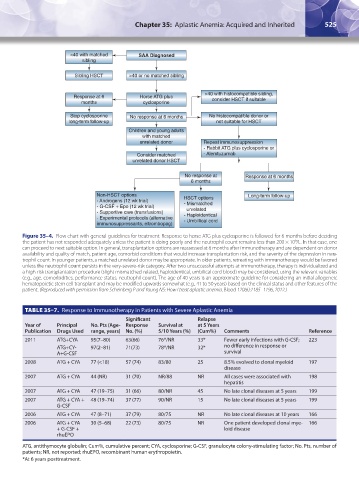
                  Figure 35–4.  Flow chart with general guidelines for treatment. Response to horse ATG plus cyclosporine is followed for 6 months before deciding
                  the patient has not responded adequately unless the patient is doing poorly and the neutrophil count remains less than 200 × 10 /L. In that case, one
                                                                                                             9
                  can proceed to next suitable option. In general, transplantation options are reassessed at 6 months after immunotherapy and are dependent on donor
                  availability and quality of match, patient age, comorbid conditions that would increase transplantation risk, and the severity of the depression in neu-
                  trophil count. In younger patients, a matched unrelated donor may be appropriate. In older patients, retreating with immunotherapy would be favored
                  unless the neutrophil count persists in the very-severe-risk category. After two unsuccessful attempts at immunotherapy, therapy is individualized and
                  a high-risk transplantation procedure (slight mismatched-related, haploidentical, umbilical cord blood) may be considered, using the relevant variables
                  (e.g., age, comorbidities, performance status, neutrophil count). The age of 40 years is an approximate guideline for considering an initial allogeneic
                  hematopoietic stem cell transplant and may be modified upwards somewhat (e.g., 41 to 50 years) based on the clinical status and other features of the
                  patient. (Reproduced with permission from Scheinberg P and Young NS: How I treat aplastic anemia. Blood 120(6):1185–1196, 2012.)


                   TABLE 35–7.  Response to Immunotherapy in Patients with Severe Aplastic Anemia
                                                    Significant              Relapse
                   Year of   Principal   No. Pts (Age- Response   Survival at   at 5 Years
                   Publication  Drugs Used  range, years) No. (%)  5/10 Years (%)  (Cum%)  Comments               Reference
                   2011      ATG+CYA     95(7–80)   63(66)     76*/NR        33*     Fewer early infections with G-CSF;   223
                             ATG+CY-     97(2–81)   71(73)     78*/NR        32*     no difference in response or
                             A+G-CSF                                                 survival
                   2008      ATG + CYA   77 (<18)   57 (74)    83/80         25      8.5% evolved to clonal myeloid   197
                                                                                     disease
                   2007      ATG + CYA   44 (NR)    31 (70)    NR/88         NR      All cases were associated with   198
                                                                                     hepatitis
                   2007      ATG + CYA   47 (19–75)  31 (66)   80/NR         45      No late clonal diseases at 5 years  199
                   2007      ATG + CYA +  48 (19–74)  37 (77)  90/NR         15      No late clonal diseases at 5 years  199
                             G-CSF
                   2006      ATG + CYA   47 (8–71)  37 (79)    80/75         NR      No late clonal diseases at 10 years  166
                   2006      ATG + CYA   30 (5–68)  22 (73)    80/75         NR      One patient developed clonal mye-  166
                             + G-CSF +                                               loid disease
                             rhuEPO
                  ATG, antithymocyte globulin; Cum%, cumulative percent; CYA, cyclosporine; G-CSF, granulocyte colony-stimulating factor; No. Pts, number of
                  patients; NR, not reported; rhuEPO, recombinant human erythropoietin.
                  *At 6 years posttreatment.


          Kaushansky_chapter 35_p0513-0538.indd   525                                                                   9/19/15   12:24 AM

