


Page 604 - Williams Hematology ( PDFDrive )
P. 604
578  Part VI:  The Erythrocyte                          Chapter 40:  Paroxysmal Nocturnal Hemoglobinuria              579


                  rapid onset of action is consistent with complement inhibition.  Poten-  TABLE 40–4.  Hematopoietic Stem Cell Transplantation for
                                                               58
                  tial complications of androgen therapy include liver toxicity, prostatic
                  hypertrophy, and virilizing effects. The toxicity profile is more favor-  Paroxysmal Nocturnal Hemoglobinuria
                  able for attenuated synthetic androgens such as danazol, making long-  Indications for transplantation
                  term use of this drug a reasonable management option in responding   •   Marrow failure—approach to management depends primarily
                  patients. A starting dose of 400 mg twice a day is recommended, but   on the underlying marrow abnormality (e.g., aplastic anemia)
                  a lower dose (100 to 400 mg/day) may be adequate to control chronic   but the treatment regimen must be sufficient to eradicate the
                  hemolysis. 28                                            paroxysmal nocturnal hemoglobinuria (PNH) clone
                     Patients with PNH frequently become iron deficient as a result   •  Major complications of PNH
                  of both hemoglobinuria and hemosiderinuria. 57,58  Clinically impor-  •  Refractory, transfusion-dependent hemolytic anemia *
                  tant iron loss from hemosiderinuria can occur (Chap. 43), even in   •  Recurrent, life-threatening, thromboembolic complications †
                  the absence of gross hemoglobinuria. Replacement is often associated
                  with exacerbation of hemolysis, regardless of the route of administra-  Conditioning regimens and donors
                  tion. 57,58  Compared with parenteral replacement, oral administration of   •   Ablative and reduced intensity conditioning regimens have
                  iron may be accompanied by less-severe hemolytic exacerbations, but   been successful
                                                                    57
                  urinary iron loss may be so great that repletion may not be achieved.    •   For transplantations involving syngeneic twins, an ablative
                  Concern for inducing a hemolytic exacerbation should not deter iron   regimen is recommended ‡
                         57
                  repletion.  If a hemolytic exacerbation occurs in the setting of iron   •   Matched unrelated donor transplantations have been successful
                  repletion, the episode can be controlled by treatment with glucocorti-  but experience is limited
                  coids or androgens or by suppression of erythropoiesis by transfusion.   Outcomes
                  There is no concern about iron-replacement therapy inducing a hemo-  •   There are no PNH-specific adverse events. Severe, acute graft-
                  lytic exacerbation in patients being treated with eculizumab as hemoly-  versus-host disease occurs in approximately 33% of patients
                  sis is inhibited by the drug.                            and the incidence of chronic graft-versus-host disease is roughly
                     Because the hemolysis is a consequence of a defect intrinsic to   35%
                  patient’s erythrocytes, the anemia of PNH responds to red cell trans-  •   Overall survival for unselected PNH patients who undergo trans-
                  fusion. Concerns about inducing a hemolytic exacerbation as a con-  plantation using an human leukocyte antigen (HLA)-matched
                  sequence of infusion of small amounts of donor plasma that may be   sibling donor is in the range of 50–60%
                  included in red cell preparations appear unwarranted.  However,   * Treatment with eculizumab controls the intravascular hemolysis of
                                                            59
                  hemofiltration is recommended to prevent transfusion reaction aris-  PNH. Mild to moderate extravascular hemolytic anemia persists in
                  ing from the interaction between donor leukocytes and recipient anti-  most patients with PNH treated with eculizumab, likely as a conse-
                  bodies. Iatrogenic hemochromatosis from chronic transfusion may   quence of opsonization of erythrocytes by activation and degrada-
                  be delayed in patients with PNH as a result of iron loss from hemo-  tion products of complement C3.
                                      57
                  globinuria/hemosiderinuria,  but iron overload remains a concern in   † Eculizumab may ameliorate the thrombophilia of PNH.
                  patients who require chronic transfusion when the anemia is primarily   ‡ Absence of graft-versus-host effect may render nonablative approaches
                  a consequence of marrow failure rather than intravascular hemolysis.  inadequate.
                     Supplemental folate (1 mg/day) is recommended to compensate
                  for increased use (Chap. 41) associated with heightened erythropoiesis
                  that is a consequence of ongoing hemolysis. 28        An understanding of the unique pathobiology of PNH and the input
                     The role of splenectomy in the management of patients with PNH   of physicians experienced in transplantation and medical management
                  has not been investigated systematically. Reports of amelioration of   of PNH are essential to develop an appropriate management plan for
                  hemolysis and improvement in cytopenias following splenectomy are   transplantation-eligible patients. 61
                  anecdotal. Concerns about lack of proven efficacy and the potential for   For patients who are receiving transplantation for marrow failure,
                  postoperative complications, particularly thrombosis, have led some to   the focus of management is on the etiology of the marrow failure (see
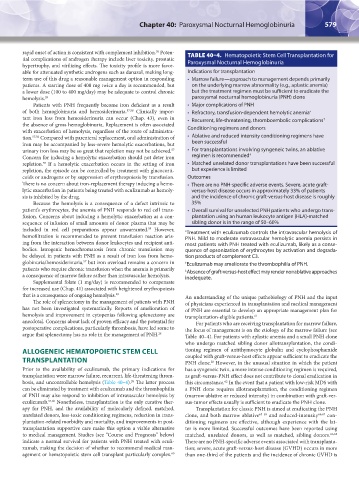
                  argue that splenectomy has no role in the management of PNH. 28  Table  40–4). For patients with aplastic anemia and a small PNH clone
                                                                        who undergo matched sibling donor allotransplantation, the condi-
                  ALLOGENEIC HEMATOPOIETIC STEM CELL                    tioning regimen of antithymocyte globulin and cyclophosphamide
                  TRANSPLANTATION                                       coupled with graft-versus-host effects appear sufficient to eradicate the
                                                                        PNH clone.  However, in the unusual situation in which the patient
                                                                                 28
                  Prior to the availability of eculizumab, the primary indications for   has a syngeneic twin, a more intense conditioning regimen is required,
                  transplantation were marrow failure, recurrent, life-threatening throm-  as graft-versus-PNH effect does not contribute to clonal eradication in
                                                      28
                  bosis, and uncontrollable hemolysis (Table 40–4).  The latter process   this circumstance.  In the event that a patient with low-risk MDS with
                                                                                      62
                  can be eliminated by treatment with eculizumab and the thrombophilia   a PNH clone requires allotransplantation, the conditioning regimen
                  of PNH may also respond to inhibition of intravascular hemolysis by   (marrow ablative or reduced intensity) in combination with graft-ver-
                  eculizumab. 54,60  Nonetheless, transplantation is the only curative ther-  sus-tumor effects usually is sufficient to eradicate the PNH clone.
                  apy for PNH, and the availability of molecularly defined, matched,   Transplantation for classic PNH is aimed at eradicating the PNH
                  unrelated donors, less-toxic conditioning regimens, reduction in trans-  clone, and both marrow ablative 63–65  and reduced-intensity 66,67  con-
                  plantation-related morbidity and mortality, and improvements in post-  ditioning regimens are effective, although experience with the lat-
                  transplantation supportive care make this option a viable alternative   ter is more limited. Successful outcomes have been reported using
                  to medical management. Studies (see “Course and Prognosis” below)   matched, unrelated donors, as well as matched, sibling donors. 66,68
                  indicate a normal survival for patients with PNH treated with eculi-  There are no PNH-specific adverse events associated with transplanta-
                  zumab, making the decision of whether to recommend medical man-  tion; severe, acute graft-versus-host disease (GVHD) occurs in more
                  agement or hematopoietic stem cell transplant particularly complex.    than one-third of the patients and the incidence of chronic GVHD is
                                                                    60


          Kaushansky_chapter 40_p0571-0582.indd   579                                                                   9/17/15   6:23 PM

