


Page 602 - Williams Hematology ( PDFDrive )
P. 602
576  Part VI:  The Erythrocyte                          Chapter 40:  Paroxysmal Nocturnal Hemoglobinuria              577


                                                  Normal Control                              Patient
                                                    PNH03.002                                PNH02.002
                                      10 4 3                                  10 4 3


                                                                              10
                                    GLYCOPHORIN PE  10 1                      10 1  72%

                            RBCs      10 2                                   GLYCOPHORIN PE  10 2


                                      10


                                      10 0                                    10 0  0     1       2      3      4
                                        10 0    10 1   10 2    10 3   10 4       10     10      10     10      10
                                               CD55 FITC + CD59 FITC                    CD55 FITC + CD59 FITC

                                                    PNH06.002                                PNH05.002
                                      10 4                                    10 4


                                      10 3                                    10 3


                            PMNs    CD11b PE  10 2                           CD11b PE  10 2  96%


                                      10 1                                    10 1


                                      10 0                                    10 0
                                         10 0   10 1   10 2    10 3   10 4       10 0    10 1   10 2   10 3   10 4
                                                   CD55 + CD59                              CD55 + CD59
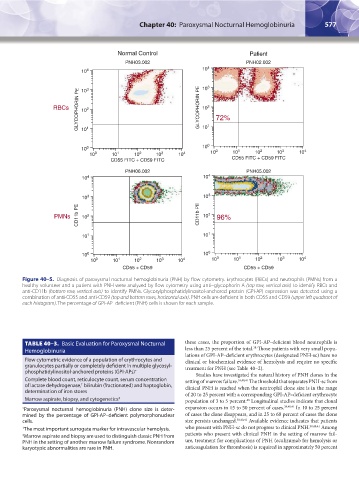
                  Figure 40–5.  Diagnosis of paroxysmal nocturnal hemoglobinuria (PNH) by flow cytometry. Erythrocytes (RBCs) and neutrophils (PMNs) from a
                  healthy volunteer and a patient with PNH were analyzed by flow cytometry using anti–glycophorin A (top row, vertical axis) to identify RBCs and
                  anti-CD11b (bottom row, vertical axis) to identify PMNs. Glycosylphosphatidylinositol-anchored protein (GPI-AP) expression was detected using a
                  combination of anti-CD55 and anti-CD59 (top and bottom rows, horizontal axis). PNH cells are deficient in both CD55 and CD59 (upper left quadrant of
                  each histogram). The percentage of GPI-AP–deficient (PNH) cells is shown for each sample.


                   TABLE 40–3.  Basic Evaluation for Paroxysmal Nocturnal   these cases, the proportion of GPI-AP–deficient blood neutrophils is
                                                                                               38
                   Hemoglobinuria                                       less than 25 percent of the total.  Those patients with very small popu-
                                                                        lations of GPI-AP–deficient erythrocytes (designated PNH-sc) have no
                   Flow cytometric evidence of a population of erythrocytes and   clinical or biochemical evidence of hemolysis and require no specific
                   granulocytes partially or completely deficient in multiple glycosyl-  treatment for PNH (see Table  40–2).
                   phosphatidylinositol-anchored proteins (GPI-APs) *       Studies have investigated the natural history of PNH clones in the
                   Complete blood count, reticulocyte count, serum concentration   setting of marrow failure. 38,40,41  The threshold that separates PNH-sc from
                   of lactate dehydrogenase,  bilirubin (fractionated) and haptoglobin,   clinical PNH is reached when the neutrophil clone size is in the range
                                      †
                   determination of iron stores                         of 20 to 25 percent with a corresponding GPI-AP–deficient erythrocyte
                   Marrow aspirate, biopsy, and cytogenetics ‡          population of 3 to 5 percent.  Longitudinal studies indicate that clonal
                                                                                             40
                  * Paroxysmal nocturnal hemoglobinuria (PNH) clone size is deter-  expansion occurs in 15 to 50 percent of cases. 38,40,41  In 10 to 25 percent
                  mined by the percentage of GPI-AP–deficient polymorphonuclear   of cases the clone disappears, and in 25 to 60 percent of cases the clone
                  cells.                                                size persists unchanged. 38,40,41  Available evidence indicates that patients
                  † The most important surrogate marker for intravascular hemolysis.  who present with PNH-sc do not progress to clinical PNH. 38,40,41  Among
                  ‡ Marrow aspirate and biopsy are used to distinguish classic PNH from   patients who present with clinical PNH in the setting of marrow fail-
                  PNH in the setting of another marrow failure syndrome. Nonrandom   ure, treatment for complications of PNH (eculizumab for hemolysis or
                  karyotypic abnormalities are rare in PNH.             anticoagulation for thrombosis) is required in approximately 50 percent


          Kaushansky_chapter 40_p0571-0582.indd   577                                                                   9/17/15   6:22 PM

