


Page 600 - Williams Hematology ( PDFDrive )
P. 600
574  Part VI:  The Erythrocyte                          Chapter 40:  Paroxysmal Nocturnal Hemoglobinuria              575


                   TABLE 40–1.  Recommendation for Screening Patients for     III
                   Paroxysmal Nocturnal Hemoglobinuria *
                   History of episodic hemoglobinuria                                            Patient with high percentage of type III
                   Evidence of nonspherocytic, Coombs-negative intravascular   Cell count  I     cells, high-grade hemolysis
                   hemolysis (must have high serum lactate dehydrogenase)
                   Patients with aplastic anemia (screen at diagnosis and once yearly
                   even in the absence of intravascular hemolysis)       A   Log fluorescence intensity
                   Patients with refractory anemia or refractory cytopenias with mul-  II
                   tilineage dysplasia variants of myelodysplastic syndrome †
                   Patients with venous thrombosis involving unusual sites (usually              Patient with high percentage of
                   have evidence of intravascular hemolysis)              Cell count             type II cells but low percentage of
                   •  Budd-Chiari syndrome                                  III             I    type III cells, minimal hemolysis
                   •  Other intraabdominal sites
                   •  Cerebral veins                                     B
                   •  Dermal veins                                           Log fluorescence intensity
                                                                                            I
                  * Screening by flow cytometric analysis of glycosylphosphatidylinos-
                  itol-anchored proteins on red blood cells and polymorphonuclear
                  cells.                                                  Cell count             Patient with low percentage
                                                                                                 of type III cells,minimal
                  † There is no indication for screening patients with other myelodys-  III      hemolysis
                  plastic syndrome classifications.

                                                                         C   Log fluorescence intensity
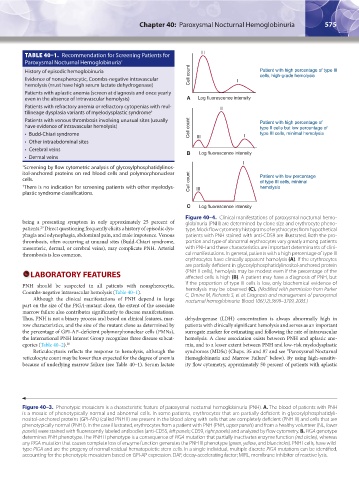
                                                                         Figure 40–4.  Clinical manifestations of paroxysmal nocturnal hemo-
                  being a presenting symptom in only approximately 25 percent of   globinuria (PNH) are determined by clone size and erythrocyte pheno-
                  patients.  Direct questioning frequently elicits a history of episodic dys-  type. Mock flow cytometry histograms of erythrocytes from hypothetical
                        29
                  phagia and odynophagia, abdominal pain, and male impotence. Venous   patients with PNH stained with anti-CD59 are illustrated. Both the pro-
                  thrombosis, often occurring at unusual sites (Budd-Chiari syndrome,   portion and type of abnormal erythrocytes vary greatly among patients
                  mesenteric, dermal, or cerebral veins), may complicate PNH. Arterial   with PNH and these characteristics are important determinants of clini-
                  thrombosis is less common.                            cal manifestations. In general, patients with a high percentage of type III
                                                                        erythrocytes have clinically apparent hemolysis (A). If the erythrocytes
                                                                        are partially deficient in glycosylphosphatidylinositol-anchored protein
                     LABORATORY FEATURES                                (PNH II cells), hemolysis may be modest even if the percentage of the
                                                                        affected cells is high (B). A patient may have a diagnosis of PNH, but
                  PNH should be suspected in all patients with nonspherocytic,   if the proportion of type III cells is low, only biochemical evidence of
                  Coombs-negative intravascular hemolysis (Table 40–1).  hemolysis may be observed (C). (Modified with permission from Parker
                                                                        C, Omine M, Richards S, et al: Diagnosis and management of paroxysmal
                     Although the clinical manifestations of PNH depend in large   nocturnal hemoglobinuria. Blood 106(12):3699–3709, 2005.)
                  part on the size of the PIGA-mutant clone, the extent of the associate
                  marrow failure also contributes significantly to disease manifestations.
                  Thus, PNH is not a binary process and based on clinical features, mar-  dehydrogenase (LDH) concentration is always abnormally high in
                  row characteristics, and the size of the mutant clone as determined by   patients with clinically significant hemolysis and serves as an important
                  the percentage of GPI-AP–deficient polymorphonuclear cells (PMNs),   surrogate marker for estimating and following the rate of intravascular
                  the International PNH Interest Group recognizes three disease subcat-  hemolysis. A close association exists between PNH and aplastic ane-
                  egories (Table 40–2). 28                              mia, and to a lesser extent between PNH and low-risk myelodysplastic
                     Reticulocytosis reflects the response to hemolysis, although the   syndromes (MDSs) (Chaps. 35 and 87 and see “Paroxysmal Nocturnal
                  reticulocyte count may be lower than expected for the degree of anemia   Hemoglobinuria and Marrow Failure” below). By using high-sensitiv-
                  because of underlying marrow failure (see Table  40–1). Serum lactate   ity flow cytometry, approximately 50 percent of patients with aplastic


                  Figure 40–3.  Phenotypic mosaicism is a characteristic feature of paroxysmal nocturnal hemoglobinuria (PNH). A. The blood of patients with PNH
                  is a mosaic of phenotypically normal and abnormal cells. In some patients, erythrocytes that are partially deficient in glycosylphosphatidyli-
                  nositol-anchored proteins (GPI-APs) (called PNH II) are present in the blood along with cells that are completely deficient (PNH III) and cells that are
                  phenotypically normal (PNH I). In the case illustrated, erythrocytes from a patient with PNH (PNH, upper panels) and from a healthy volunteer (NL, lower
                  panels) were stained with fluorescently labeled antibodies (anti-CD55, left panels; CD59, right panels) and analyzed by flow cytometry. B. PIGA genotype
                  determines PNH phenotype. The PNH II phenotype is a consequence of PIGA mutation that partially inactivates enzyme function (red circles), whereas
                  any PIGA mutation that causes complete loss of enzyme function generates the PNH III phenotype (green, yellow, and blue circles). PNH I cells, have wild-
                  type PIGA and are the progeny of normal residual hematopoietic stem cells. In a single individual, multiple discrete PIGA mutations can be identified,
                  accounting for the phenotypic mosaicism based on GPI-AP expression. DAF, decay-accelerating factor; MIRL, membrane inhibitor of reactive lysis.


          Kaushansky_chapter 40_p0571-0582.indd   575                                                                   9/17/15   6:22 PM

