


Page 659 - Williams Hematology ( PDFDrive )
P. 659
634            Part VI:  The Erythrocyte                                                                                                                                      Chapter 43:  Iron Deficiency and Overload            635


                             MCHC values in iron-deficiency anemia    iron concentration has a diurnal rhythm; it decreases in late afternoon
                                                                      and evening, reaching a nadir near 9 pm and increases to its maximum
                     36                                               between 7 and 10 am. This effect is rarely of sufficient magnitude to
                                                                                    136
                                                                      influence diagnosis.  Serum iron levels decrease at about the time of
                                                                      menstrual bleeding 137,138  regardless of whether the bleeding is physio-
                     34                                               logic or induced by withdrawal of contraceptive hormonal preparations.
                                                                          Importantly, the serum iron concentration is reduced in the presence
                    MCHC (g/dL)  32                                   of either acute or chronic inflammatory processes  or malignancy
                                                                                                           139
                                                                                                                       140
                                                                      and following acute myocardial infarction.
                                                                                                    141,142
                                                                                                         The serum iron concen-
                                                                      tration under these circumstances may be decreased sufficiently to sug-
                     30                                               gest iron deficiency. Conversely, during chemotherapy of malignancy,
                                                                      the serum iron concentration may be quite elevated, as cytotoxic effects
                                                                      of the drugs on erythroblasts inhibit erythropoiesis and related iron
                     28                                               uptake by erythroblasts. This effect is observed from the third to the
                                                                      seventh day after inception of chemotherapy of a variety of tumors. 143
                                                                          Normal or high concentrations of serum iron are commonly
                       0     2     4     6     8     10    12         observed even in patients with iron-deficiency anemia if such patients
                                Hemoglobin concentration (g/dL)       receive iron medication before blood is drawn for these measurements.
                                                                      Even multivitamin preparations, which commonly contain approxi-
                             MCV values in iron-deficiency anemia     mately 18 mg of elemental iron per tablet, can result in this effect. Oral
                    100                                               iron medication should be withheld for 24 hours before blood samples
                                                                      are obtained. Parenteral injection of iron dextran may result in a very
                                                                      high serum iron concentration (e.g., 500 to 1000 mcg/dL), at least with
                     80
                                                                                 144
                                                                      some methods,  for several weeks. The elevation of serum iron lev-
                                                                      els after infusion of sodium ferric gluconate or iron sucrose is of much
                                                                                  145
                                                                      shorter duration.
                     60
                    MCV (fL)                                          Iron-Binding Capacity and Transferrin Saturation
                     40
                                                                      The iron-binding capacity is a measure of the amount of transferrin in
                                                                      circulating blood. Normally, there is enough transferrin present in 100
                     20                                               mL serum to bind 4.4 to 8.0 μmol (250 to 450 mcg) of iron; because
                                                                      the normal serum iron concentration is approximately 1.8  μmol/dL
                                                                      (100  mcg/dL), transferrin may be found to be approximately one-third
                      0                                               saturated with iron. The unsaturated or latent iron-binding capacity
                       0     2    4     6     8     10    12          (UIBC) is easily measured with radioactive iron or by spectrophotometric
                               Hemoglobin concentration (g/dL)
                                                                      techniques. The sum of the UIBC and the plasma iron represents total
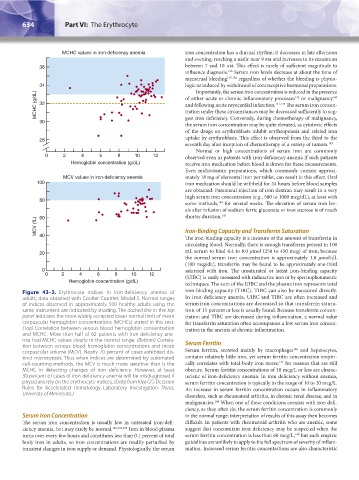
               Figure  43–3.  Erythrocyte indices in iron-deficiency anemia of   iron-binding capacity (TIBC). TIBC can also be measured directly.
               adults; data obtained with Coulter Counter, Model S. Normal ranges   In iron-deficiency anemia, UIBC and TIBC are often increased and
               of indices observed in approximately 500 healthy adults using the   serum iron concentrations are decreased so that transferrin satura-
               same instrument are indicated by shading. The dashed line in the top   tion of 15 percent or less is usually found. Because transferrin concen-
               panel indicates the more widely accepted lower normal limit of mean   tration and TIBC are decreased during inflammation, a normal value
               corpuscular hemoglobin concentrations (MCHCs) stated in this text.   for transferrin saturation often accompanies a low serum iron concen-
               (Top) Correlation between venous blood hemoglobin concentration   tration in the anemia of chronic inflammation.
               and MCHC. More than half of 62 patients with iron-deficiency ane-
               mia had MCHC values clearly in the normal range. (Bottom) Correla-
               tion between venous blood hemoglobin concentrations and mean   Serum Ferritin
                                                                                                          146
               corpuscular volume (MCV). Nearly 70 percent of cases exhibited dis-  Serum  ferritin,  secreted  mainly  by  macrophages   and  hepatocytes,
               tinct microcytosis. Thus when indices are determined by automated   contains relatively little iron, yet serum ferritin concentration empiri-
                                                                                                     147
               cell-counting methods, the MCV is much more sensitive than is the   cally correlates with total-body iron stores,  for reasons that are still
               MCHC in detecting changes of iron deficiency. However, at least     obscure. Serum ferritin concentrations of 10 mcg/L or less are charac-
               30 percent of cases of iron-deficiency anemia will be misdiagnosed if   teristic of iron-deficiency anemia. In iron deficiency without anemia,
               physicians rely on the erythrocyte indices. (Data from Klee GG: Decision   serum ferritin concentration is typically in the range of 10 to 20 mcg/L.
               Rules for Accelerated Hematology Laboratory Investigation: Thesis,   An increase  in serum ferritin concentration occurs in inflammatory
               University of Minnesota.)                              disorders, such as rheumatoid arthritis, in chronic renal disease, and in
                                                                      malignancies.  When one of these conditions coexists with iron defi-
                                                                                148
                                                                      ciency, as they often do, the serum ferritin concentration is commonly
               Serum Iron Concentration                               in the normal range; interpretation of results of this assay then becomes
               The serum iron concentration is usually low in untreated iron-defi-  difficult. In patients with rheumatoid arthritis who are anemic, some
               ciency anemia, but may rarely be normal. 125,134,135  Iron in blood plasma   suggest that concomitant iron deficiency may be suspected when the
               turns over every few hours and constitutes less than 0.1 percent of total   serum ferritin concentration is less than 60 mcg/L,  but such empiric
                                                                                                           149
               body iron in adults, so iron concentrations are readily perturbed by   guidelines are unlikely to apply to the full spectrum of severity of inflam-
               transient changes in iron supply or demand. Physiologically, the serum   mation. Increased serum ferritin concentrations are also characteristic


          Kaushansky_chapter 43_p0627-0650.indd   634                                                                   9/17/15   6:27 PM

