


Page 656 - Williams Hematology ( PDFDrive )
P. 656
630  Part VI:  The Erythrocyte                                    Chapter 43:  Iron Deficiency and Overload           631


                  Intravascular Hemolysis and Hemoglobinuria                         Normal     Iron     Iron-     Iron-
                  Iron-deficiency anemia may occur in paroxysmal nocturnal hemo-              depletion  deficiency  deficiency
                  globinuria (Chap. 40)  and in hemolysis  resulting  from mechanical   Storage         anemia    anemia
                  erythrocyte trauma from intracardiac myxomas, valvular prostheses   iron               (early)  (advanced)
                  (particularly if malfunctioning), or patches (Chaps. 33 and 51). In these
                  disorders, up to 10 mg/day of iron is lost in the urine as hemosiderin
                  and ferritin in desquamated tubular cells and as hemoglobin dimers, an   Hemoglobin
                  amount sufficient to cause systemic iron deficiency. 61,62  iron
                     Iron deficiency occurs frequently in athletes engaged in a variety
                  of sports (Chaps. 33 and 51), especially female athletes.  There may be   Transport
                                                          63
                  mild anemia. Increased intravascular hemolysis, presumably with some   iron
                  renal loss of iron, may play a role, but gastrointestinal blood loss has also
                  been demonstrated in persons engaged in strenuous athletic pursuits.   Enzyme
                  Hemoglobinuria and hemosiderinuria are also seen in competitive and   iron
                  recreational runners, that is, march hemoglobinuria (Chaps. 33 and 51).
                  Strenuous exercise also elicits a rise in serum interleukin (IL)-6 and
                  hepcidin, and this could decrease dietary iron absorption. 63  Erthrocytes  Normochromic      Hypochromic
                     Women soldiers undergoing basic training experience iron deple-         normocytic          microcytic
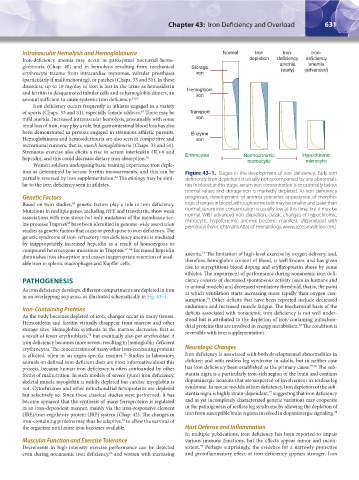
                  tion as determined by serum ferritin measurements, and this can be   Figure 43–1.  Stages in the development of iron deficiency. Early iron
                  partially reversed by iron supplementation.  The etiology may be simi-  deficiency (iron depletion) is usually not accompanied by any abnormali-
                                                 64
                  lar to the iron deficiency seen in athletes.          ties in blood; at this stage, serum iron concentration is occasionally below
                                                                        normal values and storage iron is markedly depleted. As iron deficiency
                  Genetic Factors                                       progresses, development of anemia precedes appearance of morpho-
                  Based on twin studies,  genetic factors play a role in iron deficiency.   logic changes in blood, although some cells may be smaller and paler than
                                  65
                  Mutations in multiple genes, including HFE and transferrin, show weak   normal; serum iron concentration is usually low at this time, but it may be
                  associations with iron stores but only mutations of the membrane ser-  normal. With advanced iron depletion, classic changes of hypochromic,
                  ine protease Tmprss6  have been identified in genome-wide association   microcytic, hypoferremic anemia become manifest.  (Reproduced with
                                 66
                                                                        permission from Lichtman’s Atlas of Hematology, www.accessmedicine.com.)
                  studies as genetic factors that cause or predispose to iron deficiency. The
                  genetic syndrome of iron-refractory iron deficiency anemia is mediated
                  by inappropriately increased hepcidin as a result of homozygous or
                  compound heterozygous mutations in Tmprss6. 67–69  Increased hepcidin   73
                  diminishes iron absorption and causes inappropriate retention of avail-  anemia.  The limitation of high-level exercise by oxygen delivery, and,
                  able iron in splenic macrophages and Kupffer cells.   therefore, hemoglobin content of blood, is well known, and has given
                                                                        rise to surreptitious blood doping and erythropoietin abuse by some
                                                                        athletes. The impairment of performance during nonanemic iron defi-
                  PATHOGENESIS                                          ciency consists of decreased spontaneous activity (seen in humans and
                  As iron deficiency develops, different compartments are depleted in iron   in animal models) and decreased ventilatory threshold, that is, the point
                                                                        at which ventilation starts increasing more rapidly than oxygen con-
                  in an overlapping sequence, as illustrated schematically in Fig. 43–1.
                                                                        sumption.  Other deficits that have been reported include decreased
                                                                                74
                                                                        endurance and increased muscle fatigue. The biochemical basis of the
                  Iron-Containing Proteins                              deficits associated with nonanemic iron deficiency is not well under-
                  As the body becomes depleted of iron, changes occur in many tissues.   stood but is attributed to the depletion of iron-containing mitochon-
                  Hemosiderin and ferritin virtually disappear from marrow and other   drial proteins that are involved in energy metabolism.  The condition is
                                                                                                               63
                  storage sites. Hemoglobin synthesis in the marrow decreases, first as   reversible with iron supplementation.
                  a result of fewer erythroblasts,  but eventually also per erythroblast if
                                        70
                  iron deficiency becomes more severe, resulting in hemoglobin-deficient
                  erythrocytes. The concentration of many other iron-containing proteins   Neurologic Changes
                  is affected, often in an organ-specific manner.  Studies in laboratory   Iron deficiency is associated with both developmental abnormalities in
                                                    71
                  animals on defined iron-deficient diets are most informative about this   children and with restless leg syndrome in adults, but in neither case
                  process, because human iron deficiency is often confounded by other   has iron deficiency been established as the primary cause. 75,76  The sub-
                  forms of malnutrition. In such models of severe (pure) iron deficiency,   stantia nigra is a particularly iron-rich region of the brain and contains
                  skeletal muscle myoglobin is mildly depleted but cardiac myoglobin is   dopaminergic neurons that are suspected of involvement in restless leg
                  not. Cytochromes and other mitochondrial ferroproteins are depleted   syndrome. In mouse models of iron deficiency, iron depletion of the sub-
                                                                                                     77
                  but selectively so. Since these classical studies were performed, it has   stantia nigra is highly strain-dependent,  suggesting that iron deficiency
                  become apparent that the synthesis of many ferroproteins is regulated   and as yet incompletely characterized genetic variations may cooperate
                  in an iron-dependent manner, mainly via the iron-responsive element   in the pathogenesis of restless leg syndrome by allowing the depletion of
                  (IRE)/iron-regulatory protein (IRP) system (Chap. 42). The changes in   iron from susceptible brain regions involved in dopaminergic signaling. 78
                  iron-containing proteins may thus be adaptive,  to allow the survival of
                                                   72
                  the organism until more iron becomes available.       Host Defense and Inflammation
                                                                        In multiple publications, iron deficiency has been reported to impair
                  Muscular Function and Exercise Tolerance              various immune functions, but the effects appear minor and incon-
                                                                             79
                  Decrements in high-intensity exercise performance can be detected   sistent.  Perhaps surprisingly, the evidence for a narrowly protective
                  even during nonanemic iron deficiency,  and worsen with increasing   and proinflammatory effect of iron deficiency appears stronger. Iron
                                               63


          Kaushansky_chapter 43_p0627-0650.indd   631                                                                   9/17/15   6:27 PM

