


Page 660 - Williams Hematology ( PDFDrive )
P. 660
634  Part VI:  The Erythrocyte                                    Chapter 43:  Iron Deficiency and Overload           635


                  of some malignancies, as well as of acute and chronic liver disease and   100                   Hypothetical
                  chronic renal failure. 150–153  In Gaucher disease, juvenile rheumatoid                         test
                  arthritis, and various macrophage activation syndromes, and in ferro-  75
                  portin disease characterized by massive iron loading of macrophages,                            Ferritin
                  the serum ferritin concentration is commonly in the range of thousands
                  of mcg/L and may mask iron deficiency. 154–158          Sensitivity  50

                  Erythrocyte Zinc Protoporphyrin                           25
                  Erythrocyte protoporphyrin, principally zinc protoporphyrin, is
                  increased in disorders of heme synthesis, including iron deficiency, lead   0
                                                                                                    75
                  poisoning, and sideroblastic anemias, as well as other conditions. 159–161    0  25  50  75  100
                  This assay analyzes the fluorescence of erythrocytes and uses small   100% – Specificity%
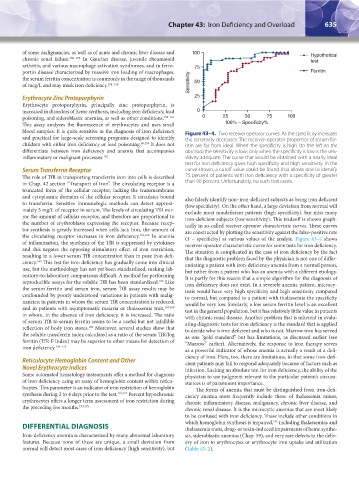
                  blood samples. It is quite sensitive in the diagnosis of iron deficiency   Figure 43–4.  Two receiver operator curves. As the specificity increases
                  and practical for large-scale screening programs designed to identify   the sensitivity decreases. The receiver-operator properties of serum fer-
                  children with either iron deficiency or lead poisoning. 58,159  It does not   ritin are far from ideal. When the specificity is high (to the left on the
                  differentiate between  iron  deficiency and  anemia  that  accompanies   abscissa) the sensitivity is low; only when the specificity is low is the sen-
                  inflammatory or malignant processes. 162              sitivity adequate. The curve that would be obtained with a nearly ideal
                                                                        test for iron deficiency gives high specificity and high sensitivity. In the
                  Serum Transferrin Receptor                            curve shown, a cutoff value could be found that allows one to identify
                  The role of TfR in transporting transferrin iron into cells is described   75 percent of patients with iron deficiency with a specificity of greater
                  in Chap. 42 section “Transport of Iron”. The circulating receptor is a   than 90 percent. Unfortunately, no such test exists.
                  truncated form of the cellular receptor, lacking the transmembrane
                  and cytoplasmic domains of the cellular receptor. It circulates bound   also falsely identify non–iron-deficient subjects as being iron deficient
                  to transferrin. Sensitive immunologic methods can detect approxi-  (low specificity). On the other hand, a large deviation from normal will
                  mately 5 mg/L of receptor in serum. The levels of circulating TfR mir-  exclude most nondeficient patients (high specificity), but miss many
                  ror the amount of cellular receptor, and therefore are proportional to   iron-deficient subjects (low sensitivity). This tradeoff is shown graph-
                  the number of erythroblasts expressing the receptor. Because recep-  ically in so-called receiver operator characteristic curves. These curves
                  tor synthesis is greatly increased when cells lack iron, the amount of   are constructed by plotting the sensitivity against the false-positive rate
                  the circulating receptor increases in iron deficiency. 163,164  In anemia   (1 − specificity) at various values of the analyte. Figure 43–4 shows
                  of inflammation, the synthesis of the TfR is suppressed by cytokines   receiver operator characteristic curve for some tests for iron deficiency.
                  and  this  negates  the  opposing stimulatory  effect of iron  restriction,   The situation is complicated in the case of iron deficiency by the fact
                  resulting in a lower serum TfR concentration than in pure iron defi-  that the diagnostic problem faced by the physician is not one of differ-
                       165
                  ciency.  This test for iron deficiency has gradually come into clinical   entiating a patient with iron-deficiency anemia from a normal person,
                  use, but the methodology has not yet been standardized, making lab-  but rather from a patient who has an anemia with a different etiology.
                  oratory-to-laboratory comparisons difficult. A method for performing   It is partly for this reason that a simple algorithm for the diagnosis of
                                                                166
                  reproducible assays for the soluble TfR has been standardized.  Like   iron deficiency does not exist. In a severely anemic patient, microcy-
                  the serum ferritin and serum iron, serum TfR assay results may be   tosis would have very high specificity and high sensitivity compared
                  confounded by poorly understood variations in patients with malig-  to normal, but compared to a patient with thalassemia the specificity
                  nancies; in patients in whom the serum TfR concentration is reduced;   would be very low. Similarly, a low serum ferritin level is an excellent
                  and in patients with asymptomatic malaria or thalassemia trait, 167,168    test in the general population, but it has relatively little value in patients
                  in whom, in the absence of iron deficiency, it is increased. The ratio   with chronic renal disease. Another problem that is inherent in evalu-
                  of serum TfR to serum ferritin seems to be a useful but not infallible   ating diagnostic tests for iron deficiency is the standard that is applied
                  reflection of body iron stores.  Moreover, several studies show that   to decide who is iron deficient and who is not. Marrow iron has served
                                        169
                  the soluble transferrin index calculated as a ratio of the serum TfR/log   as one “gold standard” but has limitations, as discussed earlier (see
                  ferritin (TfR-F Index) may be superior to other means for detection of   “Marrow” earlier). Alternatively, the response to iron therapy serves
                  iron deficiency. 170–172                              as a powerful indicator of whose anemia is actually a result of a defi-
                                                                        ciency of iron. Here, too, there are limitations, in that some iron-defi-
                  Reticulocyte Hemoglobin Content and Other             cient patients may fail to respond adequately because of factors such as
                  Novel Erythrocyte Indices                             infection. Lacking an absolute test for iron deficiency, the ability of the
                  Some automated hematology instruments offer a method for diagnosis   physician to use judgment relevant to the particular patient’s circum-
                  of iron deficiency using an assay of hemoglobin content within reticu-  stances is of paramount importance.
                  locytes. This parameter is an indicator of iron restriction of hemoglobin   The forms of anemia that must be distinguished from iron-defi-
                  synthesis during 3 to 4 days prior to the test. 173,174  Percent hypochromic   ciency  anemia  most  frequently  include  those  of  thalassemia  minor,
                  erythrocytes offers a longer term assessment of iron restriction during   chronic inflammatory disease, malignancy, chronic liver disease, and
                  the preceding few months. 173,175                     chronic renal disease. It is the microcytic anemias that are most likely
                                                                        to be confused with iron deficiency. These include other conditions in
                                                                        which hemoglobin synthesis is impaired,  including thalassemias and
                                                                                                      176
                  DIFFERENTIAL DIAGNOSIS                                thalassemia traits, drug- or toxin-induced impairments of heme synthe-
                  Iron-deficiency anemia is characterized by many abnormal laboratory   sis, sideroblastic anemias (Chap. 59), and very rare defects in the deliv-
                  features. Because none of these are unique, a small deviation from   ery of iron to erythrocytes or erythrocyte iron uptake and utilization
                  normal will detect most cases of iron deficiency (high sensitivity), but   (Table 43–2).


          Kaushansky_chapter 43_p0627-0650.indd   635                                                                   9/17/15   6:27 PM

