


Page 658 - Williams Hematology ( PDFDrive )
P. 658
632  Part VI:  The Erythrocyte                                    Chapter 43:  Iron Deficiency and Overload           633


                  (spoon nails), once a common finding, is now encountered rarely. Reti-  abnormalities correct with iron therapy. Thrombotic complications of
                  nal hemorrhages and exudates may be seen in severely anemic patients   iron deficiency have been reported but are very rare.  The etiology
                                                                                                                128
                  (e.g., hemoglobin concentration of <5 g/dL). Splenomegaly has occa-  of either abnormality is not known. Low-iron-diet-induced iron-de-
                  sionally been attributed to iron-deficiency anemia, but when it occurs,   ficiency anemia developed in a rat model within 2 weeks, and this
                  it is probably from other causes.                     was  accompanied by  sustained 50  percent  increase  in  platelet  count
                                                                        with increased platelet size but without significant changes in known
                  LABORATORY FEATURES                                   megakaryocyte growth factors (thrombopoietin, IL-6 or IL-11). It has
                  In severe, uncomplicated iron-deficiency anemia, the erythrocytes are   been suggested that high erythropoietin levels may stimulate thrombo-
                  hypochromic and microcytic; the plasma iron concentration is dimin-  poietin receptors because the two hematopoietic factors are structurally
                  ished; the iron-binding capacity is increased; the serum ferritin con-  related, but this does not seem to be the case. 129
                                                                                                                        130
                  centration is low; the serum transferrin receptor (TfR) and erythrocyte   Reticulocytes  Reticulocyte count is often mildly increased,  a
                  zinc protoporphyrin concentrations are increased; and the marrow is   finding consistent with the increased erythroid activity of the marrow
                  depleted of stainable iron. However, the classic combination of labora-  (see “Marrow” below).
                  tory findings occurs consistently only when iron-deficiency anemia is
                  far advanced, when there are no complicating factors such as infection
                  or malignant neoplasms, and when there has not been previous therapy   Marrow
                  with transfusions or parenteral iron.                 Because most of the iron in the body is normally in erythrocytes, and
                                                                        iron is not excreted, decrease in erythrocyte mass generally results in
                  Blood Cells                                           increased storage iron. Iron-deficiency anemia is the exception, as iron
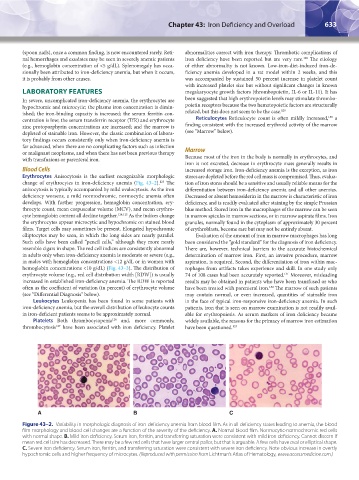
                  Erythrocytes  Anisocytosis is the earliest recognizable morphologic   stores are depleted before the red cell mass is compromised. Thus, evalua-
                  change of erythrocytes in iron-deficiency anemia (Fig. 43–2).  The   tion of iron stores should be a sensitive and usually reliable means for the
                                                                123
                  anisocytosis is typically accompanied by mild ovalocytosis. As the iron   differentiation between iron-deficiency anemia and all other anemias.
                  deficiency worsens, a mild normochromic, normocytic anemia often   Decreased or absent hemosiderin in the marrow is characteristic of iron
                  develops. With further progression, hemoglobin concentration, ery-  deficiency, and is readily evaluated after staining by the simple Prussian
                  throcyte count, mean corpuscular volume (MCV), and mean erythro-  blue method. Stored iron in the macrophages of the marrow can be seen
                  cyte hemoglobin content all decline together. 124,125  As the indices change   in marrow spicules in marrow sections, or in marrow aspirate films. Iron
                  the erythrocytes appear microcytic and hypochromic on stained blood   granules, normally found in the cytoplasm of approximately 30 percent
                  films. Target cells may sometimes be present. Elongated hypochromic   of erythroblasts, become rare but may not be entirely absent.
                  elliptocytes may be seen, in which the long sides are nearly parallel.   Evaluation of the amount of iron in marrow macrophages has long
                  Such cells have been called “pencil cells,” although they more nearly   been considered the “gold standard” for the diagnosis of iron deficiency.
                  resemble cigars in shape. The red cell indices are consistently abnormal   There are, however, technical barriers to the accurate histochemical
                  in adults only when iron-deficiency anemia is moderate or severe (e.g.,   determination of marrow iron. First, an invasive procedure, marrow
                  in males with hemoglobin concentrations <12 g/dL or in women with   aspiration, is required. Second, the differentiation of iron within mac-
                  hemoglobin concentrations <10 g/dL) (Fig. 43–3). The distribution of   rophages from artifacts takes experience and skill. In one study only
                  erythrocyte volume (e.g., red cell distribution width [RDW]) is usually   74 of 108 cases had been accurately reported.  Moreover, misleading
                                                                                                          131
                  increased in established iron-deficiency anemia. The RDW is reported   results may be obtained in patients who have been transfused or who
                  often as the coefficient of variation (in percent) of erythrocyte volume   have been treated with parenteral iron.  The marrow of such patients
                                                                                                     132
                  (see “Differential Diagnosis” below).                 may contain normal, or even increased, quantities of stainable iron
                     Leukocytes  Leukopenia has been found in some patients with   in the face of typical iron-responsive iron-deficiency anemia. In such
                  iron-deficiency anemia, but the overall distribution of leukocyte counts   patients, iron that is seen on marrow examination is not readily avail-
                  in iron-deficient patients seems to be approximately normal.  able for erythropoiesis. As serum markers of iron deficiency became
                     Platelets  Both  thrombocytopenia   and,  more  commonly,   widely available, the reasons for the primacy of marrow iron estimation
                                                126
                  thrombocytosis   have  been  associated  with  iron  deficiency.  Platelet   have been questioned. 133
                             127


                       A                               B                               C
                  Figure 43–2.  Variability in morphologic diagnosis of iron-deficiency anemia from blood film. As in all deficiency states leading to anemia, the blood
                  film morphology and blood cell changes are a function of the severity of the deficiency. A. Normal blood film. Normocytic-normochromic red cells
                  with normal shape. B. Mild iron deficiency. Serum iron, ferritin, and transferring saturation were consistent with mild iron deficiency. Cannot discern if
                  mean red cell size has decreased. There may be a few red cells that have larger central pallor, but that is arguable. A few cells have oval or elliptical shape.
                  C. Severe iron deficiency. Serum iron, ferritin, and transferring saturation were consistent with severe iron deficiency. Note obvious increase in overtly
                  hypochromic cells and higher frequency of microcytes. (Reproduced with permission from Lichtman’s Atlas of Hematology, www.accessmedicine.com.)


          Kaushansky_chapter 43_p0627-0650.indd   633                                                                   9/17/15   6:27 PM

