


Page 716 - Williams Hematology ( PDFDrive )
P. 716
690  Part VI:  The Erythrocyte                                   Chapter 47:  Erythrocyte Enzyme Disorders            691


                    National allele freq.
                        0-1%
                        >1-3%
                        >3-7%
                        >7-10%
                        >10-13%
                        >13-17%
                        >17-20%
                        >20-23%
                        Malaria free
                    A


                    G6PDd males (1,000s)
                       <50
                       50-100
                       100-500
                       500-1,000
                       1,000-2,500
                       2,500-5,000
                       5,000-10,000
                       >10,000
                       Malaria free
                    B


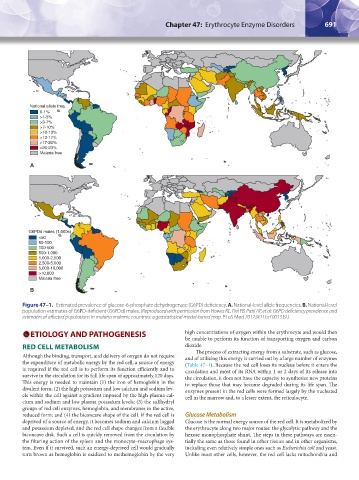
                  Figure 47–1.  Estimated prevalence of glucose-6-phosphate dehydrogenase (G6PD) deficiency. A. National-level allele frequencies. B. National-level
                  population estimates of G6PD-deficient (G6PDd) males. (Reproduced with permission from Howes RE, Piel FB, Patil AP, et al: G6PD deficiency prevalence and
                  estimates of affected populations in malaria endemic countries: a geostatistical model-based map. PLoS Med 2012;9(11):e1001339.)

                     ETIOLOGY AND PATHOGENESIS                          high concentrations of oxygen within the erythrocyte and would then
                                                                        be unable to perform its function of transporting oxygen and carbon
                  RED CELL METABOLISM                                   dioxide.
                                                                            The process of extracting energy from a substrate, such as glucose,
                  Although the binding, transport, and delivery of oxygen do not require   and of utilizing this energy is carried out by a large number of enzymes
                  the expenditure of metabolic energy by the red cell, a source of energy   (Table 47–1). Because the red cell loses its nucleus before it enters the
                  is required if the red cell is to perform its function efficiently and to   circulation and most of its RNA within 1 or 2 days of its release into
                  survive in the circulation for its full life span of approximately 120 days.   the circulation, it does not have the capacity to synthesize new proteins
                  This energy is needed to maintain (1) the iron of hemoglobin in the   to replace those that may become degraded during its life span. The
                  divalent form; (2) the high potassium and low calcium and sodium lev-  enzymes present in the red cells were formed largely by the nucleated
                  els within the cell against a gradient imposed by the high plasma cal-  cell in the marrow and, to a lesser extent, the reticulocyte.
                  cium and sodium and low plasma potassium levels; (3) the sulfhydryl
                  groups of red cell enzymes, hemoglobin, and membranes in the active,
                  reduced form; and (4) the biconcave shape of the cell. If the red cell is   Glucose Metabolism
                  deprived of a source of energy, it becomes sodium and calcium logged   Glucose is the normal energy source of the red cell. It is metabolized by
                  and potassium depleted, and the red cell shape changes from a flexible   the erythrocyte along two major routes: the glycolytic pathway and the
                  biconcave disk. Such a cell is quickly removed from the circulation by   hexose monophosphate shunt. The steps in these pathways are essen-
                  the filtering action of the spleen and the monocyte–macrophage sys-  tially the same as those found in other tissues and in other organisms,
                  tem. Even if it survived, such an energy-deprived cell would gradually   including even relatively simple ones such as Escherichia coli and yeast.
                  turn brown as hemoglobin is oxidized to methemoglobin by the very   Unlike most other cells, however, the red cell lacks mitochondria and


          Kaushansky_chapter 47_p0689-0724.indd   691                                                                   9/17/15   6:44 PM

