


Page 721 - Williams Hematology ( PDFDrive )
P. 721
696            Part VI:  The Erythrocyte                                                                                                                                     Chapter 47:  Erythrocyte Enzyme Disorders             697


               The reaction is facilitated by the presence of metal ions.  Aside from   Both intra- and intersubunit interactions are considered to be key deter-
                                                        113
               its enzymatic function in the glycolytic pathway, α-enolase (ENO1) has   minants of the allosteric response, which involves switching of the PK
               been implicated in numerous diseases, including metastatic cancer,   tetramer from the low-affinity T state to the high-affinity R state. 128–132
                                                          114
               autoimmune disorders, ischemia, and bacterial infection.  The gene   Red cell PK manifests sigmoid kinetics with respect to phosphoenolpy-
               for enolase (ENO1) is located on chromosome 1p36.23. Enolase defi-  ruvate in the absence of fructose-1,6-diphosphate. Hyperbolic kinetics
               ciency is extremely rare. Although it has been reported in association   are observed in the presence of even minute amounts of fructose-1,6-
               with hereditary nonspherocytic hemolytic anemia, 115,116  a clear cause-  diphosphate, 122,133  so that at low concentrations of phosphoenolpyru-
               and-effect relationship has not yet been firmly established.  vate the enzyme activity is greatly increased by fructose diphosphate.
                   Pyruvate Kinase The transfer of phosphate from phosphoenolpy-  PK deficiency is the most common cause of hereditary nonspherocytic
               ruvate to ADP, forming ATP and pyruvate, is catalyzed by the allosteric   hemolytic anemia.
               enzyme PK. This is the second energy-yielding step of glycolysis. Four   Lactate Dehydrogenase LDH catalyzes the reversible reduction
               PK isoenzymes are present in mammalian tissues: PK-M1 (in skele-  of pyruvate to lactate by NADH, the last step in the EMP. The enzyme
               tal muscle), PK-M2 (in leukocytes, kidney, adipose tissue, and lungs),   is composed of H (heart) and M (muscle) subunits. In red cells, the
               PK-L (in liver), and PK-R (in red blood cells). The four PK isoenzymes   predominant subunit is H. Hereditary absence of the H subunit seems
               are products of only two genes (PKLR and PKM2). The PK-M1 and   to be a benign condition, usually without clinical manifestations, 134,135
                                                                                                              136
               PK-M2 enzymes are formed from the PKM2 gene by alternative splic-  although one case with hemolysis has been reported.  Absence of
                                                                                                     137
               ing.  PK-L (the liver enzyme) and PK-R (the erythrocyte enzyme)   the M subunit has been reported as well,  and was unaccompanied
                  117
               are products of the PKLR gene, transcribed from two different, tissue-   by hematologic manifestations. Judging from the origin of the reports,
               specific promoters. 118,119  There is evidence that other, yet unknown, reg-  LDH deficiency appears to be most common in Japan, where popula-
               ulatory elements are involved in PKLR gene expression.  PKLR con-  tion surveys show a gene frequency of approximately 0.05 for each defi-
                                                        120
               sists of 12 exons and spans more than 10 kb. Exon 2, but not exon 1, is   ciency, and several mutations have been identified. 138
               present in the processed liver transcript; in the red cell enzyme exon 1,   Glucose-6-Phosphate Dehydrogenase G6PD is the most exten-
               but not exon 2, is represented.  The red blood cell–specific mRNA is   sively studied erythrocyte enzyme. It catalyzes the oxidation of glucose-6-
                                      119
               2 kb in length and codes for a full-length 63-kDa PK-R subunit of 574   phosphate to 6-phosphogluconolactone, which is rapidly hydrolyzed to
                         121
               amino acids.  Red blood cell PK is a heterotetramer comprised of two   6-phosphogluconic acid, in the first step of the hexose monophosphate
               62- to 63-kDa and two 57- to 58-kDa subunits, the latter resulting from   pathway. NADP  is reduced to NADPH in this reaction, generating 1
                                                                                  +
               limited proteolytic cleavage of the full-length subunit. 122,123  Each subunit   mole of NADPH. In the erythrocyte, the hexose monophosphate path-
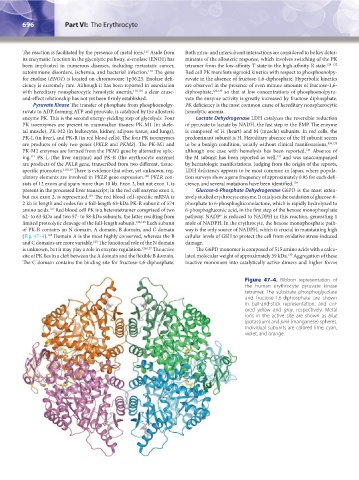
               of PK-R contains an N domain, A domain, B domain, and C domain   way is the only source of NADPH, which is crucial in maintaining high
               (Fig. 47–4).  Domain A is the most highly conserved, whereas the B   cellular levels of GSH to protect the cell from oxidative stress-induced
                        124
               and C domains are more variable.  The functional role of the N domain   damage.
                                       125
               is unknown, but it may play a role in enzyme regulation. 126,127  The active   The G6PD monomer is composed of 515 amino acids with a calcu-
                                                                                                        139
               site of PK lies in a cleft between the A domain and the flexible B domain.   lated molecular weight of approximately 59 kDa.  Aggregation of these
               The C domain contains the binding site for fructose-1,6-diphosphate.   inactive monomers into catalytically active dimers and higher forms
                                                                                          Figure 47–4.  Ribbon representation of
                                                                                          the human  erythrocyte  pyruvate  kinase
                                                                                          tetramer. The substrate phosphoglycolate
                                                                                          and fructose-1,6-diphosphate are shown
                                                                                          in  ball-and-stick  representation, and col-
                                                                                          ored  yellow and  gray, respectively. Metal
                                                                                          ions in the active site are shown as  blue
                                                                                          (potassium) and pink (manganese) spheres.
                                                                                          Individual subunits are colored lime, cyan,
                                                                                          violet, and orange.


          Kaushansky_chapter 47_p0689-0724.indd   696                                                                   9/17/15   6:44 PM

