


Page 717 - Williams Hematology ( PDFDrive )
P. 717
692            Part VI:  The Erythrocyte                                                                                                                                     Chapter 47:  Erythrocyte Enzyme Disorders             693


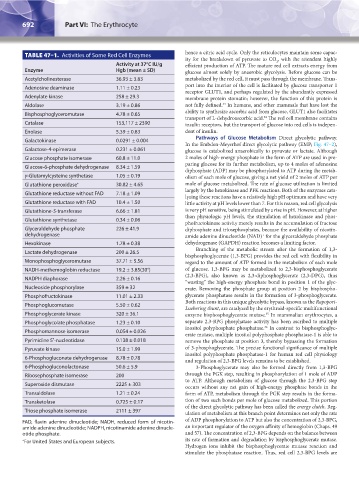
                TABLE 47–1.  Activities of Some Red Cell Enzymes      hence a citric acid cycle. Only the reticulocytes maintain some capac-
                                                                      ity for the breakdown of pyruvate to CO , with the attendant highly
                                                                                                     2
                                               Activity at 37°C IU/g   efficient production of ATP. The mature red cell extracts energy from
                Enzyme                         Hgb (mean ± SD)        glucose almost solely by anaerobic glycolysis. Before glucose can be
                Acetylcholinesterase           36.93 ± 3.83           metabolized by the red cell, it must pass through the membrane. Trans-
                Adenosine deaminase            1.11 ± 0.23            port into the interior of the cell is facilitated by glucose transporter 1
                                                                      receptor GLUT1, and perhaps regulated by the abundantly expressed
                Adenylate kinase               258 ± 29.3             membrane protein stomatin; however, the function of this protein is
                                                                                   34
                Aldolase                       3.19 ± 0.86            not fully defined.  In humans, and other mammals that have lost the
                Bisphosphoglyceromutase        4.78 ± 0.65            ability to synthesize ascorbic acid from glucose, GLUT1 also facilitates
                                                                      transport of L-dehydroascorbic acid.  The red cell membrane contains
                                                                                                34
                Catalase                       153,117 ± 2390         insulin receptors, but the transport of glucose into red cells is indepen-
                Enolase                        5.39 ± 0.83            dent of insulin.
                                                                          Pathways of Glucose Metabolism Direct glycolytic pathway.
                Galactokinase                  0.0291 ± 0.004
                                                                      In the Embden-Meyerhof direct glycolytic pathway (EMP; Fig. 47–2),
                Galactose-4-epimerase          0.231 ± 0.061          glucose  is  catabolized  anaerobically  to  pyruvate  or  lactate.  Although
                Glucose phosphate isomerase    60.8 ± 11.0            2 moles of high-energy phosphate in the form of ATP are used in pre-
                                                                      paring glucose for its further metabolism, up to 4 moles of adenosine
                Glucose-6-phosphate dehydrogenase  8.34 ± 1.59
                                                                      diphosphate (ADP) may be phosphorylated to ATP during the metab-
                γ-Glutamylcysteine synthetase  1.05 ± 0.19            olism of each mole of glucose, giving a net yield of 2 moles of ATP per
                Glutathione peroxidase *       30.82 ± 4.65           mole of glucose metabolized. The rate of glucose utilization is limited
                                                                      largely by the hexokinase and PFK reactions. Both of the enzymes cata-
                Glutathione reductase without FAD  7.18 ± 1.09
                                                                      lyzing these reactions have a relatively high pH optimum and have very
                Glutathione reductase with FAD  10.4 ± 1.50           little activity at pH levels lower than 7. For this reason, red cell glycolysis
                Glutathione-S-transferase      6.66 ± 1.81            is very pH sensitive, being stimulated by a rise in pH. However, at higher
                                                                      than physiologic pH levels, the stimulation of hexokinase and phos-
                Glutathione synthetase         0.34 ± 0.06
                                                                      phofructokinase activity merely results in the accumulation of fructose
                Glyceraldehyde phosphate       226 ± 41.9             diphosphate and triosephosphates, because the availability of nicotin-
                dehydrogenase                                         amide adenine dinucleotide (NAD)  for the glyceraldehyde phosphate
                                                                                                +
                Hexokinase                     1.78 ± 0.38            dehydrogenase (GAPDH) reaction becomes a limiting factor.
                                                                          Branching of the metabolic stream after the formation of 1,3-
                Lactate dehydrogenase          200 ± 26.5
                                                                      bisphosphoglycerate (1,3-BPG) provides the red cell with flexibility in
                Monophosphoglyceromutase       37.71 ± 5.56           regard to the amount of ATP formed in the metabolism of each mole
                NADH-methemoglobin reductase   19.2 ± 3.85(30°)       of glucose. 1,3-BPG may be metabolized to 2,3-bisphosphoglycerate
                                                                      (2,3-BPG), also known as 2,3-diphosphoglycerate (2,3-DPG), thus
                NADPH diaphorase               2.26 ± 0.16
                                                                      “wasting” the high-energy phosphate bond in position 1 of the glyc-
                Nucleoside phosphorylase       359 ± 32               erate. Removing the phosphate group at position 2 by bisphospho-
                Phosphofructokinase            11.01 ± 2.33           glycerate phosphatase results in the formation of 3-phosphoglycerate.
                                                                      Both reactions in this unique glycolytic bypass, known as the Rapoport-
                Phosphoglucomutase             5.50 ± 0.62
                                                                      Luebering shunt, are catalyzed by the erythroid-specific multifunctional
                Phosphoglycerate kinase        320 ± 36.1             enzyme bisphosphoglycerate mutase.  In mammalian erythrocytes, a
                                                                                                 35
                Phosphoglycolate phosphatase   1.23 ± 0.10            separate 2,3-BPG phosphatase activity has been ascribed to multiple
                                                                                                 36
                                                                      inositol polyphosphate phosphatase.  In contrast to bisphosphoglyc-
                Phosphomannose isomerase       0.054 ± 0.026
                                                                      erate mutase, multiple inositol polyphosphate phosphatase-1 is able to
                Pyrimidine 5′-nucleotidase     0.138 ± 0.018          remove the phosphate at position 3, thereby bypassing the formation
                Pyruvate kinase                15.0 ± 1.99            of 3-phosphoglycerate. The precise functional significance of multiple
                                                                      inositol polyphosphate phosphatase-1 for human red cell physiology
                6-Phosphogluconate dehydrogenase  8.78 ± 0.78
                                                                      and regulation of 2,3-BPG levels remains to be established.
                6-Phosphogluconolactonase      50.6 ± 5.9                 3-Phosphoglycerate may also be formed directly from 1,3-BPG
                Ribosephosphate isomerase      200                    through the PGK step, resulting in phosphorylation of 1 mole of ADP
                                                                      to ATP. Although metabolism of glucose through the 2,3-BPG step
                Superoxide dismutase           2225 ± 303
                                                                      occurs without any net gain of high-energy phosphate bonds in the
                Transaldolase                  1.21 ± 0.24            form of ATP, metabolism through the PGK step results in the forma-
                Transketolase                  0.725 ± 0.17           tion of two such bonds per mole of glucose metabolized. This portion
                                                                      of the direct glycolytic pathway has been called the energy clutch. Reg-
                Triose phosphate isomerase     2111 ± 397
                                                                      ulation of metabolism at this branch point determines not only the rate
               FAD, flavin adenine dinucleotide; NADH, reduced form of nicotin-  of ADP phosphorylation to ATP but also the concentration of 2,3-BPG,
               amide adenine dinucleotide; NADPH, nicotinamide adenine dinucle-  an important regulator of the oxygen affinity of hemoglobin (Chaps. 49
               otide phosphate.                                       and 57). The concentration of 2,3-BPG depends on the balance between
               * For United States and European subjects.             its rate of formation and degradation by bisphosphoglycerate mutase.
                                                                      Hydrogen ions  inhibit  the  bisphosphoglycerate  mutase  reaction  and
                                                                      stimulate the  phosphatase reaction.  Thus, red cell  2,3-BPG  levels are


          Kaushansky_chapter 47_p0689-0724.indd   692                                                                   9/17/15   6:44 PM

