


Page 719 - Williams Hematology ( PDFDrive )
P. 719
694            Part VI:  The Erythrocyte                                                                                                                                     Chapter 47:  Erythrocyte Enzyme Disorders             695


               reaction is exquisitely sensitive to fructose 1,6-diphosphate, the prod-  that has been made available by the oxidation of NADPH. NADPH
               uct of PFK. Conversely, other metabolic products may serve as strong   appears to function primarily as a substrate for the reduction of
               enzyme inhibitors. In addition, there is increasing evidence that glyco-  glutathione-containing disulfides in the erythrocyte through mediation
               lytic enzymes assemble into enzyme complexes to the interior of the red   of the enzyme glutathione reductase, which catalyzes the conversion
               cell membrane.  The assembly of these complexes seems to be regulated   of oxidized glutathione (GSSG) to reduced glutathione (GSH) and the
                          37
               by the oxygen status of hemoglobin and the phosphorylation status of   reduction of mixed disulfides of hemoglobin and GSH. 42
               band 3, 37,38  suggesting they play a direct role in the regulation of oxygen-   Enzymes of Glucose Metabolism
               dependent changes in glycolytic and pentose shunt fluxes. 39  Hexokinase Hexokinase catalyzes the phosphorylation of glucose
                   Notably, a number of glycolytic enzymes show additional func-  in position 6 by ATP. It thus serves as the first step in the utilization of
               tional activities. For instance, in addition to its role in glycolysis, glu-  glucose, whether by the anaerobic or the hexose monophosphate path-
               cosephosphate isomerase also functions as a neuroleukin or autocrine   way. Mannose or fructose may also serve as a substrate for this enzyme.
               motility factor. Another example is enolase, that has been reported to   Hexokinase is the glycolytic enzyme with the lowest activity. Reticulo-
               also  function  as  plasminogen  receptor. 40,41   The  additional  functional   cytes have much higher levels of hexokinase activity than do mature red
               activities of these “moonlighting” enzymes could contribute to the com-  cells. 43,44
               plexity of the phenotype of the associated disorder.       Hexokinase has an absolute requirement for magnesium. It is
                   Hexose Monophosphate Shunt Not all the glucose metabolized   strongly inhibited by its product, glucose-6-phosphate, and is released
               by the red cell passes through the direct glycolytic pathway. A direct   from this inhibition by the inorganic phosphate ion 45,46  and by high
                                                                                         47
               oxidative pathway of metabolism, the hexose monophosphate shunt,   concentrations of glucose.  Inorganic phosphate enhances the rate of
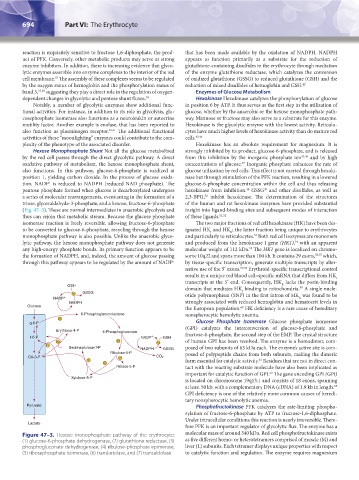
               also functions. In this pathway, glucose-6-phosphate is oxidized at   glucose utilization by red cells. This effect is not exerted through hexoki-
               position 1, yielding carbon dioxide. In the process of glucose oxida-  nase but through stimulation of the PFK reaction, resulting in a lowered
                        +
               tion, NADP  is reduced to NADPH (reduced NAD phosphate). The   glucose-6-phosphate concentration within the cell and thus releasing
                                                                                                49
                                                                                           48
               pentose phosphate formed when glucose is decarboxylated undergoes   hexokinase from inhibition.  GSSG  and other disulfides, as well as
                                                                             50
               a series of molecular rearrangements, eventuating in the formation of a   2,3-BPG,  inhibit hexokinase. The determination of the structures
               triose, glyceraldehyde-3-phosphate, and a hexose, fructose-6-phosphate     of the human and rat hexokinase isozymes have provided substantial
               (Fig. 47–3). These are normal intermediates in anaerobic glycolysis and   insight into ligand-binding sites and subsequent modes of interaction
               thus can rejoin that metabolic stream. Because the glucose phosphate   of these ligands. 51,52
               isomerase reaction is freely reversible, allowing fructose-6-phosphate   The two major fractions of red cell hexokinase (HK) have been des-
               to be converted to glucose-6-phosphate, recycling through the hexose   ignated HK  and HK ; the latter fraction being unique to erythrocytes
                                                                                     R
                                                                              I
               monophosphate pathway is also possible. Unlike the anaerobic glyco-  and particularly to reticulocytes.  Both red cell isozymes are monomers
                                                                                             53
               lytic pathway, the hexose monophosphate pathway does not generate   and produced from the hexokinase I gene (HK1),  with an apparent
                                                                                                           54
               any high-energy phosphate bonds. Its primary function appears to be   molecular weight of 112 kDa.  The HK1 gene is localized on chromo-
                                                                                           55
               the formation of NADPH, and, indeed, the amount of glucose passing   some 10q22 and spans more than 100 kb. It contains 29 exons, 56,57  which,
                                                                  +
               through this pathway appears to be regulated by the amount of NADP    by tissue-specific transcription, generate multiple transcripts by alter-
                                                                      native use of the 5′ exons. 57,58  Erythroid-specific transcriptional control
                                                                      results in a unique red blood cell–specific mRNA that differs from HK   I
                                                                      transcripts at the 5′ end. Consequently, HK  lacks the porin-binding
                                                                                                      R
                              GSH                                     domain that mediates HK  binding to mitochondria.  A single nucle-
                                                                                                            59
                                                                                         I
                                2   GSSG                              otide polymorphism (SNP) in the first intron of HK  was found to be
                          NADP                                                                              R
                               NADPH                                  strongly associated with reduced hemoglobin and hematocrit levels in
                 Glucose
                                                                      the European population.  HK deficiency is a rare cause of hereditary
                                                                                         60
                                   6-Phosphogluconolactone            nonspherocytic hemolytic anemia.
                            1
                  g-6-P                                                   Glucose  Phosphate  Isomerase  Glucose phosphate isomerase
                                                                      (GPI) catalyzes the interconversion of glucose-6-phosphate and
                           Erythrose-4-P  6-Phosphogluconate
                  f-6-P                                NADP    GSH    fructose-6-phosphate, the second step of the EMP. The crystal structure
                           7                   3             2        of human GPI has been resolved. The enzyme is a homodimer, com-
                        6
                               Sedoheptulose-7-P       NADPH   GSSG   posed of two subunits of 63 kDa each. The enzyme’s active site is com-
                                             Ribulose-5-P             posed of polypeptide chains from both subunits, making the dimeric
                 GA-3-P                         5           CO 2
                                                                                               61
                                     6                                form essential for catalytic activity.  Residues that are not in direct con-
                                           4
                                               Ribose-5-P             tact with the reacting substrate molecule have also been implicated as
                                                                                                  62
                                                                      important for catalytic function of GPI.  The gene encoding GPI (GPI)
                                Xylulose-5-P
                                                                      is located on chromosome 19q13.1 and consists of 18 exons, spanning
                                                                                                                        63
                                                                      at least 50 kb, with a complementary DNA (cDNA) of 1.9 kb in length.
                                                                      GPI deficiency is one of the relatively more common causes of heredi-
                                                                      tary nonspherocytic hemolytic anemia.
                 Pyruvate                                                 Phosphofructokinase  PFK catalyzes the rate-limiting phospho-
                                                                      rylation of fructose-6-phosphate by ATP to fructose-1,6-diphosphate.
                                                                      Under intracellular conditions this reaction is nearly irreversible. There-
                 Lactate
                                                                      fore PFK is an important regulator of glycolytic flux. The enzyme has a
               Figure 47–3.  Hexose monophosphate pathway of the erythrocyte:   molecular mass of around 340 kDa. Red cell phosphofructokinase exists
               (1) glucose-6-phosphate dehydrogenase, (2) glutathione reductase, (3)   as five different homo- or heterotetramers comprised of muscle (M) and
               phosphogluconate dehydrogenase, (4) ribulose-phosphate epimerase,   liver (L) subunits. Each tetramer displays unique properties with respect
               (5) ribosephosphate isomerase, (6) transketolase, and (7) transaldolase.  to catalytic function and regulation. The enzyme requires magnesium
          Kaushansky_chapter 47_p0689-0724.indd   694                                                                   9/17/15   6:44 PM

