


Page 722 - Williams Hematology ( PDFDrive )
P. 722
696  Part VI:  The Erythrocyte                                   Chapter 47:  Erythrocyte Enzyme Disorders            697


                                        +
                                                 140
                                                              +
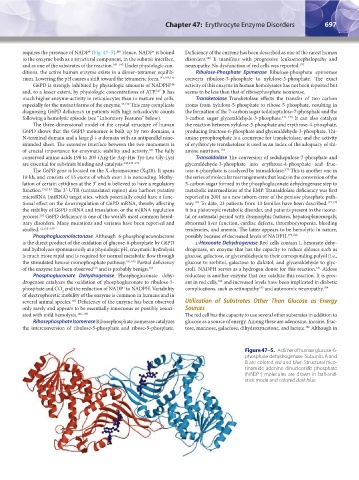
                  requires the presence of NADP  (Fig. 47–5).  Hence, NADP  is bound   Deficiency of the enzyme has been described as one of the rarest human
                                                                               169
                  to the enzyme both as a structural component, in the subunit interface,   disorders.  It manifests with progressive leukoencephalopathy and
                  and as one of the substrates of the reaction. 141–143  Under physiologic con-  neuropathy. No dysfunction of red cells was reported. 170
                  ditions, the active human enzyme exists in a dimer–tetramer equilib-  Ribulose-Phosphate Epimerase  Ribulose-phosphate  epimerase
                  rium. Lowering the pH causes a shift toward the tetrameric form. 141,144,145  converts ribulose-5-phosphate to xylulose-5-phosphate. The exact
                                                                   146
                     G6PD is strongly inhibited by physiologic amounts of NADPH    activity of this enzyme in human hemolysates has not been reported but
                                                               147
                  and, to a lesser extent, by physiologic concentrations of ATP.  It has   seems to be less than that of ribosephosphate isomerase.
                  much higher enzyme-activity in reticulocytes than in mature red cells,   Transketolase  Transketolase effects the transfer of two carbon
                  especially for the mutant forms of the enzyme. 43,148  This may complicate   atoms from xylulose-5-phosphate to ribose-5-phosphate, resulting in
                  diagnosing G6PD deficiency in patients with high reticulocyte counts   the formation of the 7-carbon sugar sedoheptulose-7-phosphate and the
                  following a hemolytic episode (see “Laboratory Features” below).  3-carbon sugar glyceraldehyde-3-phosphate. 171–173  It can also catalyze
                     The three-dimensional model of the crystal structure of human   the reaction between xylulose-5-phosphate and erythrose-4-phosphate,
                  G6PD shows that the G6PD monomer is built up by two domains, a   producing fructose-6-phosphate and glyceraldehyde-3-phosphate. Thi-
                  N-terminal domain and a large β + α domain with an antiparallel nine-  amine pyrophosphate is a coenzyme for transketolase, and the activity
                  stranded sheet. The extensive interface between the two monomers is   of erythrocyte transketolase is used as an index of the adequacy of thi-
                  of crucial importance for enzymatic stability and activity.  The fully   amine nutrition. 174
                                                            143
                  conserved amino acids 198 to 205 (Arg-Ile-Asp-His-Tyr-Leu-Gly-Lys)   Transaldolase The conversion of seduhepulose-7-phosphate and
                  are essential for substrate binding and catalysis. 143,149–151  glyceraldehyde-3-phosphate into erythrose-4-phosphate and fruc-
                                                                                                          175
                     The G6PD gene is located on the X-chromosome (Xq28). It spans   tose-6-phosphate is catalyzed by transaldolase.  This is another one in
                  18 kb, and consists of 13 exons of which exon 1 is noncoding. Methy-  the series of molecular rearrangements that leads in the conversion of the
                  lation of certain cytidines at the 3′ end is believed to have a regulatory   5-carbon sugar formed in the phosphogluconate dehydrogenase step to
                  function. 152,153  The 3′-UTR (untranslated region) also harbors putative   metabolic intermediates of the EMP. Transaldolase deficiency was first
                  microRNA (miRNA) target sites, which potentially could have a func-  reported in 2001 as a new inborn error of the pentose phosphate path-
                                                                           176
                  tional effect on the downregulation of G6PD mRNA, thereby affecting   way.  To date, 23 patients from 13 families have been described. 177,178
                  the stability of G6PD mRNA and translation, or the miRNA regulation   It is a pleiotropic metabolic disorder, and patients present in the neona-
                  process.  G6PD deficiency is one of the world’s most common hered-  tal or antenatal period with dysmorphic features, hepatosplenomegaly,
                        154
                  itary disorders. Many mutations and variants have been reported and   abnormal liver function, cardiac defects, thrombocytopenia, bleeding
                  studied. 1,2,155–160                                  tendencies, and anemia. The latter appears to be hemolytic in nature,
                     Phosphogluconolactonase  Although 6-phosphogluconolactone   possibly because of decreased levels of NADPH. 179,180
                  is the direct product of the oxidation of glucose-6-phosphate by G6PD   l-Hexonate Dehydrogenase Red cells contain L-hexonate dehy-
                  and hydrolyzes spontaneously at a physiologic pH, enzymatic hydrolysis   drogenase, an enzyme that has the capacity to reduce aldoses such as
                  is much more rapid and is required for normal metabolic flow through   glucose, galactose, or glyceraldehyde to their corresponding polyol (i.e.,
                  the stimulated hexose monophosphate pathway. 161,162  Partial deficiency   glucose to sorbitol, galactose to dulcitol, and glyceraldehyde to glyc-
                                                                                                                    181
                                          163
                  of the enzyme has been observed  and is probably benign. 164  erol). NADPH serves as a hydrogen donor for this reaction.  Aldose
                     Phosphogluconate Dehydrogenase  Phosphogluconate dehy-  reductase is another enzyme that can catalyze this reaction. It is pres-
                                                                                   182
                  drogenase catalyzes the oxidation of phosphogluconate to ribulose-5-   ent in red cells,  and increased levels have been implicated in diabetic
                                                    +
                  phosphate and CO  and the reduction of NADP  to NADPH. Variability   complications, such as retinopathy  and autonomic neuropathy. 184
                                                                                                 183
                               2
                  of electrophoretic mobility of the enzyme is common in humans and in
                  several animal species.  Deficiency of the enzyme has been observed   Utilization of Substrates Other Than Glucose as Energy
                                  165
                  only rarely and appears to be essentially innocuous or possibly associ-  Sources
                  ated with mild hemolysis. 166–168                     The red cell has the capacity to use several other substrates in addition to
                     Ribosephosphate Isomerase Ribosephosphate isomerase catalyzes   glucose as a source of energy. Among these are adenosine, inosine, fruc-
                  the interconversion of ribulose-5-phosphate and ribose-5-phosphate.   tose, mannose, galactose, dihydroxyacetone, and lactate.  Although in
                                                                                                                 185
                                                                                            Figure 47–5.  A dimer of human glucose-6-
                                                                                            phosphate dehydrogenase. Subunits A and
                                                                                            B are colored red and blue. Structural nico-
                                                                                            tinamide adenine dinucleotide phosphate
                                                                                                 +
                                                                                            (NADP ) molecules are drawn in ball-and-
                                                                                            stick mode and colored dark blue.


          Kaushansky_chapter 47_p0689-0724.indd   697                                                                   9/17/15   6:44 PM

