


Page 752 - Williams Hematology ( PDFDrive )
P. 752
726  Part VI:  The Erythrocyte                 Chapter 48:  The Thalassemias: Disorders of Globin Synthesis           727


                                               CODON 6 - 1bp              IVS 1 - 5 G→C
                                               IVS 1 - 1G→A               IVS 1 - 1 G→T
                                               IVS 2 - 1G→A               CODONS 41 - 42.4bp DEL
                                               IVS 2 - 745C→G             CODONS 26 GAG→AAG(HbE)
                                               CODON 39 CAG→TAG
                                               IVS 1 - 6T→C
                                               IVS 1 -110 G→A


                                IVS 1 - 110 G→A                                           IVS 2 - 654 C→T
                                IVS 1 -  5 G→C
                                IVS 1 -  6 T→C                                            CODONS 41 - 42.4bp DEL.
                                                                                          CODON 17 AAG→TAG
                                CODON 39 CAG→TAG                                          CODON 26 GAG→AAG(HbE)
                                CODON 8 2bp DEL
                                                                                          –28 A→G
                                                                                          –29A→G
                                                                                                    IVS 1 - 5G→C

                                               –29 A→G            IVS 1 - 5 G→C
                                               –88 C→T            619 bp DELETION
                                               CODON 24 T→A       CODON 8/9 + G
                                               POLY-A T→C         IVS 1 -1 G→T
                                                                  CODONS 41 - 42.4bp DEL.
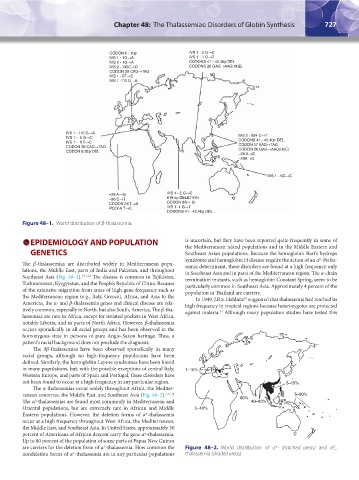
                  Figure 48–1.  World distribution of β-thalassemia.


                       EPIDEMIOLOGY AND POPULATION                      is uncertain, but they have been reported quite frequently in some of
                                                                        the Mediterranean island populations and in the Middle Eastern and
                     GENETICS                                           Southeast Asian populations. Because the hemoglobin Bart’s hydrops
                                                                        syndrome and hemoglobin H disease require the action of an α -thalas-
                                                                                                                     0
                  The  β-thalassemias are distributed widely in Mediterranean popu-  semia determinant, these disorders are found at a high frequency only
                  lations, the Middle East, parts of India and Pakistan, and throughout   in Southeast Asia and in parts of the Mediterranean region. The α-chain
                  Southeast Asia (Fig. 48–1). 7,11,12  The disease is common in Tajikistan,   termination mutants, such as hemoglobin Constant Spring, seem to be
                  Turkmenistan, Kyrgyzstan, and the People’s Republic of China. Because   particularly common in Southeast Asia. Approximately 4 percent of the
                  of the extensive migration from areas of high gene frequency such as   population in Thailand are carriers.
                  the Mediterranean region (e.g., Italy, Greece), Africa, and Asia to the   In 1949, J.B.S. Haldane  suggested that thalassemia had reached its
                                                                                            13
                  Americas, the α- and β-thalassemia genes and clinical disease are rela-  high frequency in tropical regions because heterozygotes are protected
                  tively common, especially in North, but also South, America. The β-tha-  against malaria.  Although many population studies have tested this
                                                                                    13
                  lassemias are rare in Africa, except for isolated pockets in West Africa,
                  notably Liberia, and in parts of North Africa. However, β-thalassemia
                  occurs sporadically in all racial groups and has been observed in the
                  homozygous state in persons of pure Anglo-Saxon heritage. Thus, a
                  patient’s racial background does not preclude the diagnosis.
                     The  δβ-thalassemias have been observed sporadically in many
                  racial groups, although no high-frequency populations have been
                  defined. Similarly, the hemoglobin Lepore syndromes have been found
                  in many populations, but, with the possible exceptions of central Italy,   1–15%
                  Western Europe, and parts of Spain and Portugal, these disorders have
                  not been found to occur at a high frequency in any particular region.                   5–15%
                     The α-thalassemias occur widely throughout Africa, the Mediter-
                  ranean countries, the Middle East, and Southeast Asia (Fig. 48–2). 7,11,12                 5–80%
                  The α -thalassemias are found most commonly in Mediterranean and         60%  40–80%
                      0
                  Oriental populations, but are extremely rare in African and Middle   5–40%
                  Eastern populations. However, the deletion forms of  α -thalassemia
                                                           +
                  occur at a high frequency throughout West Africa, the Mediterranean,
                  the Middle East, and Southeast Asia. In United States, approximately 30
                  percent of Americans of African descent carry the gene α -thalassemia.
                                                           +
                  Up to 80 percent of the population of some parts of Papua New Guinea
                  are carriers for the deletion form of α -thalassemia. How common the   Figure 48–2.  World distribution of  α -  (hatched areas) and  α _
                                                                                                       +
                                                                                                                          0
                                             +
                  nondeletion forms of α -thalassemia are in any particular populations   thalassemia (shaded areas).
                                   +


          Kaushansky_chapter 48_p0725-0758.indd   727                                                                   9/18/15   2:57 PM

