


Page 757 - Williams Hematology ( PDFDrive )
P. 757
732            Part VI:  The Erythrocyte                                                                                                                    Chapter 48:  The Thalassemias: Disorders of Globin Synthesis           733


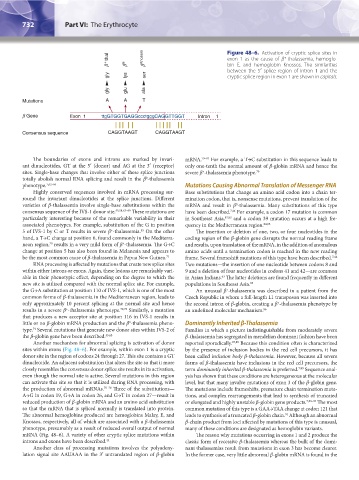
                                                                                    Figure 48–6.  Activation of cryptic splice sites in
                                                                                    exon 1 as the cause of  β -thalassemia, hemoglo-
                                                                                                       +
                                                                                    bin E, and hemoglobin Knossos.  The similarities
                                                                                    between the 5′ splice region of intron 1 and the
                                                                                    cryptic splice region in exon 1 are shown in capitals.


                   The boundaries of exons and introns are marked by invari-  mRNA. 79–81  For example, a T→C substitution in this sequence leads to
               ant dinucleotides, GT at the 5′ (donor) and AG at the 3′ (receptor)   only one-tenth the normal amount of β-globin mRNA and hence the
               sites. Single-base changes that involve either of these splice junctions   severe β -thalassemia phenotype. 79
                                                                            +
                                                         0
               totally abolish normal RNA splicing and result in the β -thalassemia
               phenotype. 7,62–66                                     Mutations Causing Abnormal Translation of Messenger RNA
                   Highly conserved sequences involved in mRNA processing sur-  Base substitutions that change an amino acid codon into a chain ter-
               round the invariant dinucleotides at the splice junctions. Different   mination codon, that is, nonsense mutations, prevent translation of the
               varieties of β-thalassemia involve single-base substitutions within the   mRNA and result in  β -thalassemia. Many substitutions of this type
                                                                                       0
               consensus sequence of the IVS-1 donor site. 55,58,63–69  These mutations are   have been described.  For example, a codon 17 mutation is common
                                                                                     7,44
               particularly interesting because of the remarkable variability in their   in Southeast Asia, 82,83  and a codon 39 mutation occurs at a high fre-
               associated phenotypes. For example, substitution of the G in position   quency in the Mediterranean region. 84,85
                                             +
               5 of IVS-1 by C or T results in severe β -thalassemia.  On the other   The insertion or deletion of one, two, or four nucleotides in the
                                                       55
               hand, a T→C change at position 6, found commonly in the Mediterra-  coding region of the β-globin gene disrupts the normal reading frame
               nean region,  results in a very mild form of β -thalassemia. The G→C   and results, upon translation of the mRNA, in the addition of anomalous
                        70
                                                 +
               change at position 5 has also been found in Melanesia and appears to   amino acids until a termination codon is reached in the new reading
               be the most common cause of β-thalassemia in Papua New Guinea. 71  frame. Several frameshift mutations of this type have been described.
                                                                                                                       7,44
                   RNA processing is affected by mutations that create new splice sites   Two mutations—the insertion of one nucleotide between codons 8 and
               within either introns or exons. Again, these lesions are remarkably vari-  9 and a deletion of four nucleotides in codons 41 and 42—are common
               able in their phenotypic effect, depending on the degree to which the   in Asian Indians.  The latter deletions are found frequently in different
                                                                                  63
               new site is utilized compared with the normal splice site. For example,   populations in Southeast Asia. 83
               the G→A substitution at position 110 of IVS-1, which is one of the most   An unusual  β -thalassemia was described in a patient from the
                                                                                    +
               common forms of β-thalassemia in the Mediterranean region, leads to   Czech Republic in whom a full-length L1 transposon was inserted into
               only approximately 10 percent splicing at the normal site and hence   the second intron of β-globin, creating a β -thalassemia phenotype by
                                                                                                     +
               results in a severe β -thalassemia phenotype. 72,73  Similarly, a mutation   an undefined molecular mechanism. 86
                              +
               that produces a new acceptor site at position 116 in IVS-1 results in
               little or no β-globin mRNA production and the β -thalassemia pheno-  Dominantly Inherited β-Thalassemia
                                                   0
               type.  Several mutations that generate new donor sites within IVS-2 of   Families in which a picture indistinguishable from moderately severe
                   74
               the β-globin gene have been described. 55,68           β-thalassemia has segregated in mendelian dominant fashion have been
                   Another mechanism for abnormal splicing is activation of donor   reported sporadically. 87,88  Because this condition often is characterized
               sites within exons (Fig. 48–6). For example, within exon 1 is a cryptic   by the presence of inclusion bodies in the red cell precursors, it has
               donor site in the region of codons 24 through 27. This site contains a GT   been called inclusion body β-thalassemia. However, because all severe
               dinucleotide. An adjacent substitution that alters the site so that it more   forms of β-thalassemia have inclusions in the red cell precursors, the
               closely resembles the consensus donor splice site results in its activation,   term dominantly inherited β-thalassemia is preferred.  Sequence anal-
                                                                                                            7,89
               even though the normal site is active. Several mutations in this region   ysis has shown that these conditions are heterogeneous at the molecular
               can activate this site so that it is utilized during RNA processing, with   level, but that many involve mutations of exon 3 of the β-globin gene.
               the production of abnormal mRNAs. 75–78  Three of the substitutions—  The mutations include frameshifts, premature chain termination muta-
               A→G in codon 19, G→A in codon 26, and G→T in codon 27—result in   tions, and complex rearrangements that lead to synthesis of truncated
               reduced production of β-globin mRNA and an amino acid substitution   or elongated and highly unstable β-globin gene products. 7,89–93  The most
               so that the mRNA that is spliced normally is translated into protein.   common mutation of this type is a GAA→TAA change at codon 121 that
               The abnormal hemoglobins produced are hemoglobins Malay, E, and   leads to synthesis of a truncated β-globin chain.  Although an abnormal
                                                                                                       94
               Knossos, respectively, all of which are associated with a β-thalassemia   β-chain product from loci affected by mutations of this type is unusual,
               phenotype, presumably as a result of reduced overall output of normal   many of these conditions are designated as hemoglobin variants.
               mRNA (Fig. 48–6). A variety of other cryptic splice mutations within   The reason why mutations occurring in exons 1 and 2 produce the
               introns and exons have been described. 44              classic form of recessive β-thalassemia whereas the bulk of the domi-
                   Another class of processing mutations involves the polyadeny-  nant thalassemias result from mutations in exon 3 has become clearer.
               lation signal site AAUAAA in the 3′ untranslated region of β-globin   In the former case, very little abnormal β-globin mRNA is found in the


          Kaushansky_chapter 48_p0725-0758.indd   732                                                                   9/18/15   2:57 PM

