


Page 754 - Williams Hematology ( PDFDrive )
P. 754
728  Part VI:  The Erythrocyte                 Chapter 48:  The Thalassemias: Disorders of Globin Synthesis           729


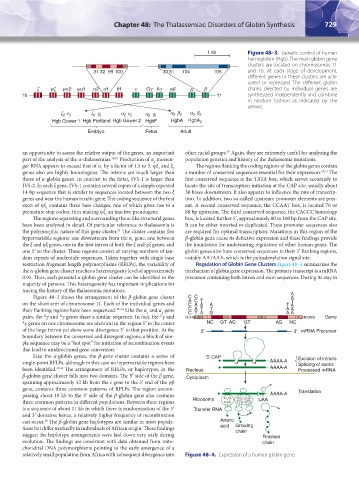
                                                                                             Figure 48–3.  Genetic control of human
                                                                                             hemoglobin (Hgb). The main globin gene
                                                                                             clusters are located on chromosomes 11
                                                                                             and  16.  At  each  stage  of  development,
                                                                                             different genes in these clusters are acti-
                                                                                             vated or repressed.  The different globin
                                                                                             chains directed by individual genes are
                                                                                             synthesized independently and combine
                                                                                             in random fashion as indicated by the
                                                                                             arrows.


                                                                                      39
                  an opportunity to assess the relative output of the genes, an important   other racial groups.  Again, they are extremely useful for analyzing the
                  part of the analysis of the α-thalassemias. 30,31  Production of α  messen-  population genetics and history of the thalassemia mutations.
                                                              2
                  ger RNA appears to exceed that of α  by a factor of 1.5 to 3. ψξ  and ξ    The regions flanking the coding regions of the globin genes contain
                                                               1
                                                                    2
                                            1
                  genes also are highly homologous. The introns are much larger than   a number of conserved sequences essential for their expression. 28,33  The
                  those of α-globin genes. In contrast to the latter, IVS-1 is larger than   first conserved sequence is the TATA box, which serves accurately to
                  IVS-2. In each ξ gene, IVS-1 contains several copies of a simple repeated   locate the site of transcription initiation at the CAP site, usually about
                  14-bp sequence that is similar to sequences located between the two ξ   30 bases downstream. It also appears to influence the rate of transcrip-
                  genes and near the human insulin gene. The coding sequence of the first   tion. In addition, two so-called upstream promoter elements are pres-
                  exon of ψξ  contains three base changes, one of which gives rise to a   ent. A second conserved sequence, the CCAAT box, is located 70 or
                          1
                  premature stop codon, thus making ψξ  an inactive pseudogene.  80 bp upstream. The third conserved sequence, the CACCC homology
                                              1
                     The regions separating and surrounding the α-like structural genes   box, is located further 5′, approximately 80 to 100 bp from the CAP site.
                  have been analyzed in detail. Of particular relevance to thalassemia is   It can be either inverted or duplicated. These promoter sequences also
                  the polymorphic nature of this gene cluster.  The cluster contains five   are required for optimal transcription. Mutations in this region of the
                                                  32
                  hypervariable regions: one downstream from the α  gene, one between   β-globin gene cause its defective expression and these findings provide
                                                       1
                  the ξ and ψξ genes, one in the first intron of both the ξ and ψξ genes, and   the foundation for understating regulation of other human genes. The
                  one 5′ to the cluster. These regions consist of varying numbers of tan-  globin genes also have conserved sequences in their 3′ flanking regions,
                  dem repeats of nucleotide sequences. Taken together with single-base   notably AATAAA, which is the polyadenylation signal site.
                  restriction fragment length polymorphisms (RFLPs), the variability of   Regulation of Globin Gene Clusters Figure 48–4 summarizes the
                  the α-globin gene cluster reaches a heterozygosity level of approximately   mechanism of globin gene expression. The primary transcript is a mRNA
                  0.95. Thus, each parental α-globin gene cluster can be identified in the   precursor containing both intron and exon sequences. During its stay in
                  majority of persons. This heterogeneity has important implications for
                  tracing the history of the thalassemia mutations.
                     Figure  48–3 shows the arrangement of the β-globin gene cluster   C C                  A
                                                                                                            A
                                                                                                            T
                  on the short arm of chromosome 11. Each of the individual genes and   A C T  A          T A
                                                                         C A A
                  their flanking regions have been sequenced. 33–36  Like the α  and α  gene   C A T  T   A A
                                                                         C T A
                                                                                                          A A
                                                                                 G
                                                           1
                                                                 2
                  pairs, the  γ and  γ genes share a similar sequence. In fact, the  γ and   FLANKING  IVS-1  IVS-2  FLANKING  Gene
                                                                G
                              A
                         G
                  A γ genes on one chromosome are identical in the region 5′ to the center   NC  GT AG  GT  AG  NC
                  of the large intron yet show some divergence 3′ to that position. At the   5′              3′ mRNA Precursor
                  boundary between the conserved and divergent regions, a block of sim-
                  ple sequence may be a “hot spot” for initiation of recombination events
                  that lead to unidirectional gene conversion.
                     Like the  α-globin genes, the  β-gene cluster contains a series of    5′ CAP             Excision of introns
                  single-point RFLPs, although in this case no hypervariable regions have            AAAA-A   Splicing of exons
                  been identified. 37,38  The arrangement of RFLPs, or haplotypes, in the   Nucleus  AAAA-A   Processed mRNA
                  β-globin gene cluster falls into two domains. The 5′ side of the β gene,   Cytoplasm
                  spanning approximately 32 kb from the ε gene to the 3′ end of the ψβ
                  gene, contains three common patterns of RFLPs. The region encom-                            Translation
                  passing about 18 kb to the 3′ side of the β-globin gene also contains   A U G      AAAA-A
                                                                                          U GC
                  three common patterns in different populations. Between these regions   Ribosome  U AC  A C G UUC  UAA
                                                                                            AAG
                  is a sequence of about 11 kb in which there is randomization of the 5′   Transfer RNA
                  and 3′ domains; hence, a relatively higher frequency of recombination
                  can occur.  The β-globin gene haplotypes are similar in most popula-  Amino
                         38
                  tions but differ markedly in individuals of African origin. These findings   acid  Growing
                  suggest the haplotype arrangements were laid down very early during    chain    Finished
                  evolution. The findings are consistent with data obtained from mito-            chain
                  chondrial DNA polymorphisms pointing to the early emergence of a
                  relatively small population from Africa with subsequent divergence into   Figure 48–4.  Expression of a human globin gene.
          Kaushansky_chapter 48_p0725-0758.indd   729                                                                   9/18/15   2:57 PM

