


Page 756 - Williams Hematology ( PDFDrive )
P. 756
730  Part VI:  The Erythrocyte                 Chapter 48:  The Thalassemias: Disorders of Globin Synthesis           731


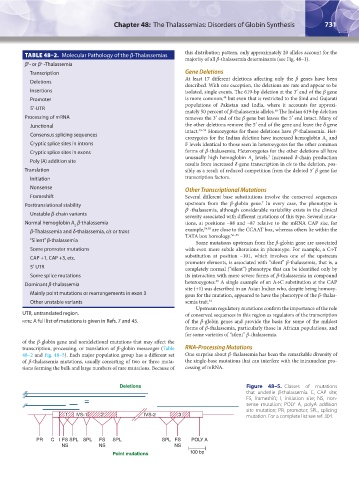
                   TABLE 48–2.  Molecular Pathology of the β-Thalassemias  this distribution pattern, only approximately 20 alleles account for the
                                                                        majority of all β-thalassemia determinants (see Fig. 48–1).
                   β - or β  -Thalassemia
                        +
                    0
                     Transcription                                      Gene Deletions
                                                                        At least 17 different deletions affecting only the  β genes have been
                     Deletions
                                                                        described. With one exception, the deletions are rare and appear to be
                     Insertions                                         isolated, single events. The 619-bp deletion at the 3′ end of the β gene
                                                                                     48
                     Promoter                                           is more common,  but even that is restricted to the Sind and Gujarati
                                                                        populations of Pakistan and India, where it accounts for approxi-
                     5′-UTR
                                                                                                      48
                                                                        mately 50 percent of β-thalassemia alleles.  The Indian 619-bp deletion
                   Processing of mRNA                                   removes the 3′ end of the β gene but leaves the 5′ end intact. Many of
                     Junctional                                         the other deletions remove the 5′ end of the gene and leave the δ gene
                                                                        intact. 49–53  Homozygotes for these deletions have β -thalassemia. Het-
                                                                                                              0
                     Consensus splicing sequences
                                                                        erozygotes for the Indian deletion have increased hemoglobin A  and
                                                                                                                        2
                     Cryptic splice sites in introns                    F levels identical to those seen in heterozygotes for the other common
                     Cryptic splice sites in exons                      forms of β-thalassemia. Heterozygotes for the other deletions all have
                                                                        unusually high  hemoglobin A  levels.  Increased  δ-chain production
                                                                                                    7
                     Poly (A) addition site                                                    2
                                                                        results from increased δ-gene transcription in cis to the deletion, pos-
                   Translation                                          sibly as a result of reduced competition from the deleted 5′ β gene for
                     Initiation                                         transcription factors.
                     Nonsense                                           Other Transcriptional Mutations
                     Frameshift                                         Several different base substitutions involve the conserved sequences
                                                                                                  7
                   Posttranslational stability                          upstream from the  β-globin gene.  In every case, the phenotype is
                                                                         +
                                                                        β -thalassemia, although considerable variability exists in the clinical
                     Unstable β-chain variants
                                                                        severity associated with different mutations of this type. Several muta-
                   Normal hemoglobin A  β-thalassemia                   tions, at positions –88 and –87 relative to the mRNA CAP site, for
                                   2
                     β-Thalassemia and δ-thalassemia, cis or trans      example, 54,55  are close to the CCAAT box, whereas others lie within the
                                                                        TATA box homology. 56–59
                     “Silent” β-thalassemia
                                                                            Some mutations upstream from the β-globin gene are associated
                     Some promoter mutations                            with even more subtle alterations in phenotype. For example, a C→T
                     CAP +1, CAP +3, etc.                               substitution at position –101, which involves one of the upstream
                                                                        promoter elements, is associated with “silent” β-thalassemia, that is, a
                     5′ UTR                                             completely normal (“silent”) phenotype that can be identified only by
                     Some splice mutations                              its interaction with more severe forms of β-thalassemia in compound
                                                                                   60
                   Dominant β-thalassemia                               heterozygotes.  A single example of an A→C substitution at the CAP
                                                                        site (+1) was described in an Asian Indian who, despite being homozy-
                     Mainly point mutations or rearrangements in exon 3  gous for the mutation, appeared to have the phenotype of the β-thalas-
                     Other unstable variants                            semia trait. 61
                                                                            Upstream regulatory mutations confirm the importance of the role
                  UTR, untranslated region.                             of conserved sequences in this region as regulators of the transcription
                  note: A full list of mutations is given in Refs. 7 and 45.  of the  β-globin genes and provide the basis for some of the mildest
                                                                        forms of β-thalassemia, particularly those in African populations, and
                                                                        for some varieties of “silent” β-thalassemia.
                  of the β-globin gene and nondeletional mutations that may affect the
                  transcription, processing, or translation of β-globin messenger (Table   RNA-Processing Mutations
                  48–2 and Fig. 48–5). Each major population group has a different set   One surprise about β-thalassemia has been the remarkable diversity of
                  of β-thalassemia mutations, usually consisting of two or three muta-  the single-base mutations that can interfere with the intranuclear pro-
                  tions forming the bulk and large numbers of rare mutations. Because of   cessing of mRNA.

                                                  Deletions                                  Figure 48–5.  Classes of mutations
                                                                                             that underlie  β-thalassemia. C, CAP site;
                                                                                             FS, frameshift; I, initiation site; NS, non-
                                                                                             sense mutation; POLY A, polyA addition
                                                                                             site  mutation; PR,  promoter;  SPL,  splicing
                                1   IVS-1   2              IVS-2      3                      mutation. For a complete list see ref. 304.


                      PR   CI FS SPL SPL    FS  SPL              SPL  FS  POLY A
                               NS          NS                        NS
                                                Point mutations           100 bp


          Kaushansky_chapter 48_p0725-0758.indd   731                                                                   9/18/15   2:57 PM

