


Page 78 - Williams Hematology ( PDFDrive )
P. 78
54             Part II:  The Organization of the Lymphohematopoietic Tissues                                                              Chapter 5:  Structure of the Marrow and the Hematopoietic Microenvironment                55


                                                                                                                        32
                             Prenatal            Postnatal            display a specific integrin (Mac-1) that is not found in marrow HSCs.
                    Cellularity                                       In the last third of gestation, the HSCs and early hematopoietic pro-
                     (%)
                                                                      genitor cells migrate from the fetal liver through the circulation seed-
                     100          Bone
                          Yolk sac                                    ing the spleen and marrow. Fetal liver hematopoiesis declines steadily
                                  marrow
                      80       Liver                   Vertebra       as the spleen and marrow become the major hematopoietic sites. At
                                                                      birth, the marrow is the major hematopoietic site in humans, while the
                      60                               Sternum        spleen remains a prominent but decreasing site in the mouse (Chap. 7).
                                                                          Visceral endoderm is in close proximity to the mesoderm formed
                      40
                             Spleen      Tibia            Rib         by gastrulation in those sites where HSCs are generated in the embryo.
                      20                      Femur                   This proximity is important in that the endoderm appears to induce
                                                                      both endothelial and blood cell development in the adjacent mesoderm
                      0
                         12 34 56 78 9   10  20  30  40  50  60  70   through secretion of Indian hedgehog (IHH), a member of the hedge-
                                       Birth
                                                                                       33
                            Fetal months         Age in years         hog family of proteins.  IHH, in turn, upregulates the expression of
                                                                      BMP4 in the developing mesodermal cells.  BMP4 upregulation is
                                                                                                       33
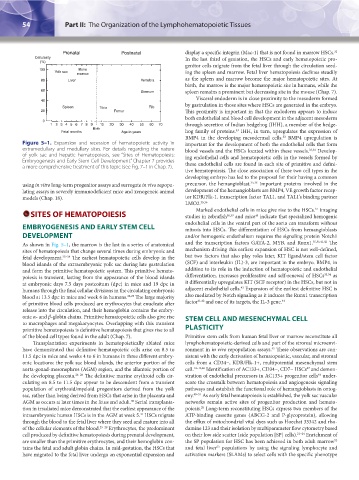
               Figure 5–1.  Expansion and recession of hematopoietic activity in   important for the development of both the endothelial cells that form
               extramedullary and medullary sites. For details regarding the nature   blood vessels and the HSCs located within these vessels. 33,34  Develop-
               of yolk sac and hepatic hematopoiesis, see “Sites of Hematopoiesis:   ing endothelial cells and hematopoietic cells in the vessels formed by
               Embryogenesis and Early Stem Cell Development.” Chapter 7 provides   these endothelial cells are found in each site of primitive and defini-
               a more comprehensive treatment of this topic (see Fig. 7–1 in Chap. 7).
                                                                      tive hematopoiesis. The close association of these two cell types in the
                                                                      developing embryo has led to the proposal for their having a common
               using in vitro long-term progenitor assays and surrogate in vivo repopu-  precursor,  the  hemangioblast. 35,36   Important  proteins  involved  in  the
               lating assays in severely immunodeficient mice and xenogeneic animal   development of the hemangioblasts are BMP4, VE growth factor recep-
               models (Chap. 18).                                     tor KDR/Flk-1, transcription factor TAL1, and TAL1’s binding partner
                                                                      LMO2. 35,36
                                                                                                                  37
                                                                          Marked endothelial cells in mice give rise to the HSCs.  Imaging
                  SITES OF HEMATOPOIESIS                              studies in zebrafish 38,39  and mice  indicate that specialized hemogenic
                                                                                              40
               EMBRYOGENESIS AND EARLY STEM CELL                      endothelial cells in the ventral part of the aorta can transform without
                                                                      mitosis into HSCs. The differentiation of HSCs from hemangioblasts
               DEVELOPMENT                                            and/or hemogenic endothelium requires the signaling protein Notch1
               As shown in Fig. 5–1, the marrow is the last in a series of anatomical   and the transcription factors GATA-2, MYB, and Runx1. 35,36,41,42  The
               sites of hematopoiesis that change several times during embryonic and   mechanism driving this earliest expansion of HSC is not well-defined,
               fetal development. 25–28  The earliest hematopoietic cells develop in the   but two factors that also play roles later, KIT ligand/stem cell factor
               blood islands of the extraembryonic yolk sac during late gastrulation   (SCF) and interleukin (IL)-3, are important in the embryo. BMP4, in
               and form the primitive hematopoietic system. This primitive hemato-  addition to its role in the induction of hematopoietic and endothelial
               poiesis is transient, lasting from the appearance of the blood islands   differentiation, increases proliferative and self-renewal of HSCs 33,34  as
               at embryonic days 7.5 days postcoitum (dpc) in mice and 19 dpc in   it differentially upregulates KIT (SCF receptor) in the HSCs, but not in
                                                                                         43
               humans through the final cellular divisions in the circulating embryonic   adjacent endothelial cells.  Expansion of the earliest definitive HSC is
               blood at 13.5 dpc in mice and week 6 in humans. 28,29  The large majority   also mediated by Notch signaling as it induces the Runx1 transcription
               of primitive blood cells produced are erythrocytes that enucleate after   factor 41,42  and one of its targets, the IL-3 gene. 44
               release into the circulation, and their hemoglobin contains the embry-
               onic α- and β-globin chains. Primitive hematopoietic cells also give rise   STEM CELL AND MESENCHYMAL CELL
               to macrophages and megakaryocytes. Overlapping with this transient
               primitive hematopoiesis is definitive hematopoiesis that gives rise to all   PLASTICITY
               of the blood cell types found in the adult (Chap. 7).  Primitive stem cells from human fetal liver or marrow reconstitute all
                   Transplantation experiments in hematopoietically ablated mice   lymphohematopoietic-derived cells and part of the stromal microenvi-
               have demonstrated that definitive hematopoietic cells arise on 8.5 to   ronment in in vivo repopulation assays.  These observations are con-
                                                                                                   45
               11.5 dpc in mice and weeks 4 to 6 in humans in three different embry-  sistent with the early derivation of hematopoietic, vascular, and stromal
               onic locations: the yolk sac blood islands, the anterior portion of the   cells from a CD34−, KDR/Flk-1+, multipotential mesenchymal stem
                                                                                                               47
               aorta-gonad-mesonephros (AGM) region, and the allantoic portion of   cell. 14–16,46  Identification of AC133+, CD34−, CD7− HSCs  and demon-
                                                                                                                   48
               the developing placenta. 26–28  The definitive murine erythroid cells cir-  stration of endothelial precursors in AC133+ progenitor cells  under-
               culating on 8.5 to 11.5 dpc appear to be descendent from a transient   score the crosstalk between hematopoiesis and angiogenesis signaling
               population of erythroid/myeloid progenitors derived from the yolk   pathways and establish the functional role of hemangioblasts in ontog-
               sac, rather than being derived from HSCs that arise in the placenta and   eny. 49–51  As early fetal hematopoiesis is established, the yolk sac vascular
               AGM as occurs at later times in the fetus and adult.  Serial transplanta-  networks remain active sites of progenitor production and hemato-
                                                    30
                                                                           28
               tion in irradiated mice demonstrated that the earliest appearance of the   poiesis.  Long-term reconstituting HSCs express two members of the
               intraembryonic human HSCs is in the AGM at week 5.  HSCs migrate   ATP-binding cassette genes (ABCG-2 and P-glycoprotein), allowing
                                                       31
               through the blood to the fetal liver where they seed and mature into all   the efflux of mitochondrial vital dyes such as Hoechst 33342 and rho-
               of the cellular elements of the blood. 25–28  Erythrocytes, the predominant   damine 123 and their isolation by multiparameter flow cytometry based
               cell produced by definitive hematopoiesis during prenatal development,   on their low side scatter (side population [SP] cells). 21–24  Enrichment of
                                                                                                                        52
               are smaller than the primitive erythrocytes, and their hemoglobin con-  the SP population for HSC has been achieved in both adult marrow
               tains the fetal and adult globin chains. In mid-gestation, the HSCs that   and fetal liver  populations by using the signaling lymphocyte and
                                                                                 53
               have migrated to the fetal liver undergo an exponential expansion and   activation markers (SLAMs) to select cells with the specific phenotype


          Kaushansky_chapter 05_p0051-0084.indd   54                                                                    9/19/15   12:10 AM

