


Page 83 - Williams Hematology ( PDFDrive )
P. 83
58  Part II:  The Organization of the Lymphohematopoietic Tissues  Chapter 5:  Structure of the Marrow and the Hematopoietic Microenvironment  59


                  expressing leptin receptors. 115,134  The human  equivalents  are a popu-  Adipocytes
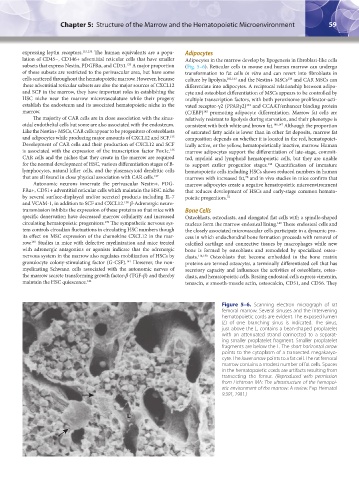
                  lation of CD45−, CD146+ adventitial reticular cells that have smaller   Adipocytes in the marrow develop by lipogenesis in fibroblast-like cells
                  subsets that express Nestin, PDGFRα, and CD51.  A major proportion   (Fig. 5–6). Reticular cells in mouse and human marrow can undergo
                                                     133
                  of these subsets are restricted to the perivascular area, but have some   transformation to fat cells  in vitro and can revert into fibroblasts in
                  cells scattered throughout the hematopoietic marrow. However, because   culture by lipolysis, 101,143  and the Nestin+ MSCs  and CAR MSCs can
                                                                                                           138
                  these adventitial reticular subsets are also the major sources of CXCL12   differentiate into adipocytes. A reciprocal relationship between adipo-
                  and SCF in the marrow, they have important roles in establishing the   cyte and osteoblast differentiation of MSCs appears to be controlled by
                  HSC niche near the marrow microvasculature while their progeny   multiple transcription factors, with both peroxisome proliferator-acti-
                  establish the endosteum and its associated hematopoietic niche in the     vated receptor-γ2 (PPARγ2)  and CCAAT/enhancer binding protein
                                                                                             144
                  marrow.                                               (C/EBP)  promoting adipocyte differentiation. Marrow fat cells are
                                                                               145
                     The majority of CAR cells are in close association with the sinus-  relatively resistant to lipolysis during starvation, and their phenotype is
                  oidal endothelial cells but some are also associated with the endosteum.   consistent with both white and brown fat. 146,147  Although the proportion
                  Like the Nestin+ MSCs, CAR cells appear to be progenitors of osteoblasts   of saturated fatty acids is lower than in other fat deposits, marrow fat
                                                                   135
                  and adipocytes while producing major amounts of CXCL12 and SCF.    composition depends on whether it is located in the red, hematopoiet-
                  Development of CAR cells and their production of CXCL12 and SCF   ically active, or the yellow, hematopoietically inactive, marrow. Human
                                                                   136
                  is associated with the expression of the transcription factor Fox1c.    marrow adipocytes support the differentiation of late-stage, commit-
                  CAR cells and the niches that they create in the marrow are required   ted,  myeloid  and  lymphoid  hematopoietic  cells,  but  they  are  unable
                  for the normal development of HSC, various differentiation stages of B-   to support earlier progenitor stages.  Quantification of immature
                                                                                                    148
                  lymphocytes, natural killer cells, and the plasmacytoid dendritic cells   hematopoietic cells including HSCs shows reduced numbers in human
                  that are all found in close physical association with CAR cells. 137  marrows with increased fat,  and in vivo studies in mice confirm that
                                                                                             70
                     Autonomic  neurons  innervate  the  perivascular  Nestin+,  PDG-  marrow adipocytes create a negative hematopoietic microenvironment
                  FRα+, CD51+ adventitial reticular cells which maintain the HSC niche   that reduces development of HSCs and early-stage common hemato-
                  by several surface-displayed and/or secreted products including IL-7   poietic progenitors. 72
                                                    138
                  and VCAM-1, in addition to SCF and CXCL12.  β-Adrenergic neuro-
                  transmission inhibits the expression of these proteins so that mice with   Bone Cells
                  specific denervation have decreased marrow cellularity and increased   Osteoblasts, osteoclasts, and elongated flat cells with a spindle-shaped
                                             139
                  circulating hematopoietic progenitors.  The sympathetic nervous sys-  nucleus form the marrow endosteal lining.  These endosteal cells and
                                                                                                       149
                  tem controls circadian fluctuations in circulating HSC numbers though   the closely associated microvascular cells participate in a dynamic pro-
                  its effect on MSC expression of the chemokine CXCL12 in the mar-  cess in which endochondral bone formation proceeds with removal of
                     140
                  row.  Studies in mice with defective myelinization and mice treated   calcified cartilage and connective tissues by macrophages while new
                  with adrenergic antagonists or agonists indicate that the adrenergic   bone is formed by osteoblasts and remodeled by specialized osteo-
                  nervous system in the marrow also regulates mobilization of HSCs by   clasts. 114,150  Osteoblasts that become embedded in the bone matrix
                  granulocyte colony-stimulating factor (G-CSF).  However, the non-  proteins are termed osteocytes, a terminally differentiated cell that has
                                                     141
                  myelinating Schwann cells associated with the autonomic nerves of   secretory  capacity  and  influences  the  activities  of  osteoblasts,  osteo-
                  the marrow secrete transforming growth factor-β (TGF-β) and thereby   clasts, and hematopoietic cells. Resting endosteal cells express vimentin,
                  maintain the HSC quiescence. 142                      tenascin, α smooth-muscle actin, osteocalcin, CD51, and CD56. They

                                                                                     Figure 5–6.  Scanning electron micrograph of rat
                                                                                     femoral marrow. Several sinuses and the intervening
                                                                                     hematopoietic cords are evident. The exposed lumen
                                                                                     (L) of one branching sinus is indicated.  The sinus,
                                                                                     just above the L, contains a bean-shaped proplatelet
                                                                                     with an attenuated strand connected to a separat-
                                                                                     ing smaller proplatelet fragment. Smaller proplatelet
                                                                                     fragments are below the L. The short horizontal arrow
                                                                                     points to the cytoplasm of a transected megakaryo-
                                                                                     cyte. The lower arrow points to a fat cell. The rat femoral
                                                                                     marrow contains a modest number of fat cells. Spaces
                                                                                     in the hematopoietic cords are artifacts resulting from
                                                                                     transecting the femur.  (Reproduced with permission
                                                                                     from Lichtman MA: The ultrastructure of the hemopoi-
                                                                                     etic environment of the marrow: A review. Exp Hematol
                                                                                     9:391, 1981.)


                                                     L


          Kaushansky_chapter 05_p0051-0084.indd   59                                                                    9/19/15   12:10 AM

