


Page 80 - Williams Hematology ( PDFDrive )
P. 80
56             Part II:  The Organization of the Lymphohematopoietic Tissues                                                              Chapter 5:  Structure of the Marrow and the Hematopoietic Microenvironment                57


                               Periosteal artery                      highly innervated along the arterioles and less frequently along capillar-
                                             Periosteal capillaries   ies, where neurologic control of blood flow and angiogenesis appear to
                                                                      be mediated via neurokinin A and substance P. 86

                                                        Cortex
                                                                      SINUS ARCHITECTURE, NONHEMATOPOIETIC
                                                       Venous         CELL ORGANIZATION AND NICHE FORMATION
                    Radial                             sinuses
                    branches                                          In mammals, hematopoiesis occurs in the extravascular spaces between
                                                       Hemopoietic
                                                       spaces         marrow sinuses. The marrow sinus wall is composed of a luminal layer
                                                                      of endothelial cells and an abluminal coat of adventitial reticular cells,
                                                 Central sinus
                                                                      which forms an incomplete outer lining (Fig. 5–3). A thin, interrupted
                                                                      basement lamina is present between the cell layers. Circulating HSCs
                                                                      move across the sinus endothelium into the extravascular space where
                                                                      they proliferate and differentiate into mature cells, which move across
                            Central artery                            the sinus endothelium and circulate in the blood. Nonhematopoietic
                                                                      cells and extracellular matrix in the extravascular space form the mar-
                                                                      row stroma. Stromal cells obtained from animal or human marrow can
                                                                                      87
                                                                      be studied in cultures,  are derived from fibroblasts, and have unique
                                                                      phenotypic and functional characteristics that allow them to nurture
                                                                      hematopoietic development in highly specialized microenvironmental
                     Emissary vein              Nutrient artery
                                                                      niches.  However, newer studies with mutant mice and mice with spe-
                                                                           88
                                                                                                                    89
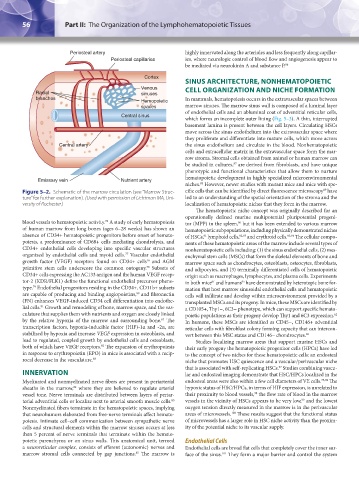
               Figure 5–2.  Schematic of the marrow circulation (see “Marrow Struc-  cific cells that can be identified by direct fluorescence microscopy  have
               ture” for further explanation). (Used with permission of Lichtman MA, Uni-  led to an understanding of the spatial orientation of the stroma and the
               versity of Rochester.)                                 localization of hematopoietic niches that they form in the marrow.
                                                                          The hematopoietic niche concept was originally described for an
                                                                      operationally defined murine multipotential pluripotential progeni-
               blood vessels to hematopoietic activity.  A study of early hematopoiesis   tor (MPP) in the spleen,  but it has been extended to various marrow
                                           76
                                                                                        90
               of human marrow from long bones (ages 6–28 weeks) has shown an   hematopoietic subpopulations, including physically demonstrated niches
               absence of CD34+ hematopoietic progenitors before onset of hemato-  of HSCs,  lymphoid cells, 92,93  and erythroid cells. 93,94  The cellular compo-
                                                                            91
               poiesis, a predominance of CD68+ cells mediating chondrolysis, and   nents of these hematopoietic areas of the marrow include several types of
               CD34+ endothelial cells developing into specific vascular structures   nonhematopoietic cells including: (1) the sinus endothelial cells, (2) mes-
               organized by endothelial cells and myoid cells.  Vascular endothelial   enchymal stem cells (MSCs) that form the skeletal elements of bone and
                                                  77
               growth  factor  (VEGF)  receptors  found on  CD34+  cells   and  AGM   marrow space such as chondrocytes, osteoblasts, osteocytes, fibroblasts,
                                                         16
               primitive stem cells underscore the common ontogeny.  Subsets of   and adipocytes, and (3) terminally differentiated cells of hematopoietic
                                                         78
               CD34+ cells expressing the AC133 antigen and the human VEGF recep-  origin such as macrophages, lymphocytes, and plasma cells. Experiments
               tor-2 (KDR/FLK1) define the functional endothelial precursor pheno-  in both mice  and humans  have demonstrated by heterotopic bone for-
                                                                                         95
                                                                               61
               type.  Endothelial progenitors residing in the CD34+, CD11b+ subsets   mation that host marrow sinusoidal endothelial cells and hematopoietic
                   79
               are capable of producing and binding angiopoietins,  and fibronectin   cells will infiltrate and develop within microenvironment provided by a
                                                      80
               (FN) enhances VEGF-induced CD34 cell differentiation into endothe-  transplanted MSCs and its progeny. In mice, these MSCs are identified by
               lial cells.  Growth and remodeling of bone, marrow space, and the vas-  a CD105+, Thy1−, 6C3− phenotype, which can support specific hemato-
                      81
               culature that supplies them with nutrients and oxygen are closely linked   poietic populations as their progeny develop Thy1 and 6C3 expression.
                                                                                                                        62
               by the relative hypoxia of the marrow and surrounding bone.  The   In humans, these MSCs are identified as CD45−, CD146+ adventitial
                                                              82
               transcription factors, hypoxia-inducible factor (HIF)-1α and -2α, are   reticular cells with fibroblast colony forming capacity that can intercon-
               stabilized by hypoxia and increase VEGF expression in osteoblasts, and   vert between this MSC status and CD146− chondrocytes. 96
               lead to regulated, coupled growth by endothelial cells and osteoblasts,   Studies localizing marrow areas that support murine HSCs and
               both of which have VEGF receptors.  The expansion of erythropoiesis   their early progeny the hematopoietic progenitor cells (HPCs) have led
                                          82
               in response to erythropoietin (EPO) in mice is associated with a recip-  to the concept of two niches for these hematopoietic cells: an endosteal
               rocal decrease in the vasculature. 83                  niche that promotes HSC quiescence and a vascular/perivascular niche
                                                                                                     97
                                                                      that is associated with self-replicating HSCs.  Studies combining vascu-
               INNERVATION                                            lar and endosteal imaging demonstrate that HSC/HPCs localized in the
               Myelinated and nonmyelinated nerve fibers are present in periarterial   endosteal areas were also within a few cell diameters of VE cells. 75,98  The
               sheaths in the marrow,  where they are believed to regulate arterial   hypoxic status of HSC/HPCs, in terms of HIF expression, is unrelated to
                                 84
                                                                                             98
               vessel tone. Nerve terminals are distributed between layers of periar-  their proximity to blood vessels,  the flow rate of blood in the marrow
                                                                                                             99
               terial adventitial cells or localize next to arterial smooth muscle cells.    vessels in the vicinity of HSCs appears to be very low,  and the lowest
                                                                 85
               Nonmyelinated fibers terminate in the hematopoietic spaces, implying   oxygen tension directly measured in the marrow is in the perivascular
               that neurohumors elaborated from free-nerve terminals affect hemato-  areas of microvessels.  These results suggest that the functional status
                                                                                     100
               poiesis. Intimate cell–cell communication between sympathetic nerve   of microvessels has a larger role in HSC niche activity than the proxim-
               cells and structural elements within the marrow sinuses occurs at less   ity of the potential niche to its vascular supply.
               than 5 percent of nerve terminals that terminate within the hemato-
               poietic parenchyma or on sinus walls. This anatomical unit, termed   Endothelial Cells
               a neuroreticular complex, consists of efferent (autonomic) nerves and   Endothelial cells are broad flat cells that completely cover the inner sur-
               marrow stromal cells connected by gap junctions.  The marrow is   face of the sinus.  They form a major barrier and control the system
                                                     85
                                                                                  101
          Kaushansky_chapter 05_p0051-0084.indd   56                                                                    9/19/15   12:10 AM

