


Page 785 - Williams Hematology ( PDFDrive )
P. 785
760            Part VI:  The Erythrocyte                                                                                     Chapter 49:  Disorders of Hemoglobin Structure: Sickle Cell Anemia and Related Abnormalities          761


               or δ). The α-chains of all human Hbs encountered after early embryo-  molecules. Areas of contact between chains and between heme and glo-
               genesis are the same. The non-α chains include the β-chain of normal   bin tend to contain invariant residues. The non-α (β, γ, δ, or ε) chains
               adult Hb (α β ), the γ-chain of fetal Hb (α γ ), and the δ-chain of the   are all 146 amino acids in length. The γ-chain of fetal Hb (HbF) differs
                                               2 2
                        2 2
               minor adult Hb (HbA  [α δ ]), which accounts for 2.5 percent of the Hb   from the β-chain by 39 residues. The γ genes are duplicated: one codes
                               2
                                  2 2
                                                                               G
                                                                                                      7
               of normal adults. Chapter 48 discusses the regulation of production of   for glycine ( γ) and the other for alanine ( γ)  at residue 136, giving rise
                                                                                                    A
               the globin chains.                                     to two kinds of γ chains. In addition, a common polymorphism, the
                   Certain residues in the amino acid sequence of each polypeptide   substitution of threonine for isoleucine, is frequently found at residue
               chain appear to be critical to stability and function. Such residues are   75 of the  γ-chain.
                                                                             A
               usually the same (invariant) in α or β chains. The NH -terminal valines of   Approximately 75 percent of the amino acids in α and β chains are
                                                    2
               the β chains are important in 2,3-BPG interactions. The C-terminal res-  in a helical arrangement. All Hbs studied have a similar helical content
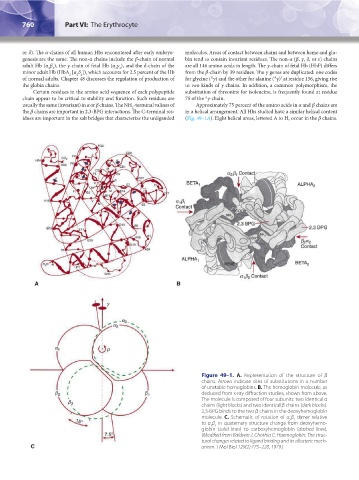
               idues are important in the salt bridges that characterize the unliganded   (Fig. 49–1A). Eight helical areas, lettered A to H, occur in the β chains.


                                                                           Figure  49–1.  A. Representation of the structure of  β
                                                                           chains. Arrows indicate sites of substitutions in a number
                                                                           of unstable hemoglobins. B. The hemoglobin molecule, as
                                                                           deduced from x-ray diffraction studies, shown from above.
                                                                           The molecule is composed of four subunits: two identical α
                                                                           chains (light blocks) and two identical β chains (dark blocks).
                                                                           2,3-BPG binds to the two β chains in the deoxyhemoglobin
                                                                           molecule. C. Schematic of rotation of α β  dimer relative
                                                                                                         2 2
                                                                           to α β  in quaternary structure change from deoxyhemo-
                                                                               1 1
                                                                           globin (solid  lines) to carboxyhemoglobin (dashed  lines).
                                                                           (Modified from Baldwin J, Chothia C: Haemoglobin: The struc-
                                                                           tural changes related to ligand binding and its allosteric mech-
                                                                           anism. J Mol Biol 129(2):175–220, 1979.)


          Kaushansky_chapter 49_p0759-0788.indd   760                                                                   9/18/15   3:01 PM

