


Page 789 - Williams Hematology ( PDFDrive )
P. 789
764            Part VI:  The Erythrocyte                                                                                     Chapter 49:  Disorders of Hemoglobin Structure: Sickle Cell Anemia and Related Abnormalities          765


                                                                        +
                                                                       K  loss
                                                                       RBC dehydration


                                                               Hb Polymerization
                                                                                      Vasoocclusion
                                                                 Sickled RBCs         Ischemia reperfusion injury


                          Membrane damage
                             Lipid peroxidation
                             ROS, XO


                            PS exposure
                            Activation of coagulation
                              TF  Thrombin
                              Protein C & S
                              Platelet activation                                   Adhesion to WBCs, endothelium


                                                   Hemolysis                               Increased inflammation
                                                                                              NFκ B Activation
                                                 NO scavenging                                Adhesive proteins
                                                                                              Inflammatory cytokines
                                                  Endothetial                                 Activation of WBCs,
                                                   dysfunction                                 platelets


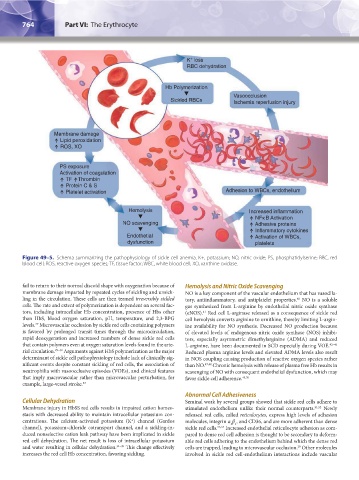
               Figure 49–5.  Schema summarizing the pathophysiology of sickle cell anemia. K+, potassium; NO, nitric oxide; PS, phosphatidylserine; RBC, red
               blood cell; ROS, reactive oxygen species; TF, tissue factor; WBC, white blood cell; XO, xanthine oxidase.


               fail to return to their normal discoid shape with oxygenation because of   Hemolysis and Nitric Oxide Scavenging
               membrane damage imparted by repeated cycles of sickling and unsick-  NO is a key component of the vascular endothelium that has vasodila-
               ling in the circulation. These cells are then termed irreversibly sickled   tory, antiinflammatory, and antiplatelet properties.  NO is a soluble
                                                                                                           40
               cells. The rate and extent of polymerization is dependent on several fac-  gas synthesized from L-arginine by endothelial nitric oxide synthase
               tors, including intracellular Hb concentration, presence of Hbs other   (eNOS).  Red cell L-arginase released as a consequence of sickle red
                                                                            41
               than  HbS,  blood  oxygen  saturation,  pH,  temperature,  and  2,3-BPG    cell hemolysis converts arginine to ornithine, thereby limiting L-argin-
               levels.  Microvascular occlusion by sickle red cells containing polymers   ine availability for NO  synthesis. Decreased NO  production because
                    29
               is  favored  by  prolonged  transit  times  through  the  microcirculation,   of elevated levels of endogenous nitric oxide synthase (NOS) inhibi-
               rapid deoxygenation and increased numbers of dense sickle red cells   tors, especially asymmetric dimethylarginine (ADMA) and reduced
               that contain polymers even at oxygen saturation levels found in the arte-  L-arginine, have been documented in SCD especially during VOE. 42–46
               rial circulation. 29–32  Arguments against HbS polymerization as the major   Reduced plasma arginine levels and elevated ADMA levels also result
               determinant of sickle cell pathophysiology include lack of clinically sig-  in NOS coupling causing production of reactive oxygen species rather
               nificant events despite constant sickling of red cells, the association of   than NO. 47,48  Chronic hemolysis with release of plasma free Hb results in
               neutrophilia with vasoocclusive episodes (VOEs), and clinical features   scavenging of NO with consequent endothelial dysfunction, which may
               that imply macrovascular rather than microvascular perturbation, for   favor sickle cell adherence. 49,50
               example, large-vessel stroke. 33
                                                                      Abnormal Cell Adhesiveness
               Cellular Dehydration                                   Seminal work by several groups showed that sickle red cells adhere to
               Membrane injury in HbSS red cells results in impaired cation homeo-  stimulated endothelium unlike their normal counterparts. 51,52  Newly
               stasis with decreased ability to maintain intracellular potassium con-  released red cells, called reticulocytes, express high levels of adhesion
               centrations. The calcium-activated potassium (K ) channel (Gardos   molecules, integrin α β , and CD36, and are more adherent than dense
                                                    +
                                                                                     4 1
               channel), potassium-chloride cotransport channel, and a sickling-in-  sickle red cells. 53,54  Increased endothelial reticulocyte adhesion as com-
               duced nonselective cation leak pathway have been implicated in sickle   pared to dense red cell adhesion is thought to be secondary to deform-
               red cell dehydration. The net result is loss of intracellular potassium   able red cells adhering to the endothelium behind which the dense red
               and water resulting in cellular dehydration. 34–39  This change effectively   cells are trapped, leading to microvascular occlusion.  Other molecules
                                                                                                            29
               increases the red cell Hb concentration, favoring sickling.  involved in sickle red cell-endothelium interactions include vascular


          Kaushansky_chapter 49_p0759-0788.indd   764                                                                   9/18/15   3:01 PM

