


Page 786 - Williams Hematology ( PDFDrive )
P. 786
760  Part VI:  The Erythrocyte  Chapter 49:  Disorders of Hemoglobin Structure: Sickle Cell Anemia and Related Abnormalities  761


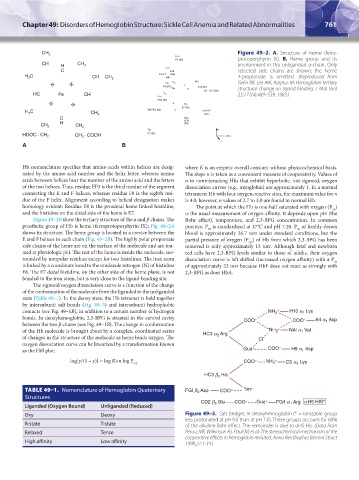
                        CH 2                                         Leu                  Figure 49–2.  A. Structure of heme (ferro-
                                                                     F4 (83)              protoporphyrin IX).  B. Heme group and its
                        CH     H    CH 3                                                  environment in the unliganded α-chain. Only
                               C                                  Leu H19                 selected side chains are shown; the heme
                   H C                   CH   CH 2              Leu F7 (86) (136)         4-propionate is omitted.  (Reproduced from
                    3
                            N    N                                His  C e  1  Lys        Gelin BR, Lee AW, Karplus M: Hemoglobin tertiary
                                                                 F8 (87)
                                                                    N e  2   E10 (61)  E11 (62)  structural change on ligand binding. J Mol Biol
                                                                               Val
                     HC       Fe      CH                       Leu  C δ                   25;171(4):489–559, 1983.)
                                                               FG3 (91)
                                                                    4   His
                            N
                                                                       E7 (58)
                                   N
                    C                                       Val FG5 (93)  3   Leu G8
                   H 3
                                         CH 3                                  (101)
                              C                                         Phe
                                                                        CD4
                        CH 2  H     CH 2                                (46)
                                                            Tyr                    y
                  HOOC · CH 2      CH · COOH                C7 (42)                    x
                                      2
                                                                                    z
                  A                                B
                  Hb nomenclature specifies that amino acids within helices are desig-  where K is an empiric overall constant without physicochemical basis.
                  nated by the amino acid number and the helix letter, whereas amino   The slope n is taken as a convenient measure of cooperativity. Values of
                  acids between helices bear the number of the amino acid and the letters   n in noninteracting Hbs that exhibit hyperbolic, not sigmoid, oxygen
                  of the two helices. Thus, residue EF3 is the third residue of the segment   dissociation curves (e.g., myoglobin) are approximately 1. In a normal
                  connecting the E and F helices, whereas residue F8 is the eighth resi-  tetrameric Hb with four oxygen-reactive sites, the maximum value for n
                  due of the F helix. Alignment according to helical designation makes   is 4.0; however, n values of 2.7 to 3.0 are found in normal Hb.
                  homology evident: Residue F8 is the proximal heme linked histidine,   The point at which the Hb is one-half saturated with oxygen (P )
                                                                                                                          50
                  and the histidine on the distal side of the heme is E7.  is the usual measurement of oxygen affinity. It depends upon pH (the
                     Figure 49–1B show the tertiary structure of the α and β chains. The   Bohr effect), temperature, and 2,3-BPG concentration. In common
                  prosthetic group of Hb is heme (ferroprotoporphyrin IX); Fig. 49–2A   practice, P  is standardized at 37°C and pH 7.20. P  of freshly drawn
                                                                                50
                                                                                                              50
                  shows its structure. The heme group is located in a crevice between the   blood is approximately 26.7 torr under standard conditions, but the
                  E and F helices in each chain (Fig. 49–2B). The highly polar propionate   partial pressure of oxygen (P ) of Hb from which 2,3-BPG has been
                                                                                              O2
                  side chains of the heme are on the surface of the molecule and are ion-  removed is only approximately 13 torr. Although fetal and newborn
                  ized at physiologic pH. The rest of the heme is inside the molecule, sur-  red cells have 2,3-BPG levels similar to those of adults, their oxygen
                  rounded by nonpolar residues except for two histidines. The iron atom   dissociation curve is left shifted (increased oxygen affinity) with a P
                                                                                                                          50
                  is linked by a coordinate bond to the imidazole nitrogen (N) of histidine   of approximately 23 torr because HbF does not react as strongly with
                  F8. The E7 distal histidine, on the other side of the heme plane, is not   2,3-BPG as does HbA.
                  bonded to the iron atom, but is very close to the ligand-binding site.
                     The sigmoid oxygen dissociation curve is a function of the change
                  of the conformation of the molecule from the liganded to the unliganded
                  state (Table 49–1). In the deoxy state, the Hb tetramer is held together
                  by intersubunit salt bonds (Fig. 49–3) and intersubunit hydrophobic
                  contacts (see Fig. 49–1B), in addition to a certain number of hydrogen
                  bonds. In deoxyhemoglobin, 2,3-BPG is situated in the central cavity
                  between the two β chains (see Fig. 49–1B). The change in conformation
                  of the Hb molecule is brought about by a complex, coordinated series
                  of changes in the structure of the molecule as heme binds oxygen. The
                  oxygen dissociation curve can be linearized by a transformation known
                  as the Hill plot:
                                  log[y/(1 – y)] = log K+n log P
                                                       O2


                   TABLE 49–1.  Nomenclature of Hemoglobin Quaternary
                   Structures
                   Liganded (Oxygen Bound)  Unliganded (Reduced)
                   Oxy                      Deoxy                       Figure 49–3.  Salt bridges in deoxyhemoglobin (* = ionizable group
                                                                        less protonated at pH 9.0 than at pH 7.0). These groups account for 60%
                   R-state                  T-state                     of the alkaline Bohr effect. The remainder is due to αH5 His. (Data from
                   Relaxed                  Tense                       Perutz MF, Wilkinson AJ, Paoli M, et al: The stereochemical mechanism of the
                                                                        cooperative effects in hemoglobin revisited, Annu Rev Biophys Biomol Struct
                   High affinity            Low affinity                1998;27:1-34.)


          Kaushansky_chapter 49_p0759-0788.indd   761                                                                   9/18/15   3:01 PM

