


Page 793 - Williams Hematology ( PDFDrive )
P. 793
768            Part VI:  The Erythrocyte                                                                                     Chapter 49:  Disorders of Hemoglobin Structure: Sickle Cell Anemia and Related Abnormalities          769


                                                     Changes during the progression of
                                                            the painful crisis
                                           Prodromal   Initial   Established    Resolving
                                            phase      phase       phase          phase

                                             Numbness Problems with Joint effusion  Problems with
                                             parasthesia er personnel  signs of  hospital personnel
                                               aches  anxiety, fear  inflammation  depression
                                                                                 RBC DI
                                                 Dense RBC     Temperature  Reticulo-  Fibrinogen
                                                      ISC       WBC count  cytes  Orosomucoid
                                      10             RDW        CRP      LDH     ESR
                                    Categorical pain scale  8  (Steady state values)  SAA  CPK  viscosity
                                                                                 Platelets
                                                     HDW
                                                                                 Plasma
                                       6
                                                                           RDW

                                                                                    RBC
                                       4                   Platelets       HOW     Dense       Arbitrary values  relativfe to steady state
                                                         RBC             Hb          ISC
                                                          DI
                                       2
                                              I         II           III           IV
                                       0   –2   –1  1   2    3   4   5   6   7   8   9   10
                                                             Crisis day                   Ballas 1995, 1992
                                                                                          Akinola et al, 1992
                                                                                          Beyer et al, 1999
                                                                                          Jacob et al, 2005

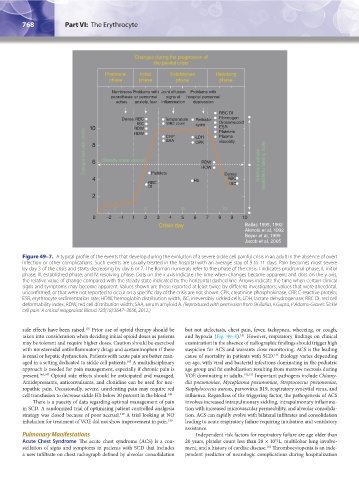
               Figure 49–7.  A typical profile of the events that develop during the evolution of a severe sickle cell painful crisis in an adult in the absence of overt
               infection or other complications. Such events are usually treated in the hospital with an average stay of 9 to 11 days. Pain becomes most severe
               by day 3 of the crisis and starts decreasing by day 6 or 7. The Roman numerals refer to the phase of the crisis: I indicates prodromal phase; II, initial
               phase; III, established phase; and IV, resolving phase. Dots on the x-axis indicate the time when changes became apparent; and dots on the y-axis,
               the relative value of change compared with the steady state indicated by the horizontal dashed line. Arrows indicate the time when certain clinical
               signs and symptoms may become apparent. Values shown are those reported at least twice by different investigators; values that were anecdotal,
               unconfirmed, or that were not reported to occur on a specific day of the crisis are not shown. CPK, creatinine phosphokinase; CRP, C-reactive protein;
               ESR, erythrocyte sedimentation rate; HDW, hemoglobin distribution width; ISC, irreversibly sickled cells; LDH, lactate dehydrogenase; RBC DI, red cell
               deformability index; RDW, red cell distribution width; SAA, serum amyloid A. (Reproduced with permission from SK Ballas, K Gupta, P Adams-Graves: Sickle
               cell pain: A critical reappraisal. Blood 120(18):3647–3656, 2012.)


               side effects have been raised.  Prior use of opioid therapy should be   but not atelectasis, chest pain, fever, tachypnea, wheezing, or cough,
                                     125
                                                                                        151
               taken into consideration when deciding initial opioid doses as patients   and hypoxia (Fig. 49–8).  However, respiratory findings on clinical
               may be tolerant and require higher doses. Caution should be exercised   examination in the absence of radiographic findings should trigger high
               with nonsteroidal antiinflammatory drugs and acetaminophen if there   suspicion for ACS and warrants close monitoring. ACS is the leading
               is renal or hepatic dysfunction. Patients with acute pain are better man-  cause of mortality in patients with SCD.  Etiology varies depending
                                                                                                    121
               aged in a setting dedicated to sickle cell patients.  A multidisciplinary   on age, with viral and bacterial infections dominating in the pediatric
                                                  145
               approach is needed for pain management, especially if chronic pain is   age group and fat embolization resulting from marrow necrosis during
               present. 146,147  Opioid side effects should be anticipated and managed.   VOE dominating in adults. 152,153  Important pathogens include Chlamy-
               Antidepressants, anticonvulsants, and clonidine can be used for neu-  dia pneumoniae, Mycoplasma pneumoniae, Streptococcus pneumoniae,
               ropathic pain. Occasionally, severe, unrelenting pain may require red   Staphylococcus aureus, parvovirus B19, respiratory syncytial virus, and
               cell transfusion to decrease sickle Hb below 30 percent in the blood. 148  influenza. Regardless of the triggering factor, the pathogenesis of ACS
                   There is a paucity of data regarding optimal management of pain   involves increased intrapulmonary sickling, intrapulmonary inflamma-
               in SCD. A randomized trial of optimizing patient controlled analgesia   tion with increased microvascular permeability, and alveolar consolida-
                                                149
               strategy was closed because of poor accrual.  A trial looking at NO   tion. ACS can rapidly evolve with bilateral infiltrates and consolidation
               inhalation for treatment of VOE did not show improvement in pain. 150  leading to acute respiratory failure requiring intubation and ventilatory
                                                                      assistance.
               Pulmonary Manifestations                                   Independent risk factors for respiratory failure are age older than
                                                                                                    9
               Acute Chest Syndrome  The  acute  chest  syndrome  (ACS)  is  a  con-  20 years, platelet count less than 20 × 10 /L, multilobar lung involve-
                                                                                                 152
               stellation of signs and symptoms in patients with SCD that includes   ment, and a history of cardiac disease.  Thrombocytopenia is an inde-
               a new infiltrate on chest radiograph defined by alveolar consolidation   pendent predictor of neurologic complications during hospitalization


          Kaushansky_chapter 49_p0759-0788.indd   768                                                                   9/18/15   3:01 PM

