


Page 796 - Williams Hematology ( PDFDrive )
P. 796
770  Part VI:  The Erythrocyte  Chapter 49:  Disorders of Hemoglobin Structure: Sickle Cell Anemia and Related Abnormalities  771


                  to that of age-matched controls. 224–226  It tends to decrease with age but
                  is still prevalent in adults. Social and environmental factors, decreased
                  functional bladder capacity, and decreased arousal during sleep appear
                  to be contributing factors.

                  Musculoskeletal System
                  VOE is commonly manifested by marrow infarction causing mus-
                  culoskeletal pain, swelling at involved sites, fever, and leukocytosis.
                  Marrow hypercellularity is thought to predispose to this phenomenon
                  by causing a decrease in local blood flow and oxygenation.
                     Dactylitis  Dactylitis is a painful swelling of digits of the hands
                  and feet (“hand-foot syndrome”). It occurs early in infancy as hemato-
                  poietic marrow is still present in these bones at this age. Most episodes
                  resolve within in 2 weeks. 227–230  Epiphyseal infarction can result in joint
                  pain and swelling mimicking septic arthritis. Use of hydroxyurea in the
                  BABY HUG trial resulted in significant reduction of rate of dactylitis. 161
                     Osteomyelitis, Septic Arthritis, and Bone Infarction  Impaired
                  cellular and humoral immunity together with infarction of bone con-
                  tribute to this complication with an estimated prevalence of 12 percent.
                  Atypical serotypes of Salmonella, S. aureus, and Gram-negative bacilli
                  are the principal infectious offenders. No single lab or imaging test
                  reliably differentiates osteomyelitis from infarction. 227,229,231–235  Culture
                  results may be nondiagnostic as patients usually receive antibiotics on
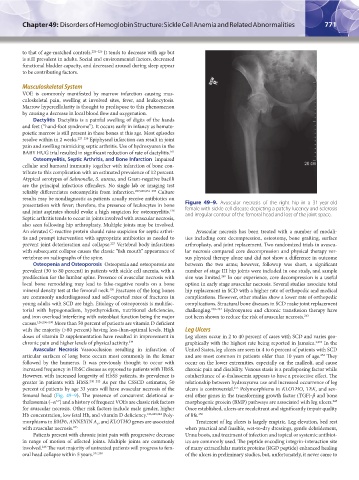
                  presentation with fever; therefore, the presence of leukocytes in bone   Figure 49–9.  Avascular necrosis of the right hip in a 31-year-old
                                                                   126
                  and joint aspirates should evoke a high suspicion for osteomyelitis.    female with sickle cell disease depicting a patchy lucency and sclerosis
                                                                        and irregular contour of the femoral head and loss of the joint space.
                  Septic arthritis tends to occur in joints involved with avascular necrosis,
                  also seen following hip arthroplasty. Multiple joints may be involved.
                  An elevated C-reactive protein should raise suspicion for septic arthri-  Avascular necrosis  has  been  treated  with  a  number  of  modali-
                  tis and prompt intervention with appropriate antibiotics as needed to   ties including core decompression, osteotomy, bone grafting, surface
                                               227
                  prevent joint deterioration and collapse.  Vertebral body infarctions   arthroplasty, and joint replacement. Two randomized trials in avascu-
                  with subsequent collapse causes the classic “fish mouth” appearance of   lar necrosis compared core decompression and physical therapy ver-
                  vertebrae on radiographs of the spine.                sus physical therapy alone and did not show a difference in outcome
                     Osteopenia and Osteoporosis  Osteopenia and osteoporosis are   between the two arms; however, followup was short, a significant
                  prevalent (30 to 80 percent) in patients with sickle cell anemia, with a   number of stage III hip joints were included in one study, and sample
                  predilection for the lumbar spine. Presence of avascular necrosis with   size was limited.  In our experience, core decompression is a useful
                                                                                     249
                  local bone remodeling may lead to false-negative results on a bone   option in early stage avascular necrosis. Several studies associate total
                  mineral density test at the femoral neck.  Fractures of the long bones   hip replacement in SCD with a higher rate of orthopedic and medical
                                               126
                  are commonly underdiagnosed and self-reported rates of fractures in   complications. However, other studies show a lower rate of orthopedic
                  young adults with SCD are high. Etiology of osteoporosis is multifac-  complications. Structural bone diseases in SCD make joint replacement
                  torial with hypogonadism, hypothyroidism, nutritional deficiencies,   challenging. 250–252  Hydroxyurea and chronic transfusion therapy have
                  and iron overload interfering with osteoblast function being the major   not been shown to reduce the risk of avascular necrosis. 243
                  causes. 126,236–238  More than 50 percent of patients are vitamin D deficient
                  with the majority (>80 percent) having less-than-optimal levels. High   Leg Ulcers
                  doses of vitamin D supplementation have resulted in improvement in   Leg ulcers occur in 2 to 40 percent of cases with SCD and varies geo-
                  chronic pain and higher levels of physical activity. 239  graphically with the highest rate being reported in Jamaica. 1,253  In the
                     Avascular Necrosis  Vasoocclusion resulting in infarction of   United States, leg ulcers are seen in 4 to 6 percent of patients with SCD
                  articular surfaces of long bone occurs most commonly in the femur   and are most common in patients older than 10 years of age.  They
                                                                                                                      254
                  followed by the humerus. It was previously thought to occur with   occur on the lower extremities, especially on the malleoli, and cause
                  increased frequency in HbSC disease as opposed to patients with HbSS.   chronic pain and disability. Venous stasis is a predisposing factor while
                  However, with increased longevity of HbSS patients, its prevalence is   coinheritance of α-thalassemia appears to have a protective effect. The
                  greater in patients with HbSS. 240–242  As per the CSSCD estimates, 50   relationship between hydroxyurea use and increased occurrence of leg
                  percent of patients by age 33 years will have avascular necrosis of the   ulcers is controversial.  Polymorphisms in KLOTHO, TEK, and sev-
                                                                                         255
                  femoral head (Fig. 49–9). The presence of concurrent deletional  α-   eral other genes in the transforming growth factor (TGF)-β and bone
                  thalassemia (–α ) and a history of frequent VOEs are classic risk factors   morphogenic protein (BMP) pathways are associated with leg ulcers.
                             3·7
                                                                                                                          245
                  for avascular necrosis. Other risk factors include male gender, higher   Once established, ulcers are recalcitrant and significantly impair quality
                  Hb concentration, low fetal Hb, and vitamin D deficiency. 126,243,244  Poly-  of life. 256
                  morphisms in BMP6, ANNEXIN A , and KLOTHO genes are associated   Treatment of leg ulcers is largely empiric. Leg elevation, bed rest
                                           2
                  with avascular necrosis. 245                          when practical and feasible, wet-to-dry dressings, gentle debridement,
                     Patients present with chronic joint pain with progressive decrease   Unna boots, and treatment of infection and topical or systemic antibiot-
                  in range of motion of affected joints. Multiple joints are commonly   ics are commonly used. The peptide encoding integrin-interaction site
                  involved.  The vast majority of untreated patients will progress to fem-  of many extracellular matrix proteins (RGD peptide) enhanced healing
                        246
                  oral head collapse within 5 years. 247,248            of the ulcers in preliminary studies, but, unfortunately, it never came to


          Kaushansky_chapter 49_p0759-0788.indd   771                                                                   9/18/15   3:01 PM

