


Page 799 - Williams Hematology ( PDFDrive )
P. 799
774            Part VI:  The Erythrocyte                                                                                     Chapter 49:  Disorders of Hemoglobin Structure: Sickle Cell Anemia and Related Abnormalities          775


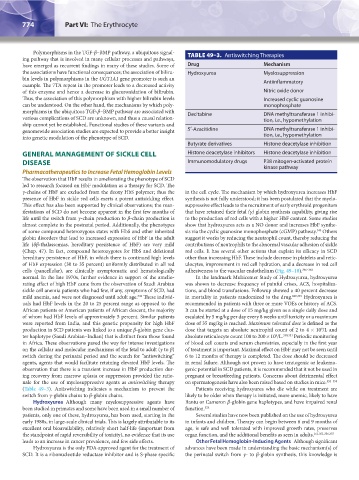
                   Polymorphisms in the TGF-β–BMP pathway, a ubiquitous signal-  TABLE 49–3.  Antiswitching Therapies
               ing pathway that is involved in many cellular processes and pathways,
               have emerged as recurrent findings in many of these studies. Some of   Drug      Mechanism
               the associations have functional consequences; the association of biliru-  Hydroxyurea  Myelosuppression
               bin levels in polymorphisms in the UGT1A1 gene promoter is such an               Antiinflammatory
               example. The 7TA repeat in the promoter leads to a decreased activity
               of this enzyme and hence a decrease in glucuronidation of bilirubin.             Nitric oxide donor
               Thus, the association of this polymorphism with higher bilirubin levels          Increased cyclic guanosine
               can be understood. On the other hand, the mechanisms by which poly-              monophosphate
               morphisms in the ubiquitous TGF-β–BMP pathway are associated with   Decitabine   DNA methyltransferase 1 inhibi-
               various complications of SCD are unknown, and thus a causal relation-            tion, i.e., hypomethylation
               ship cannot yet be established. Functional studies of these variants and
               genomewide association studies are expected to provide a better insight   5′-Azacitidine  DNA methyltransferase 1 inhibi-
               into genetic modulation of the phenotype of SCD.                                 tion, i.e., hypomethylation
                                                                       Butyrate derivatives     Histone deacetylase inhibition
               GENERAL MANAGEMENT OF SICKLE CELL                       Histone deacetylase inhibitors  Histone deacetylase inhibition
               DISEASE                                                 Immunomodulatory drugs   P38 mitogen-activated protein
                                                                                                kinase pathway
               Pharmacotherapeutics to Increase Fetal Hemoglobin Levels
               The observation that HbF results in ameliorating the phenotype of SCD
               led to research focused on HbF modulation as a therapy for SCD. The
               γ-chains of HbF are excluded from the deoxy HbS polymer; thus the   in the cell cycle. The mechanism by which hydroxyurea increases HbF
               presence of HbF in sickle red cells exerts a potent antisickling effect.   synthesis is not fully understood; it has been postulated that the myelo-
               This effect has also been supported by clinical observations; the man-  suppressive effect leads to the recruitment of early erythroid progenitors
               ifestations of SCD do not become apparent in the first few months of   that have retained their fetal (γ) globin synthesis capability, giving rise
               life until the switch from γ-chain production to β-chain production is   to the production of red cells with a higher HbF content. Some studies
               almost complete in the postnatal period. Additionally, the phenotypes   show that hydroxyurea acts as a NO donor and increases HbF synthe-
               of some compound heterozygous states with HbS and other inherited   sis via the cyclic guanosine monophosphate (cGMP) pathway.  Others
                                                                                                                  345
               globin disorders that lead to increased expression of HbF in the adult   suggest it works by reducing the neutrophil count, thereby reducing the
               life (δβ-thalassemias, hereditary persistence of HbF) are very mild   contributions of neutrophils to the abnormal vascular adhesion of sickle
               (Chap. 47). In fact, compound heterozygotes for HbS and deletional   red cells. It has several other actions that explain its efficacy in SCD
               hereditary persistence of HbF, in which there is continued high levels   other than increasing HbF. These include decrease in platelets and retic-
               of HbF expression (30 to 35 percent) uniformly distributed in all red   ulocytes, improvement in red cell hydration, and a decrease in red cell
               cells  (pancellular),  are  clinically  asymptomatic  and  hematologically   adhesiveness to the vascular endothelium (Fig. 49–10). 346–348
               normal. In the late 1970s, further evidence in support of the amelio-  In the landmark Multicenter Study of Hydroxyurea, hydroxyurea
               rating effect of high HbF came from the observation of Saudi Arabian   was shown to decrease frequency of painful crises, ACS, hospitaliza-
               sickle cell anemia patients who had few, if any, symptoms of SCD, had   tions, and blood transfusions. Followup showed a 40 percent decrease
                                                      344
               mild anemia, and were not diagnosed until adult age.  These individ-  in mortality in patients randomized to the drug. 160,349  Hydroxyurea is
               uals had HbF levels in the 20 to 25 percent range as opposed to the   recommended in patients with three or more VOEs or history of ACS.
               African patients or American patients of African descent, the majority   It can be started at a dose of 15 mg/kg given as a single daily dose and
               of whom had HbF levels of approximately 5 percent. Similar patients   escalated by 5 mg/kg per day every 8 weeks until toxicity or a maximum
               were reported from India, and this genetic propensity for high HbF   dose of 35 mg/kg is reached. Maximum tolerated dose is defined as the
               production in SCD patients was linked to a unique β-globin gene clus-  dose that targets an absolute neutrophil count of 2 to 4 × 10 /L and
                                                                                                                    9
               ter haplotype (Saudi Arabian–Indian) that is distinct from those found   absolute reticulocyte count 100 to 200 × 10 /L. 350,351  Periodic monitoring
                                                                                                    9
               in Africa. These observations paved the way for intense investigations   of blood cell counts and serum chemistries, especially in the first year
               on the cellular and molecular mechanisms of the fetal to adult (γ to β)   of treatment is important. Maximal effect on HbF may not be seen until
               switch during the perinatal period and the search for “antiswitching”   6 to 12 months of therapy is completed. The dose should be decreased
               agents, agents that would facilitate retaining elevated HbF levels. The   in renal failure. Although not proven to have teratogenic or leukemo-
               observation that there is a transient increase in HbF production dur-  genic potential in SCD patients, it is recommended that it not be used in
               ing recovery from marrow aplasia or suppression provided the ratio-  pregnant or breastfeeding patients. Concerns about detrimental effect
               nale for the use of myelosuppressive agents as  antiswitching therapy    on spermatogenesis have also been raised based on studies in mice. 352–355
               (Table 49–3). Antiswitching indicates a mechanism  to prevent the   Patients receiving hydroxyurea who die while on treatment are
               switch from γ-globin chains to β-globin chains.        likely to be older when therapy is initiated, more anemic, likely to have
                   Hydroxyurea  Although many myelosuppressive agents have   Bantu or Cameron β-globin gene haplotypes, and have impaired renal
               been studied in primates and some have been used in a small number of   function. 324
               patients, only one of these, hydroxyurea, has been used, starting in the   Several studies have now been published on the use of hydroxyurea
               early 1980s, in large-scale clinical trials. This is largely attributable to its   in infants and children. Therapy can begin between 6 and 9 months of
               excellent oral bioavailability, relatively short half-life (important from   age, is safe and well tolerated with improved growth rates, preserves
               the standpoint of rapid reversibility of toxicity), no evidence that its use   organ function, and the additional benefits as seen in adults. 161,351,356,357
               leads to an increase in cancer prevalence, and few side effects.  Other Fetal Hemoglobin-Inducing Agents  Although significant
                   Hydroxyurea is the only FDA-approved agent for the treatment of   advances have been made in understanding the basic mechanism(s) of
               SCD. It is a ribonucleotide reductase inhibitor and is S-phase specific   the perinatal switch from γ- to β-globin synthesis, this knowledge is


          Kaushansky_chapter 49_p0759-0788.indd   774                                                                   9/18/15   3:01 PM

