


Page 800 - Williams Hematology ( PDFDrive )
P. 800
774  Part VI:  The Erythrocyte  Chapter 49:  Disorders of Hemoglobin Structure: Sickle Cell Anemia and Related Abnormalities  775


                                   A                                   B
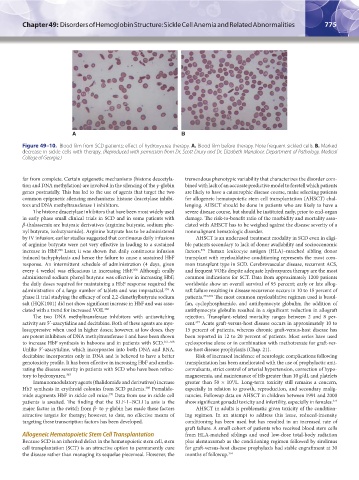
                  Figure 49–10.  Blood film from SCD patients: effect of hydroxyurea therapy. A. Blood film before therapy. Note frequent sickled cells. B. Marked
                  decrease in sickle cells with therapy. (Reproduced with permission from Dr. Scott Drury and Dr. Elizabeth Manaloor, Department of Pathology, Medical
                  College of Georgia.)


                  far from complete. Certain epigenetic mechanisms (histone deacetyla-  tremendous phenotypic variability that characterizes the disorder com-
                  tion and DNA methylation) are involved in the silencing of the γ-globin   bined with lack of an accurate predictive model to foretell which patients
                  genes postnatally. This has led to the use of agents that target the two   are likely to have a catastrophic disease course, make selecting patients
                  common epigenetic silencing mechanisms: histone deacetylase inhibi-  for allogeneic hematopoietic stem cell transplantation (AHSCT) chal-
                  tors and DNA methyltransferase 1 inhibitors.          lenging. AHSCT should be done in patients who are likely to have a
                     The histone deacetylase inhibitors that have been most widely used   severe disease course, but should be instituted early, prior to end-organ
                  in early phase small clinical trials in SCD and in some patients with   damage. The risk-to-benefit ratio of the morbidity and mortality asso-
                  β-thalassemia are butyrate derivatives (arginine butyrate, sodium phe-  ciated with AHSCT has to be weighed against the disease severity of a
                  nyl butyrate, isobutyramide). Arginine butyrate has to be administered   nonmalignant hematologic disorder.
                  by IV infusion; earlier studies suggested that continuous daily infusions   AHSCT is an underused treatment modality in SCD even in eligi-
                  of arginine butyrate were not very effective in leading to a sustained   ble patients secondary to lack of donor availability and socioeconomic
                              258
                                                                              371
                  increase in HbF.  Later, it was shown that daily continuous infusion   factors.  Human leukocyte antigen (HLA)–matched sibling donor
                  induced tachyphylaxis and hence the failure to cause a sustained HbF   transplant with myeloablative conditioning represents the most com-
                  response. An intermittent schedule  of administration (4 days,  given   mon transplant type in SCD. Cerebrovascular disease, recurrent ACS,
                  every 4 weeks) was efficacious in increasing HbF.  Although orally   and frequent VOEs despite adequate hydroxyurea therapy are the most
                                                       358
                  administered sodium phenyl butyrate was effective in increasing HbF,   common indications for SCT. Data from approximately 1200 patients
                  the daily doses required for maintaining a HbF response required the   worldwide show an overall survival of 95 percent; early or late allog-
                  administration of a large number of tablets and was impractical.  A   raft failure resulting in disease recurrence occurs in 10 to 15 percent of
                                                                 359
                  phase II trial studying the efficacy of oral 2,2-dimethylbutyrate sodium   patients. 371,372  The most common myeloablative regimen used is busul-
                  salt (HQK1001) did not show significant increase in HbF and was asso-  fan, cyclophosphamide, and antithymocyte globulin; the addition of
                  ciated with a trend for increased VOE. 360            antithymocyte globulin resulted in a significant reduction in allograft
                     The  two  DNA  methyltransferase  inhibitors  with  antiswitching   rejection. Transplant-related mortality ranges between 2 and 8 per-
                  activity are 5′-azacytidine and decitabine. Both of these agents are mye-  cent.  Acute graft-versus-host disease occurs in approximately 10 to
                                                                            372
                  losuppressive when used in higher doses; however, at low doses, they   15 percent of patients, whereas chronic graft-versus-host disease has
                  are potent inhibitors of DNA methyltransferase 1 and have been shown   been reported in 12 to 20 percent of patients. Most series have used
                  to increase HbF synthesis in baboons and in patients with SCD. 361–368    cyclosporine alone or in combination with methotrexate for graft-ver-
                  Unlike 5′-azacytidine, which incorporates into both DNA and RNA,   sus-host disease prophylaxis (Chap. 21).
                  decitabine incorporates only in DNA and is believed to have a better   Risk of increased incidence of neurologic complications following
                  genotoxicity profile. It has been effective in increasing HbF and amelio-  transplantation has been ameliorated with the use of prophylactic anti-
                  rating the disease severity in patients with SCD who have been refrac-  convulsants, strict control of arterial hypertension, correction of hypo-
                  tory to hydroxyurea. 363                              magnesemia, and maintenance of Hb greater than 10 g/dL and platelets
                     Immunomodulatory agents (thalidomide and derivatives) increase   greater than 50 × 10 /L. Long-term toxicity still remains a concern,
                                                                                        9
                                                           369
                  HbF synthesis in erythroid colonies from SCD patients.  Pomalido-  especially in relation to growth, reproduction, and secondary malig-
                                               370
                  mide augments HbF in sickle cell mice.  Data from use in sickle cell   nancies. Followup data on AHSCT in children between 1991 and 2000
                  patients is awaited. The finding  that the  KLF-1–BCL11a axis is  the   show significant gonadal toxicity and infertility, especially in females. 373
                  major factor in the switch from β- to γ-globin has made these factors   AHSCT in adults is problematic given toxicity of the condition-
                  attractive targets for therapy; however, to date, no effective means of   ing regimen. In an attempt to address this issue, reduced-intensity
                  targeting these transcription factors has been developed.  conditioning has been used but has resulted in an increased rate of
                                                                        graft failure. A small cohort of patients who received blood stem cells
                  Allogeneic Hematopoietic Stem Cell Transplantation    from HLA-matched siblings and used low-dose total-body radiation
                  Because SCD is an inherited defect in the hematopoietic stem cell, stem   plus alemtuzumab as the conditioning regimen followed by sirolimus
                  cell transplantation (SCT) is an attractive option to permanently cure   for graft-versus-host disease prophylaxis had stable engraftment at 30
                  the disease rather than managing its sequelae piecemeal. However, the   months of followup. 374


          Kaushansky_chapter 49_p0759-0788.indd   775                                                                   9/18/15   3:01 PM

