


Page 802 - Williams Hematology ( PDFDrive )
P. 802
776  Part VI:  The Erythrocyte  Chapter 49:  Disorders of Hemoglobin Structure: Sickle Cell Anemia and Related Abnormalities  777


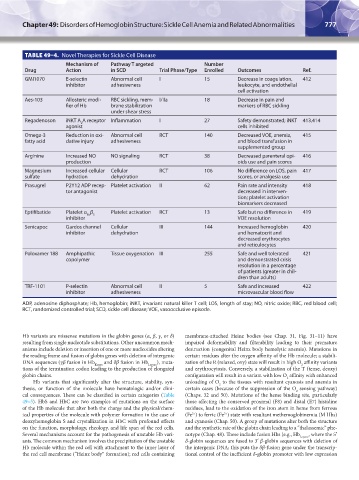
                   TABLE 49–4.  Novel Therapies for Sickle Cell Disease
                                Mechanism of   Pathway T argeted               Number
                   Drug         Action         in SCD           Trial Phase/Type  Enrolled  Outcomes            Ref.
                   GMI1070      E-selectin     Abnormal cell    I              15         Decrease in coagulation,   412
                                inhibitor      adhesiveness                               leukocyte, and endothelial
                                                                                          cell activation
                   Aes-103      Allosteric modi-  RBC sickling, mem-  I/IIa    18         Decrease in pain and
                                fier of Hb     brane stabilization                        markers of RBC sickling
                                               under shear stress
                   Regadenoson  iNKT A A receptor  Inflammation  I             27         Safety demonstrated; iNKT  413,414
                                     2
                                agonist                                                   cells inhibited
                   Omega-3      Reduction in oxi-  Abnormal cell   RCT         140        Decreased VOE, anemia,   415
                   fatty acid   dative injury  adhesiveness                               and blood transfusion in
                                                                                          supplemented group
                   Arginine     Increased NO   NO signaling     RCT            38         Decreased parenteral opi-  416
                                production                                                oids use and pain scores
                   Magnesium    Increased cellular  Cellular    RCT            106        No difference on LOS, pain  417
                   sulfate      hydration      dehydration                                scores, or analgesia use
                   Prasugrel    P2Y12 ADP recep- Platelet activation  II       62         Pain rate and intensity   418
                                tor antagonist                                            decreased in interven-
                                                                                          tion; platelet activation
                                                                                          biomarkers decreased
                   Eptifibatide  Platelet α β    Platelet activation  RCT      13         Safe but no difference in   419
                                       IIb 3
                                inhibitor                                                 VOE resolution
                   Senicapoc    Gardos channel   Cellular       III            144        Increased hemoglobin   420
                                inhibitor      dehydration                                and hematocrit and
                                                                                          decreased erythrocytes
                                                                                          and reticulocytes
                   Poloxamer 188  Amphipathic   Tissue oxygenation  III        255        Safe and well tolerated   421
                                copolymer                                                 and demonstrated crisis
                                                                                          resolution in a percentage
                                                                                          of patients (greater in chil-
                                                                                          dren than adults)
                   TRF-1101     P-selectin     Abnormal cell    II             5          Safe and increased    422
                                inhibitor      adhesiveness                               microvascular blood flow
                  ADP, adenosine diphosphate; Hb, hemoglobin; iNKT, invariant natural killer T cell; LOS, length of stay; NO, nitric oxide; RBC, red blood cell;
                  RCT, randomized controlled trial; SCD, sickle cell disease; VOE, vasoocclusive episode.


                  Hb variants are missense mutations in the globin genes (α, β, γ, or δ)   membrane-attached Heinz bodies (see Chap. 31, Fig. 31–11) have
                  resulting from single nucleotide substitutions. Other uncommon mech-  impaired deformability and filterability leading to their premature
                  anisms include deletion or insertion of one or more nucleotides altering   destruction (congenital Heinz body hemolytic anemia). Mutations in
                  the reading frame and fusion of globin genes with deletion of intergenic   certain residues alter the oxygen affinity of the Hb molecule; a stabili-
                  DNA sequences (γβ fusion in Hb Kenya  and δβ fusion in Hb Lepore ), muta-  zation of the R (relaxed, oxy) state will result in high O  affinity variants
                                                                                                               2
                  tions of the termination codon leading to the production of elongated   and erythrocytosis. Conversely, a stabilization of the T (tense, deoxy)
                  globin chains.                                        configuration will result in a variant with low O  affinity with enhanced
                                                                                                          2
                     Hb variants that significantly alter the structure, stability, syn-  unloading of O  to the tissues with resultant cyanosis and anemia in
                                                                                    2
                  thesis, or function of the molecule have hematologic and/or clini-  certain cases (because of the suppression of the O  sensing pathway)
                                                                                                              2
                  cal consequences. These can be classified in certain categories (Table   (Chaps. 32 and 50). Mutations of the heme binding site, particularly
                  49–5). HbS and HbC are two examples of mutations on the surface   those affecting the conserved proximal (F8) and distal (E7) histidine
                  of the Hb molecule that alter both the charge and the physical/chem-  residues, lead to the oxidation of the iron atom in heme from ferrous
                  ical properties of the molecule with polymer formation in the case of   (Fe ) to ferric (Fe ) state with resultant methemoglobinemia (M Hbs)
                                                                           2+
                                                                                     3+
                  deoxyhemoglobin S and crystallization in HbC with profound effects   and cyanosis (Chap. 50). A group of mutations alter both the structure
                  on the function, morphology, rheology, and life span of the red cells.   and the synthetic rate of the globin chain leading to a “thalassemic” phe-
                  Several mechanisms account for the pathogenesis of unstable Hb vari-  notype (Chap. 48). These include fusion Hbs (e.g., Hb Lepore , where the 5′
                  ants. The common mechanism involves the precipitation of the unstable   δ-globin sequences are fused to 3′ β-globin sequences with deletion of
                  Hb molecule within the red cell with attachment to the inner layer of   the intergenic DNA; this puts the δβ-fusion gene under the transcrip-
                  the red cell membrane (“Heinz body” formation); red cells containing   tional control of the inefficient δ-globin promoter with low expression


          Kaushansky_chapter 49_p0759-0788.indd   777                                                                   9/18/15   3:01 PM

