


Page 816 - Williams Hematology ( PDFDrive )
P. 816
790  Part VI:  The Erythrocyte           Chapter 50:  Methemoglobinemia and Other Dyshemoglobinemias                  791


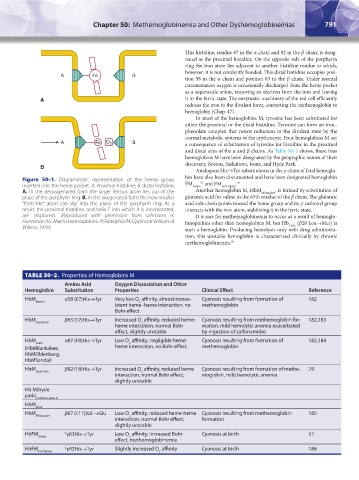
                                                                        This histidine, residue 87 in the α chain and 92 in the β chain, is desig-
                                                                        nated as the proximal histidine. On the opposite side of the porphyrin
                                                                        ring the iron atom lies adjacent to another histidine residue to which,
                                                                        however, it is not covalently bonded. This distal histidine occupies posi-
                               A         Fe            B
                                                                        tion 58 in the α chain and position 63 in the β chain. Under normal
                                                                        circumstances oxygen is occasionally discharged from the heme pocket
                                                                        as a superoxide anion, removing an electron from the iron and leaving
                        A                                               it in the ferric state. The enzymatic machinery of the red cell efficiently
                                                                        reduces the iron to the divalent form, converting the methemoglobin to
                                                                        hemoglobin (Chap. 47).
                                                                            In most of the hemoglobins M, tyrosine has been substituted for
                                                                        either the proximal or the distal histidine. Tyrosine can form an iron–
                                                                        phenolate complex that resists reduction to the divalent state by the
                                                                        normal metabolic systems of the erythrocyte. Four hemoglobins M are
                               A          Fe  O 2      B                a consequence of substitution of tyrosine for histidine in the proximal
                                                                        and distal sites of the α and β chains. As Table 50–2 shows, these four
                                                                        hemoglobins M have been designated by the geographic names of their
                                                                        discovery, Boston, Saskatoon, Iwate, and Hyde Park.
                        B
                                                                            Analogous His→Tyr substitutions in the γ chain of fetal hemoglo-
                                                                        bin have also been documented and have been designated hemoglobin
                  Figure 50–1.  Diagrammatic representation of the heme group   57        58
                  inserted into the heme pocket. A, Proximal histidine; B, distal histidine.   FM Osaka   and FM Fort Ripley .
                  A. In the deoxygenated form the larger ferrous atom lies out of the   Another hemoglobin M, HbM Milwaukee , is formed by substitution of
                  place of the porphyrin ring. B. In the oxygenated form the now smaller     glutamic acid for valine in the 67th residue of the β chain. The glutamic
                  “ferric-like” atom can slip into the plane of the porphyrin ring. As a   acid side chain points toward the heme group and its γ-carboxyl group
                  result, the proximal histidine, and helix F into which it is incorporated,     interacts with the iron atom, stabilizing it in the ferric state.
                  are displaced.  (Reproduced with permission from Lehmann H,     It is rare for methemoglobinemia to occur as a result of hemoglo-
                  Huntsman RG: Man’s Haemoglobins. Philadelphia PA: Lippincott Williams &     binopathies other than hemoglobins M, but Hb   (β28 Leu→Met) is
                                                                                                           Chile
                  Wilkins; 1974.)                                       such a hemoglobin. Producing hemolysis only with drug administra-
                                                                        tion, this unstable hemoglobin is characterized clinically by chronic
                                                                        methemoglobinemia. 59


                   TABLE 50–2.  Properties of Hemoglobins M
                                Amino Acid       Oxygen Dissociation and Other
                   Hemoglobin   Substitution     Properties                   Clinical Effect                     Reference
                   HbM          α58 (E7)His→Tyr  Very low O  affinity, almost nonex-  Cyanosis resulting from formation of   182
                      Boston                             2
                                                 istent heme–heme interaction, no   methemoglobin
                                                 Bohr effect
                   HbM          β63 (E7)His→Tyr  Increased O  affinity, reduced heme-  Cyanosis resulting from methemoglobin for-  182,183
                      Saskatoon                           2
                                                 heme interaction, normal Bohr   mation, mild hemolytic anemia exacerbated
                                                 effect, slightly unstable    by ingestion of sulfonamides
                   HbM          α87 (F8)His→Tyr  Low O  affinity, negligible heme-  Cyanosis resulting from formation of   182,184
                      Iwate                           2
                   (HbMKankakee,                 heme interaction, no Bohr effect  methemoglobin
                   HbMOldenburg,
                   HbMSendai)
                   HbM          β92 (F8)His→Tyr  Increased O  affinity, reduced heme   Cyanosis resulting from formation of methe-  79
                      Hyde Park                           2
                                                 interaction, normal Bohr effect,   moglobin, mild hemolytic anemia
                                                 slightly unstable
                   Hb M(hyde
                   park)
                      (HbMilwaukee 2)
                   HbM
                      Akita
                   HbM          β67 (E11)Val →Glu  Low O  affinity, reduced heme-heme  Cyanosis resulting from methemoglobin   185
                      Milwaukee                       2
                                                 interaction, normal Bohr effect,   formation
                                                 slightly unstable
                   HbFM         G γ63His→Tyr     Low O  affinity, increased Bohr   Cyanosis at birth              57
                       Osaka                          2
                                                 effect, methemoglobinemia
                   HbFM         G γ92His→Tyr     Slightly increased O  affinity  Cyanosis at birth                186
                       Fort Ripley                              2


          Kaushansky_chapter 50_p0789-0800.indd   791                                                                   9/17/15   2:38 PM

