


Page 819 - Williams Hematology ( PDFDrive )
P. 819
794            Part VI:  The Erythrocyte                                                                                                             Chapter 50:  Methemoglobinemia and Other Dyshemoglobinemias                   795


               CLINICAL FEATURES                                      or reference laboratories. A mathematical formula has been developed
                                                                                                                       105
               Sulfhemoglobinemia  is  characterized  by cyanosis. Drugs  that  cause   that can be used to calculate P  reliably from a venous blood sample.
                                                                                            50
               sulfhemoglobinemia often have the capacity to produce accelerated red   Calculating P  using this formula requires the following venous gas
                                                                                50
               cell destruction as well. Thus, mild hemolysis is sometimes observed in   parameters: partial pressure of oxygen (venous), venous pH, and venous
               patients with sulfhemoglobinemia.                      oxygen saturation, and uses an antilog mathematical function that many
                                                                      clinicians find difficult to use for calculation. An electronic version (in
                                                                      Microsoft Excel) of this mathematical formula is available for rapid cal-
               LABORATORY FEATURES                                    culation of P  from venous blood gases.  The P  of a healthy person
                                                                                                   106
                                                                               50
                                                                                                          50
               Sulfhemoglobin is detected in the lysate of blood treated with ferricya-  with normal hemoglobin is 26 ± 1.3 torr. An abnormally low P  reflects
                                                                                                                  50
               nide, cyanide, and ammonia by comparing the optical density at 620 nm   an increased affinity of hemoglobin for oxygen and vice versa, and is
               with that at 540 nm. 63,64                             especially useful for detecting those high affinity hemoglobin mutants
                                                                      associated with polycythemia (Chaps. 49 and 57).
               TREATMENT AND COURSE
               Sulfhemoglobinemia is almost always a benign disorder. Unlike methe-  DIFFERENTIAL DIAGNOSIS
               moglobin, sulfhemoglobin does not produce a left shift in the oxygen   Cyanosis resulting from methemoglobinemia or sulfhemoglobinemia
               dissociation curve; instead, it decreases the affinity of hemoglobin for   should be differentiated from cyanosis resulting from cardiac or pul-
               oxygen.  The disorder tends to recur in the same persons after exposure   monary disease, particularly when right-to-left shunting is present. In
                     98
               to drugs but does not generally appear to affect their overall health. Unlike   the latter instances, the arterial oxygen tension will be low, whereas in
               methemoglobin, sulfhemoglobin cannot be converted to hemoglobin.   methemoglobinemia and sulfhemoglobinemia it should be normal.
               Thus, once sulfhemoglobinemia occurs, it will persist until the erythro-  One should be certain, however, that the oxygen tension was measured
               cytes carrying the abnormal pigment reach the end of their life span.  directly and not deduced from the percent saturation of hemoglobin.
                                                                      Blood from a patient with cyanosis because of arterial oxygen desatura-
                                                                      tion promptly becomes bright red upon being shaken with air. In addi-
                    LOW-OXYGEN-AFFINITY                               tion, these causes of cyanosis are readily differentiated by carrying out
                  HEMOGLOBINS: A CAUSE OF CYANOSIS                    quantitative blood methemoglobin and sulfhemoglobin levels. Because
                                                                      of the potential lethal nature of high levels of methemoglobin and
               ETIOLOGY AND PATHOGENESIS                              because prompt treatment may be life-saving, a high index of suspicion
               In some hemoglobin variants, the deoxy conformation of the hemo-  is important. A patient with cyanosis whose arterial blood is brown with
                                                                      an SpO  that is found to be normal on blood gas examination is likely
               globin  molecule  is  favored  because  the  angle  of  the  heme  is  altered   to have methemoglobinemia. One should not rely on the readings of a
                                                                           2
               from that found normally in deoxyhemoglobin. Such changes occur in   standard pulse oximeter, as false readings may be obtained in the pres-
               Hb Hammersmith , Hb Bucuresti , Hb Torino , and Hb Peterborough . In other instances, the   ence of methemoglobin. Rapid examination of a blood sample using an
               quaternary conformation is changed by mutations involving the α β    automatic analyzer, such as a cooximeter, is the first step in confirming
                                                                1 2
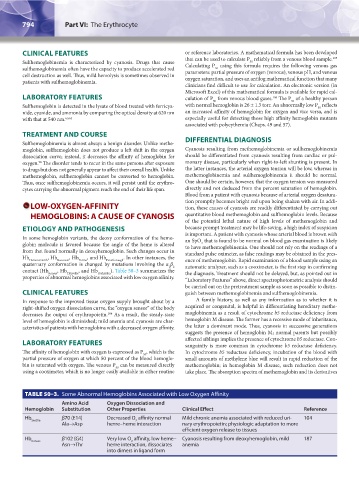
               contact (Hb Kansas , Hb Titusville , and Hb Yoshizuka ). Table 50–3 summarizes the   the diagnosis. Treatment should not be delayed, but, as pointed out in
               properties of abnormal hemoglobins associated with low oxygen affinity.
                                                                      “Laboratory Features” above, direct spectrophotometric analysis should
                                                                      be carried out on the pretreatment sample as soon as possible to distin-
               CLINICAL FEATURES                                      guish between methemoglobinemia and sulfhemoglobinemia.
               In response to the improved tissue oxygen supply brought about by a   A family history, as well as any information as to whether it is
               right-shifted oxygen dissociation curve, the “oxygen sensor” of the body   acquired or congenital, is helpful in differentiating hereditary methe-
               decreases the output of erythropoietin.  As a result, the steady-state   moglobinemia as a result of cytochrome b5 reductase deficiency from
                                            104
               level of hemoglobin is diminished; mild anemia and cyanosis are char-  hemoglobin M disease. The former has a recessive mode of inheritance,
               acteristics of patients with hemoglobins with a decreased oxygen affinity.  the latter a dominant mode. Thus, cyanosis in successive generations
                                                                      suggests the presence of hemoglobin M; normal parents but possibly
                                                                      affected siblings implies the presence of cytochrome b5 reductase. Con-
               LABORATORY FEATURES                                    sanguinity is more common in cytochrome  b5 reductase deficiency.
               The affinity of hemoglobin with oxygen is expressed as P , which is the   In cytochrome b5 reductase deficiency, incubation of the blood with
                                                        50
               partial pressure of oxygen at which 50 percent of the blood hemoglo-  small amounts of methylene blue will result in rapid reduction of the
               bin is saturated with oxygen. The venous P  can be measured directly   methemoglobin; in hemoglobin M disease, such reduction does not
                                               50
               using a cooximeter, which is no longer easily available in either routine   take place. The absorption spectra of methemoglobin and its derivatives


                TABLE 50–3.  Some Abnormal Hemoglobins Associated with Low Oxygen Affinity
                             Amino Acid     Oxygen Dissociation and
                Hemoglobin   Substitution   Other Properties         Clinical Effect                          Reference
                Hb           β70 (E14)      Decreased O  affinity normal   Mild chronic anemia associated with reduced uri-  104
                  Seattle                            2
                             Ala→Asp        heme–heme interaction    nary erythropoietin; physiologic adaptation to more
                                                                     efficient oxygen release to tissues
                Hb           β102 (G4)      Very low O  affinity, low heme–  Cyanosis resulting from deoxyhemoglobin, mild   187
                  Kansas                            2
                             Asn→Thr        heme interaction, dissociates   anemia
                                            into dimers in ligand form


          Kaushansky_chapter 50_p0789-0800.indd   794                                                                   9/17/15   2:38 PM

