


Page 818 - Williams Hematology ( PDFDrive )
P. 818
792  Part VI:  The Erythrocyte           Chapter 50:  Methemoglobinemia and Other Dyshemoglobinemias                  793


                           0.8                                          blue per kilogram body weight has produced acute hemolysis even in
                                                                        patients with normal glucose-6-phosphate dehydrogenase levels. 89
                                                                            The response to treatment is so rapid, with marked lowering or
                                                                        normalization of methemoglobin levels within an hour or two, that no
                                                                        other treatment is usually needed, but the patient should be observed
                                                    D
                                                                        carefully because continued absorption of a toxic substance from the
                           0.6
                                                                        gastrointestinal tract may cause recurrence of the methemoglobinemia.
                                                                        In patients who are in shock, blood transfusion may be helpful. Cimeti-
                                                                        dine, used as a selective inhibitor of N-hydroxylation, may decrease the
                                                                        methemoglobinemia produced by dapsone in patients with dermatitis
                         Optical density  0.4  C                        herpetiformis. 90

                                                                        Hereditary Methemoglobinemia
                                                                        The  course  of hereditary  methemoglobinemia  is  generally  benign
                                               B
                                                                        (although not in type II cytochrome  b5 reductase deficiency), but
                                                                        patients with this disorder should be shielded from exposure to aniline
                                                                        derivatives, nitrites, and other agents that may, even in normal persons,
                           0.2                                          induce methemoglobinemia.
                                                 A                          Hereditary methemoglobinemia resulting from cytochrome  b5
                                                                        reductase deficiency is readily treated by the administration of ascor-
                                                                        bic acid, 300 to 600 mg orally daily divided into three or four doses.
                                                                        Although intravenously administered methylene blue is very effective
                                                                        in correcting this type of methemoglobinemia, it is not suitable for the
                             0                                          long-term therapy that needs to be given if the state is to be treated at
                                   500          600         700         all. Riboflavin administration seems to benefit some patients  but not
                                                                                                                     91
                                        Wavelength (mm)
                                                                        others. 92
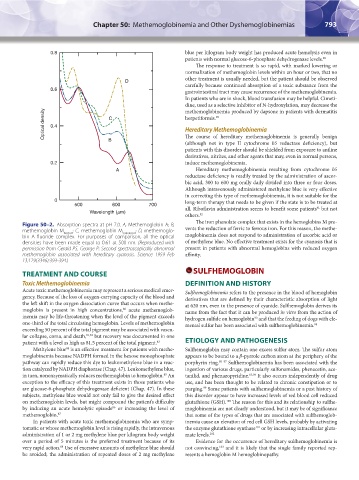
                                                                            The iron phenolate complex that exists in the hemoglobins M pre-
                  Figure 50–2.  Absorption spectra at pH 7.0. A, Methemoglobin A; B,
                  methemoglobin M Boston ; C, methemoglobin M Saskatoon ; D, methemoglo-  vents the reduction of ferric to ferrous iron. For this reason, the methe-
                  bin A  fluoride complex.  For purposes  of comparison,  all the  optical   moglobinemia does not respond to administration of ascorbic acid or
                  densities have been made equal to 0.61 at 500 nm. (Reproduced with   of methylene blue. No effective treatment exists for the cyanosis that is
                  permission from Gerald PS, George P: Second spectroscopically abnormal   present in patients with abnormal hemoglobins with reduced oxygen
                  methemoglobin associated with hereditary cyanosis. Science 1959 Feb   affinity.
                  13;129(3346):393-394.)

                  TREATMENT AND COURSE                                     SULFHEMOGLOBIN
                  Toxic Methemoglobinemia                               DEFINITION AND HISTORY
                  Acute toxic methemoglobinemia may represent a serious medical emer-  Sulfhemoglobinemia refers to the presence in the blood of hemoglobin
                  gency. Because of the loss of oxygen-carrying capacity of the blood and   derivatives that are defined by their characteristic absorption of light
                  the left shift in the oxygen dissociation curve that occurs when methe-  at 620 nm, even in the presence of cyanide. Sulfhemoglobin derives its
                  moglobin is present in high concentrations,  acute methemoglob-  name from the fact that it can be produced in vitro from the action of
                                                    80
                  inemia may be life-threatening when the level of the pigment exceeds   hydrogen sulfide on hemoglobin  and that the feeding of dogs with ele-
                                                                                                93
                  one-third of the total circulating hemoglobin. Levels of methemoglobin   mental sulfur has been associated with sulfhemoglobinemia. 94
                  exceeding 50 percent of the total pigment may be associated with vascu-
                  lar collapse, coma, and death, 81,82  but recovery was documented in one
                  patient with a level as high as 81.5 percent of the total pigment. 83  ETIOLOGY AND PATHOGENESIS
                     Methylene blue  is an effective treatment for patients with methe-  Sulfhemoglobin may contain one excess sulfur atom. The sulfur atom
                                84
                  moglobinemia because NADPH formed in the hexose monophosphate   appears to be bound to a β-pyrrole carbon atom at the periphery of the
                  pathway can rapidly reduce this dye to leukomethylene blue in a reac-  porphyrin ring. 95–97  Sulfhemoglobinemia has been associated with the
                  tion catalyzed by NADPH diaphorase (Chap. 47). Leukomethylene blue,   ingestion of various drugs, particularly sulfonamides, phenacetin, ace-
                  in turn, nonenzymatically reduces methemoglobin to hemoglobin.  An   tanilid, and phenazopyridine. 65,98  It also occurs independently of drug
                                                                 85
                  exception to the efficacy of this treatment exists in those patients who   use, and has been thought to be related to chronic constipation or to
                  are glucose-6-phosphate dehydrogenase deficient (Chap. 47). In these   purging.  Some patients with sulfhemoglobinemia or a past history of
                                                                              99
                  subjects, methylene blue would not only fail to give the desired effect   this disorder appear to have increased levels of red blood cell reduced
                  on methemoglobin levels, but might compound the patient’s difficulty   glutathione (GSH).  The reason for this and its relationship to sulfhe-
                                                                                      100
                  by  inducing  an  acute  hemolytic  episode   or  increasing  the  level  of   moglobinemia are not clearly understood, but it may be of significance
                                                86
                  methemoglobin. 87                                     that some of the types of drugs that are associated with sulfhemoglob-
                     In patients with acute toxic methemoglobinemia who are symp-  inemia cause an elevation of red cell GSH levels, probably by activating
                  tomatic or whose methemoglobin level is rising rapidly, the intravenous   the enzyme glutathione synthase  or by increasing intracellular gluta-
                                                                                                101
                  administration of 1 or 2 mg methylene blue per kilogram body weight   mate levels. 102
                  over a period of 5 minutes is the preferred treatment because of its   Evidence for the occurrence of hereditary sulfhemoglobinemia is
                  very rapid action.  Use of excessive amounts of methylene blue should   not convincing,  and it is likely that the single family reported rep-
                              88
                                                                                    103
                  be avoided; the administration of repeated doses of 2 mg methylene   resents a hemoglobin M hemoglobinopathy.


          Kaushansky_chapter 50_p0789-0800.indd   793                                                                   9/17/15   2:38 PM

