


Page 898 - Williams Hematology ( PDFDrive )
P. 898
872  Part VI:  The Erythrocyte                          Chapter 57:  Primary and Secondary Erythrocytoses             873


                                                                                                          49
                  Polycythemia of High Altitude                         endemic congenital polycythemia in the world.  Outside of Chuvashia,
                  Elevation of red cell mass as a response to high altitude hypoxia rep-  Chuvash polycythemia has also been found sporadically in diverse eth-
                  resents an appropriate adjustment to reduced blood oxygen content   nic and racial groups, 50,51  and recently a high prevalence of this disorder
                  and delivery. The exponentially decreasing atmospheric oxygen pres-  has also been reported on the Italian island of Ischia. 52
                  sure with altitude stimulates the body to accommodate by an increase
                  in respiratory rate and volume. Such adaptation is possible only in the
                  short-term, because the body may not always be able to adequately   ETIOLOGY AND PATHOGENESIS
                  enhance respiration. Polycythemia is considered to be a universal, uni-
                  form adaptation response to hypoxia that arises in normal individuals,   PRIMARY POLYCYTHEMIAS
                  but when it is exaggerated, in some cases it results in chronic mountain   Primary Familial and Congenital Polycythemia
                  sickness with associated symptoms of fatigue, headache, and pulmonary   In contrast to polycythemia vera, PFCP is caused by germline rather
                  hypertension. 42                                      than acquired somatic mutations. It is congenital and manifests autoso-
                     Altitude above sea level should be used as an independent variable   mal dominant inheritance  and, not infrequently, sporadic occurrence
                                                                                           3
                  for the definition of polycythemia  and Centers for Disease Control   from de novo germline mutations. Like polycythemia vera (Chap. 84),
                                           43
                  data lists the appropriate adjustment values. 44      it is primary in that the defect changes intrinsic responses of erythroid
                                                                        progenitors, and erythropoietin levels are low.
                  Post–Renal Transplant Erythrocytosis                      To date, 12 mutations of the erythropoietin receptor (EPOR) asso-
                  This syndrome, defined as a persistent elevation of hematocrit at greater   ciated with PFCP have been described (Table 57–1). Nine of the 12
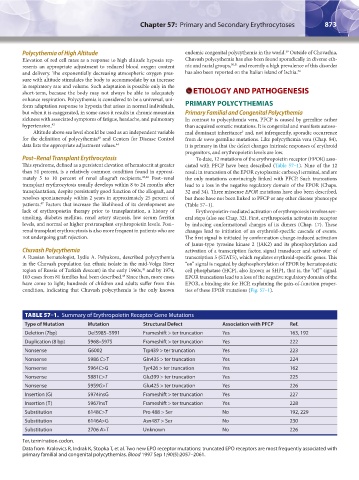
                  than 51 percent, is a relatively common condition found in approxi-  result in truncation of the EPOR cytoplasmic carboxyl terminal, and are
                  mately 5 to 10 percent of renal allograft recipients. 45,46  Post–renal   the only mutations convincingly linked with PFCP. Such truncations
                  transplant erythrocytosis usually develops within 8 to 24 months after   lead to a loss in the negative regulatory domain of the EPOR (Chaps.
                  transplantation, despite persistently good function of the allograft, and   32 and 34). Three missense EPOR mutations have also been described,
                  resolves spontaneously within 2 years in approximately 25 percent of   but these have not been linked to PFCP or any other disease phenotype
                  patients.  Factors that increase the likelihood of its development are   (Table  57–1).
                        47
                  lack of erythropoietin therapy prior to transplantation, a history of   Erythropoietin-mediated activation of erythropoiesis involves sev-
                  smoking, diabetes mellitus, renal artery stenosis, low serum ferritin   eral steps (also see Chap. 32). First, erythropoietin activates its receptor
                  levels, and normal or higher pretransplant erythropoietin levels. Post–  by inducing conformational changes of its dimers (Chap. 17). These
                  renal transplant erythrocytosis is also more frequent in patients who are   changes lead to initiation of an erythroid-specific cascade of events.
                  not undergoing graft rejection.                       The first signal is initiated by conformation change-induced activation
                                                                        of Janus-type tyrosine kinase 2 (JAK2) and its phosphorylation and
                  Chuvash Polycythemia                                  activation of a transcription factor, signal transducer and activator of
                  A Russian hematologist, Lydia A. Polyakova, described polycythemia   transcription 5 (STAT5), which regulates erythroid-specific genes. This
                  in the Chuvash population (an ethnic isolate in the mid-Volga River   “on” signal is negated by dephosphorylation of EPOR by hematopoietic
                  region of Russia of Turkish descent) in the early 1960s,  and by 1974,   cell phosphatase (HCP), also known as SHP1, that is, the “off” signal.
                                                          48
                  103 cases from 81 families had been described.  Since then, more cases   EPOR truncations lead to a loss of the negative regulatory domain of the
                                                   48
                  have come to light; hundreds of children and adults suffer from this   EPOR, a binding site for HCP, explaining the gain-of-function proper-
                  condition, indicating that Chuvash polycythemia is the only known   ties of these EPOR mutations (Fig. 57–1).


                   TABLE 57–1.  Summary of Erythropoietin Receptor Gene Mutations
                   Type of Mutation     Mutation          Structural Defect          Association with PFCP  Ref.
                   Deletion (7bp)       Del5985–5991      Frameshift > ter truncation  Yes                  163, 192
                   Duplication (8 bp)   5968–5975         Frameshift > ter truncation  Yes                  222
                   Nonsense             G6002             Trp439 > ter truncation    Yes                    223
                   Nonsense             5986 C>T          Gln435 > ter truncation    Yes                    224
                   Nonsense             5964C>G           Tyr426 > ter truncation    Yes                    162
                   Nonsense             5881C>T           Glu399 > ter truncation    Yes                    225
                   Nonsense             5959G>T           Glu425 > ter truncation    Yes                    226
                   Insertion (G)        5974insG          Frameshift > ter truncation  Yes                  227
                   Insertion (T)        5967insT          Frameshift > ter truncation  Yes                  228
                   Substitution         6148C>T           Pro 488 > Ser              No                     192, 229
                   Substitution         6146A>G           Asn487 > Ser               No                     230
                   Substitution         2706 A>T          Unknown                    No                     226
                  Ter, termination codon.
                  Data from  Kralovics R, Indrak K, Stopka T, et al. Two new EPO receptor mutations: truncated EPO receptors are most frequently associated with
                  primary familial and congenital polycythemias. Blood 1997 Sep 1;90(5):2057–2061.


          Kaushansky_chapter 57_p0871-0888.indd   873                                                                   9/18/15   9:36 AM

