


Page 899 - Williams Hematology ( PDFDrive )
P. 899
874            Part VI:  The Erythrocyte                                                                                                                             Chapter 57:  Primary and Secondary Erythrocytoses             875


                                                Erythropoietin                  Receptor


                                               PO4        JAK               PO4         JAK
                                                                                           STAT5
                                                            STAT5    HCP
                                         Negative        HCP                            HCP
                                        regulatory
                                          domain

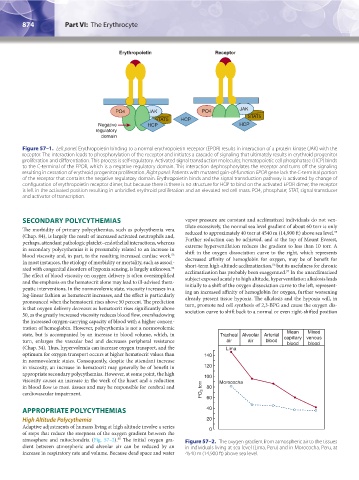
               Figure 57–1.  Left panel: Erythropoietin binding to a normal erythropoietin receptor (EPOR) results in interaction of a protein kinase (JAK) with the
               receptor. The interaction leads to phosphorylation of the receptor and initiates a cascade of signaling that ultimately results in erythroid progenitor
               proliferation and differentiation. This process is self-regulatory. Activated signal transduction molecules, hematopoietic cell phosphatase (HCP) binds
               to the C-terminal of the EPOR, which is a negative regulatory domain. This interaction dephosphorylates the receptor and turns off the signaling
               resulting in cessation of erythroid progenitor proliferation. Right panel: Patients with mutated gain-of-function EPOR gene lack the C-terminal portion
               of the receptor that contains the negative regulatory domain. Erythropoietin binds and the signal transduction pathway is activated by change of
               configuration of erythropoietin receptor dimer, but because there is there is no structure for HCP to bind on the activated EPOR dimer, the receptor
               is left in the activated position resulting in unbridled erythroid proliferation and an elevated red cell mass. PO4, phosphate; STAT, signal transducer
               and activator of transcription.


               SECONDARY POLYCYTHEMIAS                                vapor pressure are constant and acclimatized individuals do not ven-
               The morbidity of primary polycythemias, such as polycythemia vera   tilate excessively, the normal sea level gradient of about 60 torr is only
                                                                      reduced to approximately 40 torr at 4540 m (14,900 ft) above sea level.
                                                                                                                        55
               (Chap. 84), is largely the result of increased activated neutrophils and,   Further reduction can be achieved, and at the top of Mount Everest,
               perhaps, attendant pathologic platelet–endothelial interactions, whereas   extreme hyperventilation reduces the gradient to less than 10 torr. A
               in secondary polycythemias it is presumably related to an increase in   shift  in the oxygen  dissociation curve  to the right, which  represents
                                                                 53
               blood viscosity and, in part, to the resulting increased cardiac work.    decreased affinity of hemoglobin for oxygen, may be of benefit for
               In most instances, the etiology of morbidity or mortality, such as associ-  short-term high-altitude acclimatization,  but its usefulness for chronic
                                                                                                   56
                                                                 54
               ated with congenital disorders of hypoxia sensing, is largely unknown.    acclimatization has probably been exaggerated.  In the unacclimatized
                                                                                                        57
               The effect of blood viscosity on oxygen delivery is often oversimplified   subject exposed acutely to high altitude, hyperventilation alkalosis leads
               and the emphasis on the hematocrit alone may lead to ill-advised thera-  initially to a shift of the oxygen dissociation curve to the left, represent-
               peutic interventions. In the normovolemic state, viscosity increases in a   ing an increased affinity of hemoglobin for oxygen, further worsening
               log-linear fashion as hematocrit increases, and the effect is particularly   already present tissue hypoxia. The alkalosis and the hypoxia will, in
               pronounced when the hematocrit rises above 50 percent. The prediction   turn, promote red cell synthesis of 2,3-BPG and cause the oxygen dis-
               is that oxygen delivery decreases as hematocrit rises significantly above   sociation curve to shift back to a normal or even right-shifted position
               50, as the greatly increased viscosity reduces blood flow, overshadowing
               the increased oxygen-carrying capacity of blood with a higher concen-
               tration of hemoglobin. However, polycythemia is not a normovolemic
               state, but is accompanied by an increase in blood volume, which, in   Tracheal Alveolar  Arterial  Mean  Mixed
               turn, enlarges the vascular bed and decreases peripheral resistance   air   air   blood  capillary venous
                                                                                                        blood
                                                                                                               blood
               (Chap. 34). Thus, hypervolemia can increase oxygen transport, and the   Lima
               optimum for oxygen transport occurs at higher hematocrit values than   140
               in normovolemic states. Consequently, despite the attendant increase
               in viscosity, an increase in hematocrit may generally be of benefit in   120
               appropriate secondary polycythemias. However, at some point, the high   100
               viscosity causes an increase in the work of the heart and a reduction   Morococha
               in blood flow to most tissues and may be responsible for cerebral and   80
               cardiovascular impairment.                                  PO 2  torr  60

               APPROPRIATE POLYCYTHEMIAS                                     40
               High Altitude Polycythemia                                    20
               Adaptive adjustments of humans living at high altitude involve a series
               of steps that reduce the steepness of the oxygen gradient between the   0
               atmosphere and mitochondria (Fig. 57–2).  The initial oxygen gra-  Figure 57–2.  The oxygen gradient from atmospheric air to the tissues
                                               55
               dient between atmospheric and alveolar air can be reduced by an   in individuals living at sea level (Lima, Peru) and in Morococha, Peru, at
               increase in respiratory rate and volume. Because dead space and water   4540 m (14,900 ft) above sea level.


          Kaushansky_chapter 57_p0871-0888.indd   874                                                                   9/18/15   9:36 AM

