


Page 960 - Williams Hematology ( PDFDrive )
P. 960
934  Part VII:  Neutrophils, Eosinophils, Basophils, and Mast Cells  Chapter 60:  Structure and Composition of Neutrophils, Eosinophils, and Basophils  935


                     Gene expression profiling has provided rich insights into the   TABLE 60–8.  Unbound Amino Acid Concentrations in
                  capacity of the mature neutrophil to change in response to envi-
                  ronmental stimuli. Following exposure to 10 ng/mL Escherichia coli   Leukocytes (Lymphocytes Included)
                                                  114
                  LPS, 307 genes are activated or repressed.  These changes include   Amino Acid   μmol/kg Water*
                  transcription factors, cytokines, chemokines, interleukins, surface   Alanine       2881 ± 256
                  antigens, toll-like receptors, and members of immune mediator gene
                                                                   115
                  families. Major changes in gene expression occur following LPS,    Arginine             <290
                                                         117
                                  116
                  migration in wounds,  activation by phagocytosis,  or during the   Ergothioneine        <300
                  processes of apoptosis.  These findings indicate that the neutrophil   Ethanolamine     <250
                                   118
                  is a transcriptionally active cell responsive to environmental stimuli
                  and capable of a complex series of both early and late changes in   Glutamic acid   2745 ± 251
                  gene expression.                                       Glutamine                    2650 ± 251
                                                                         Histidine                      762 ± 70
                       OTHER BIOCHEMICAL FEATURES                        Leucine plus isoleucine      1999 ± 195
                     OF NEUTROPHILS.                                     Lysine                       2111 ± 216
                                                                         Methionine                     391 ± 54
                  The neutrophil is particularly rich in glycogen. The concentration of
                  this complex polysaccharide has been reported to average 7.36 mg/10    O-phosphoethanolamine  2651 ± 389
                                                                    9
                  cells. 119–121   The  rate  of  glucose  metabolism  by  neutrophils  is  affected   Ornithine  1767 ± 113
                  by insulin in diabetics but not in normal subjects. 122,123  Inflammatory
                  activation of normal neutrophils stimulates glucose uptake. The plasma   Phenylalanine  647 ± 105
                  membrane and the membranes of the intracellular organelles are rich   Proline         862 ± 79
                  in lipids. Five percent of the wet weight of neutrophils is lipid, which   Serine plus glycine  13,021 ± 1480
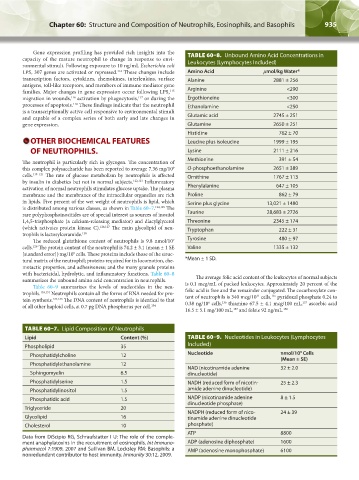
                  is distributed among various classes, as shown in Table 60–7. 124,125  The
                  rare polyphosphoinositides are of special interest as sources of inositol   Taurine  28,683 ± 2726
                  1,4,5-trisphosphate (a calcium-releasing mediator) and diacylglycerol   Threonine   2345 ± 174
                  (which activates protein kinase C). 126,127  The main glycolipid of neu-  Tryptophan  222 ± 31
                  trophils is lactosylceramide. 128
                     The reduced glutathione content of neutrophils is 9.8 nmol/10    Tyrosine          480 ± 97
                                                                    7
                     129
                  cells.  The protein content of the neutrophil is 74.2 ± 3.1 (mean ± 1 SE   Valine   1335 ± 132
                  [standard error]) mg/10  cells. These proteins include those of the struc-
                                   9
                  tural matrix of the neutrophil; proteins required for its locomotion, che-  *Mean ± 1 SD.
                  motactic properties, and adhesiveness; and the many granule proteins
                  with bactericidal, hydrolytic, and inflammatory functions. Table 60–8
                  summarizes the unbound amino acid concentration in neutrophils.  The average folic acid content of the leukocytes of normal subjects
                     Table 60–9 summarizes the levels of nucleotides in the neu-  is 0.1 mcg/mL of packed leukocytes. Approximately 20 percent of the
                  trophils. 130,131  Neutrophils contain all the forms of RNA needed for pro-  folic acid is free and the remainder conjugated. The cocarboxylate con-
                                                                                                     135
                                                                                                11
                  tein synthesis. 132,133  The DNA content of neutrophils is identical to that   tent of neutrophils is 340 mcg/10  cells,  pyridoxal phosphate 0.24 to
                                                                                                                137
                                                                                6
                                                                                     136
                  of all other haploid cells, at 0.7 pg DNA phosphorus per cell. 134  0.38 ng/10  cells,  thiamine 67.5 ± 4.1 mcg/100 mL,  ascorbic acid
                                                                        16.5 ± 5.1 mg/100 mL,  and folate 92 ng/mL. 138
                                                                                         137
                   TABLE 60–7.  Lipid Composition of Neutrophils
                   Lipid                           Content (%)           TABLE 60–9.  Nucleotides in Leukocytes (Lymphocytes
                   Phospholipid                    35                    Included)
                                                                                                               9
                    Phosphatidylcholine            12                    Nucleotide                     nmol/10  Cells
                                                                                                        (Mean ± SE)
                    Phosphatidylethanolamine       12
                                                                         NAD (nicotinamide adenine      32 ± 2.0
                    Sphingomyelin                  6.5                   dinucleotide)
                    Phosphatidylserine             1.5                   NADH (reduced form of nicotin-  25 ± 2.3
                    Phosphatidylinositol           1.5                   amide adenine dinucleotide)
                    Phosphatidic acid              1.5                   NADP (nicotinamide adenine     8 ± 1.5
                                                                         dinucleotide phosphate)
                   Triglyceride                    20
                                                                         NADPH (reduced form of nico-   24 ± 39
                   Glycolipid                      16                    tinamide adenine dinucleotide
                   Cholesterol                     10                    phosphate)
                                                                         ATP                            8800
                  Data from DiScipio RG, Schraufstatter I U: The role of the comple-
                  ment anaphylatoxins in the recruitment of eosinophils. Int Immuno-  ADP (adenosine diphosphate)  1600
                  pharmacol 7:1909, 2007 and Sullivan BM, Locksley RM: Basophils: a   AMP (adenosine monophosphate)  6100
                  nonredundant contributor to host immunity. Immunity 30:12, 2009.


          Kaushansky_chapter 60_p0923-0938.indd   935                                                                   9/18/15   10:35 PM

