


Page 1059 - Clinical Immunology_ Principles and Practice ( PDFDrive )
P. 1059
1022         Part seven  Organ-Specific Inflammatory Disease


        anti-SMA. Also, AIH-1 may deteriorate despite corticosteroid   TABLE 76.1  Diagnostic Criteria for
                                                          2
        treatment and is more likely to progress to liver transplantation.    autoimmune Hepatitis
        Type 2 AIH (AIH-2) affects primarily girls and young women,
        and it has been linked to alleles encoding the DR3 (DRB1*0301)   Criteria                          Points
        and DR7 (DRB1*07:01) molecules, and to positivity for anti-LMK   Sex
        antibodies. 2                                            Male                                        +2
           Blood tests usually show marked elevation of aminotransfer-  Female                                0
        ases, usually with an increase in the cholestatic pattern (increased   Ratio of alkaline phosphatase vs. AST/ALT
        alkaline phosphatase, bilirubin). Furthermore, serum globulins,   >3.0                               +3
        particularly of the γ type, are commonly increased in AIH cases,   1.5–2.0                           +2
                                                                                                             +1
                                                                 1.0–1.5
        regardless of the histological stage.                    <1.0                                         0
           Lastly and most importantly, serum autoantibodies are invari-  Autoantibodies (ANA, SMA, LKM-1) titer
        ably positive (defined as titer  >1 : 80) in patients with  AIH.   >1 : 80                           +3
        Antinuclear antibodies (ANAs) and/or antismooth-muscle (SMAs,   1 : 80                               +2
        directed against actin) autoantibodies are more frequently detected   1 : 40                         +1
        in AIH-1, whereas anti-LKM-1 antibodies (directed at cytochrome   <1 : 40                             0
                                                                 AMA
        P450 2D6 or UDP-glucuronosyltransferases) predominate in   Positive                                  −4
        AIH-2.                                                   Negative                                     0
           Without treatment, the clinical course of AIH is characterized   Seropositivity for other autoantibodies  +2
        by high mortality, with 5- and 10-year survival rates estimated   Viral hepatitis markers
        as 50% and 10%, respectively. However, the use of corticosteroids   Negative                         +3
        has dramatically improved the course of the disease, with a 10-year   Positive                       −3
                              2
        survival rate exceeding 90%.  Complications associated with AIH   History of drug use                −4
                                                                 Yes
        are similar to those of other progressive liver diseases, as chronic   No                            +1
        hepatitis can evolve to cirrhosis and ultimately to hepatocellular   Average alcohol consumption (g/day)
        carcinoma (HCC), despite the use of immunosuppressive therapy.   <25                                 +2
        At the time of diagnosis, approximately 30% of adult patients   >60                                  −2
        have histological evidence of cirrhosis; when appropriately treated,   Presence of genetic factors (HLA, DR3 or DR4)  +1
        however, only a small number of patients develop cirrhosis during   Presence of other autoimmune disorders  +2
                                                                 Liver histology
        follow-up if inflammation is resolved. The occurrence of HCC   Interface hepatitis                   +3
        in patients with AIH is a rare event and develops only in long-  Predominant lymphocytic infiltrate  +1
        standing cirrhosis. In the absence of solid data on large numbers   Rosetting of liver cells         +1
        of cases, the incidence of primary liver neoplasia  should  be   None of the above                   −5
        regarded as similar to other nonviral cases of cirrhosis.  Biliary changes                           −3
           There is no single diagnostic test for AIH; therefore diagnosis   Other changes                   −3
        is based upon several indicative clinical, serological, biochemical,   Response to therapy           +2
                                                                 Complete
        and histological findings. The presence of other causes of liver   Relapse                           +3
        disease must also be excluded. A set of diagnostic criteria has
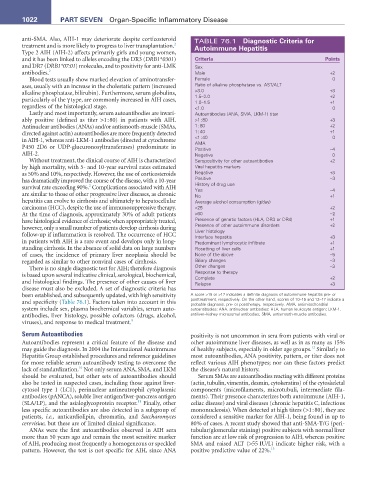
        been established, and subsequently updated, with high sensitivity   A score >15 or >17 indicates a definite diagnosis of autoimmune hepatitis pre- or
        and specificity (Table 76.1). Factors taken into account in this   posttreatment, respectively. On the other hand, scores of 10–15 and 12–17 indicate a
                                                               probable diagnosis, pre- or posttherapy, respectively. AMA, antimitochondrial
        system include sex, plasma biochemical variables, serum auto-  autoantibodies; ANA, antinuclear antibodies; HLA, human leukocyte antigen; LKM-1,
        antibodies, liver histology, possible cofactors (drugs, alcohol,   antiliver–kidney microsomal antibodies; SMA, antismooth-muscle antibodies.
        viruses), and response to medical treatment. 9
        Serum Autoantibodies                                   positivity is not uncommon in sera from patients with viral or
        Autoantibodies represent a critical feature of the disease and   other autoimmune liver diseases, as well as in as many as 15%
                                                                                                       12
        may guide the diagnosis. In 2004 the International Autoimmune   of healthy subjects, especially in older age groups.  Similarly to
        Hepatitis Group established procedures and reference guidelines   most autoantibodies, ANA positivity, pattern, or titer does not
        for more reliable serum autoantibody testing to overcome the   reflect various AIH phenotypes; nor can these factors predict
                           10
        lack of standardization.  Not only serum ANA, SMA, and LKM   the disease’s natural history.
        should be evaluated, but other sets of autoantibodies should   Serum SMAs are autoantibodies reacting with different proteins
        also be tested in suspected cases, including those against liver-  (actin, tubulin, vimentin, desmin, cytokeratins) of the cytoskeletal
        cytosol type 1 (LC1), perinuclear antineutrophil cytoplasmic   components (microfilaments, microtubuli, intermediate fila-
        antibodies (pANCA), soluble liver antigen/liver-pancreas antigen   ments). Their presence characterizes both autoimmune (AIH-1,
                                              11
        (SLA/LP), and the asialoglycoprotein receptor.  Finally, other   celiac disease) and viral diseases (chronic hepatitis C, infectious
        less specific autoantibodies are also detected in a subgroup of   mononucleosis). When detected at high titers (>1 : 80), they are
        patients,  i.e., anticardiolipin, chromatin, and  Saccharomyces   considered a sensitive marker for AIH-1, being found in up to
        cerevisiae, but these are of limited clinical significance.  80% of cases. A recent study showed that anti-SMA-T/G (peri-
           ANAs were the first autoantibodies observed in  AIH sera   tubular/glomerular staining) positive subjects with normal liver
        more than 50 years ago and remain the most sensitive marker   function are at low risk of progression to AIH, whereas positive
        of AIH, producing most frequently a homogeneous or speckled   SMA and raised ALT (>55 IU/L) indicate higher risk, with a
        pattern. However, the test is not specific for AIH, since ANA   positive predictive value of 22%. 13

