


Page 1064 - Clinical Immunology_ Principles and Practice ( PDFDrive )
P. 1064
CHaPter 76  Inflammatory Hepatobiliary Diseases              1027


           Minnesota, reported a disease prevalence of 20.9 per 100 000   normal until late stages. Autoantibodies are of limited use in
                                    36
           men and 6.3 per 100 000 women.  Epidemiological data indicate   the diagnosis of PSC due to low sensitivity and specificity. Only
           that annual incidence rates are not increasing over time despite   a limited percentage of patients (33%) has positive pANCA,
           earlier ages at diagnosis, and survival is possibly longer, similar   which usually is found in IBD patients without PSC.
           to what was observed in PBC.                             Imaging represents a useful diagnostic tool, as it may find
             In contrast to the vast majority of autoimmune diseases, PSC   the unique strictured and dilated tracts within the intrahepatic
           is more commonly diagnosed in men, with a female:male ratio   or extrahepatic bile ducts.  Among the imaging techniques,
           estimated as 1 : 2, with a preference for 30- to 40-year-olds. PSC   endoscopic retrograde cholangiopancreatography (ERCP) and
           has a strong association with inflammatory bowel disease.   magnetic resonance cholangiopancreatography (MRCP) are
           Approximately 60–80%  of patients with  PSC present with   currently considered equal for sensitivity, but their results are
           inflammatory bowel disease, of which 87% have ulcerative colitis   influenced by the operator’s skill and experience.
           and 13% have Crohn disease. 37
                                                                  Histology
           Pathogenesis                                           Although not necessary for establishing the diagnosis, liver
           The etiopathogenesis of PSC is unknown, but evidence is growing   histology is essential when staging PSC or when the small-duct
           that (auto) immune-mediated mechanisms play a role. The notion   variant, an overlap syndrome, or CCA is suspected. The histologi-
           of an autoimmune pathogenesis is supported by the frequent   cal picture varies widely, from minimal alterations to cirrhosis
           association with inflammatory bowel disease (IBD), the presence   with portal inflammation, concentric “onion skin” periductal
           of serum autoantibodies, and the reported HLA associations.   fibrosis, and periportal fibrosis developing into septal and bridging
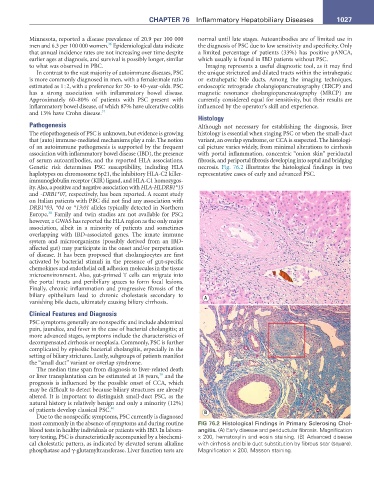
           Genetic risk determines PSC susceptibility, including HLA   necrosis.  Fig. 76.2 illustrates the histological findings in two
           haplotypes on chromosome 6p21, the inhibitory HLA-C2 killer-  representative cases of early and advanced PSC.
           immunoglobulin receptor (KIR) ligand, and HLA-C1 homozygos-
           ity. Also, a positive and negative association with HLA-HLDRB1*15
           and -DRB1*07, respectively, has been reported. A recent study
           on Italian patients with PBC did not find any association with
           DRB1*03, *04 or *13:01 alleles typically detected in Northern
                 38
           Europe.  Family and twin studies are not available for PSC;
           however, a GWAS has reported the HLA region as the only major
           association, albeit in a minority of patients and sometimes
           overlapping with IBD-associated genes. The innate immune
           system and microorganisms (possibly derived from an IBD-
           affected gut) may participate in the onset and/or perpetuation
           of disease. It has been proposed that cholangiocytes are first
           activated by bacterial stimuli in the presence of gut-specific
           chemokines and endothelial cell adhesion molecules in the tissue
           microenvironment. Also, gut-primed T cells can migrate into
           the portal tracts and peribiliary spaces to form focal lesions.
           Finally, chronic inflammation and progressive fibrosis of the
           biliary epithelium lead to chronic cholestasis secondary to   A
           vanishing bile ducts, ultimately causing biliary cirrhosis.
           Clinical Features and Diagnosis
           PSC symptoms generally are nonspecific and include abdominal
           pain, jaundice, and fever in the case of bacterial cholangitis; at
           more advanced stages, symptoms include the characteristics of
           decompensated cirrhosis or neoplasia. Commonly, PSC is further
           complicated by episodic bacterial cholangitis, especially in the
           setting of biliary strictures. Lastly, subgroups of patients manifest
           the “small duct” variant or overlap syndrome.
             The median time span from diagnosis to liver-related death
                                                     39
           or liver transplantation can be estimated at 18 years,  and the
           prognosis  is influenced  by  the possible onset  of  CCA, which
           may be difficult to detect because biliary structures are already
           altered. It is important to distinguish small-duct PSC, as the
           natural history is relatively benign and only a minority (12%)
           of patients develop classical PSC. 40                    B
             Due to the nonspecific symptoms, PSC currently is diagnosed
           most commonly in the absence of symptoms and during routine   FIG 76.2  Histological Findings in Primary Sclerosing Chol-
           blood tests in healthy individuals or patients with IBD. In labora-  angitis. (A) Early disease and periductular fibrosis. Magnification
           tory testing, PSC is characteristically accompanied by a biochemi-  x 200, hematoxylin and eosin staining. (B) Advanced disease
           cal cholestatic pattern, as indicated by elevated serum alkaline   with cirrhosis and bile duct substitution by fibrous scar (square).
           phosphatase and γ-glutamyltransferase. Liver function tests are   Magnification × 200, Masson staining.

