


Page 1079 - Clinical Immunology_ Principles and Practice ( PDFDrive )
P. 1079
1044         ParT EighT  Immunology of Neoplasia


         TABLE 77.2  Frequency of immune-related adverse Events in Phase iii Clinical Trials With
         immune Checkpoint Therapies across Diseases

                                   any Toxicity
                                   all grades %/
          Drug/ Disease/No. of pts  grade ≥3 %     Diarrhea  Colitis      Pneumonitis  hepatitis  rash  Endocrine
          Ipilimumab                                 33/5   8/5               NA          4/0    44/2      8/4
          Melanoma 108
          {Hodi FS, 2010 #10}
          Ipilimumab Adjuvant
          Melanoma Resected/       99/55             49/10  16.3/8            NA         25/8    34/13    38/8
           471{Eggermont AM, 201 #59}
          Ipilimumab
          MCRPC 393{Kwon ED, 2014 #56}  98/59        51/17  7/5               NA         12/4    17/1      5/2
          Tremelimumab             96/52             51/18  NA included with   NA         1/1    33/2      8/3
          Melanoma 325{Ribas A, 2013 #58}                     diarrhea
          Ipilimumab/ 311          99/56             33/6   12/9              2/0         7/2    35/0     11/2
          Nivolumab/ 313           99/44             19/2   1/1               1/0         6/3    22/0     14/1
          Combination/ 313         100/69            44/9   12/8                                 28/3     30/5
          Melanoma
          {Larkin J, 2015 #1}
                                   Related to Tx
          Pembro Q2wk / 278        80/13             17/3   2/1               0/0         1/1    15/0     17/1
          Pembro Q3wk / 277        73/10             15/1   4/3               1/0         2/2    13/0     13/1
          Ipilimumab / 256         73/20             23/3   8/7               0/0         1/0    15/1      7/2
          Melanoma
          {Robert C, 2015 #9}
          Nivolumab
          NSCLC Squamous 272       58/7               8/0   1/1               5/1         2/0     4/0      2/ 0
          {Brahmer J, 2015 #43}    69/10              8/1   1/1               4/1         1/1    13/1      8/0
          NSCLC Non-Squamous 292
          {Borghaei H, 2015 #42}
          Pembro
          2 mg/kg / 339            63/15              7/1   1/1               5/2         1/<1    9/<1    14/1
          10 mg/kg 343             66/16              6/1   1/<1              4/2         1/0    13/<1    16/1
          NSCLC All{Herbst RS, 2015 #45}
          Nivolumab
          MRCC / 406{Motzer RJ, 2015 #31}  79/19     12/1   NA                4/1         NA     10/<1    NA
        MCRPC, metastatic castrate-resistant prostate cancer; NSCLC, non–small-cell lung cancer; MRCC, metastatic clear-cell renal cell carcinoma; pembro, Pembrolizumab; NA, not
        available; pts, patients.


        germ-free tumor bearing mice did not respond to anti-CTLA-4   immune checkpoint antibodies can be associated with distinctive
                                                                                      81
        therapy compared with mice harboring  Bacteroides fragilis.   inflammatory tissue damage,  which has been termed immune-
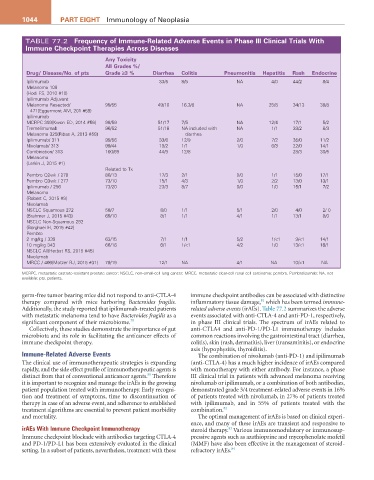
        Additionally, the study reported that ipilimumab-treated patients   related adverse events (irAEs). Table 77.2 summarizes the adverse
        with metastatic melanoma tend to have Bacteroides fragilis as a   events associated with anti-CTLA-4 and anti-PD-1, respectively,
        significant component of their microbiome. 79          in phase III clinical trials. The spectrum of irAEs related to
           Collectively, these studies demonstrate the importance of gut   anti-CTLA4 and  anti-PD-1/PD-L1  immunotherapy includes
        microbiota and its role in facilitating the anticancer effects of   common reactions involving the gastrointestinal tract (diarrhea,
        immune checkpoint therapy.                             colitis), skin (rash, dermatitis), liver (transaminitis), or endocrine
                                                               axis (hypophysitis, thyroiditis).
        Immune-Related Adverse Events                             The combination of nivolumab (anti-PD-1) and ipilimumab
        The clinical use of immunotherapeutic strategies is expanding   (anti-CTLA-4) has a much higher incidence of irAEs compared
        rapidly, and the side effect profile of immunotherapeutic agents is   with monotherapy with either antibody. For instance, a phase
                                                 80
        distinct from that of conventional anticancer agents.  Therefore   III clinical trial in patients with advanced melanoma receiving
        it is important to recognize and manage the irAEs in the growing   nivolumab or ipilimumab, or a combination of both antibodies,
        patient population treated with immunotherapy. Early recogni-  demonstrated grade 3/4 treatment-related adverse events in 16%
        tion and treatment of symptoms, time to discontinuation of   of patients treated with nivolumab, in 27% of patients treated
        therapy in case of an adverse event, and adherence to established   with ipilimumab, and in 55% of patients treated with the
        treatment algorithms are essential to prevent patient morbidity   combination. 82
        and mortality.                                            The optimal management of irAEs is based on clinical experi-
                                                               ence, and many of these irAEs are transient and responsive to
        irAEs With Immune Checkpoint Immunotherapy             steroid therapy.  Various immunomodulatory or immunosup-
                                                                            83
        Immune checkpoint blockade with antibodies targeting CTLA-4   pressive agents such as azathioprine and mycophenolate mofetil
        and PD-1/PD-L1 has been extensively evaluated in the clinical   (MMF) have also been effective in the management of steroid-
        setting. In a subset of patients, nevertheless, treatment with these   refractory irAEs. 84

