


Page 1074 - Clinical Immunology_ Principles and Practice ( PDFDrive )
P. 1074
ChaPTEr 77  Immunotherapy of Cancer               1039


             Several early-phase clinical trials have evaluated different doses,   costimulatory signal for T-cell proliferation and survival. We
                                                                                    +
           schedules, and combinations of immune checkpoint inhibitors   have shown that ICOS  effector T cells increase in patients after
                                                                                                45
           in patients with mCRPC.  A phase I/II trial (CA184–107) of   anti-CTLA-4 (ipilimumab) treatment.  An increased frequency
                                                                        +
           ipilimumab as a single agent or in combination with radiotherapy   of ICOS  CD4 T cells was also identified as a pharmacodynamic
                                                                                                46
           in patients with previously treated mCRPC demonstrated a   biomarker of anti-CTLA-4 therapy.   Another study with a
                                                            42
           decline in prostate-specific antigen (PSA) in 15% of patients.    different anti-CTLA-4 antibody (tremelimumab) also reported
                                                                                  +
           However, a phase III clinical trial (CA184–043) of bone-directed   an increase in ICOS  CD4 T cells in blood samples obtained
                                                                                             47
           radiotherapy followed by either ipilimumab or placebo in patients   from patients with breast cancer.  Collectively, these findings
           with mCRPC failed to demonstrate an improvement in OS. 43  indicated a biologically relevant role for ICOS in antitumor
             Further studies are warranted to investigate the potential   immune responses elicited by anti-CTLA-4 therapy.
           effects  of  combining  immune  checkpoint  therapy  with  other   Furthermore, preclinical studies demonstrated that combina-
           treatment strategies, including other immunotherapies, chemo-  tion therapy with anti-CTLA-4 plus an agonist to target the
           therapy,  radiotherapy,  and  hormonal  agents,  in  patients  with   ICOS/ICOSL pathway led to a significant improvement in T-cell
                                                                                           48
           prostate cancer in different treatment settings (metastatic hor-  responses and tumor rejection.  These data led multiple phar-
           mone-naïve or metastatic castration-resistant disease).  maceutical companies to pursue the development of an anti-ICOS
                                                                  antibody, including a recent trial with GSK3359609, an anti-ICOS
           IMMUNE COSTIMULATORY MOLECULES                         antibody for treating patients with advanced solid tumors
                                                                  (NCT02723955; ClinicalTrials.gov).
           Multiple ligand-receptor interactions play a pivotal role in shaping   ICOS previously was shown to be expressed on T-follicular
                                                                                   49
           T-cell responses, including those that positively regulate T-cell   helper cells (Tfh cells).  A clinical trial is ongoing with administra-
           function, thus making them potential targets for cancer immu-  tion of an anti-ICOS antibody as treatment for patients with
           notherapy. Many such costimulatory molecules are being   relapsed or refractory peripheral T-cell lymphoma follicular
           investigated in preclinical or early-phase clinical studies. The   variant or angioimmunoblastic T-cell lymphoma (ClinicalTrials.
           two major families of costimulatory receptors expressed by T   gov).
           cells are the immunoglobulin-like (Ig) superfamily (including
           inducible T-cell costimulator [ICOS]) and the tumor necrosis   4-1BB (CD137)
           factor receptor (TNFR) superfamily (including OX40 and   4-1BB (CD137) is an activation-induced costimulatory molecule
                 44
           4–1BB).  These costimulatory molecules are suitable candidates   that is expressed on activated T cells, NK cells, dendritic cells,
           for the development of targeted therapeutics.  A schematic   eosinophils, mast cells, endothelial cells, and  some tumor
           overview of the costimulatory and coinhibitory ligand-receptor   cells. Anti-4-1BB mAs have demonstrated improved antitumor
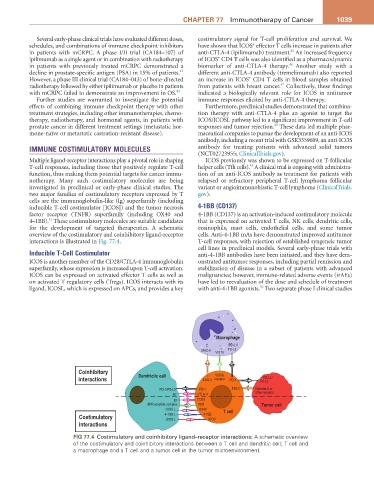
           interactions is illustrated in Fig. 77.4.              T-cell responses, with rejection of established syngeneic tumor
                                                                  cell lines in preclinical models. Several early-phase trials with
           Inducible T-Cell Costimulator                          anti-4-1BB antibodies have been initiated, and they have dem-
           ICOS is another member of the CD28/CTLA-4 immunoglobulin   onstrated antitumor responses, including partial remission and
           superfamily, whose expression is increased upon T-cell activation.   stabilization of disease in a subset of patients with advanced
           ICOS can be expressed on activated effector T cells as well as   malignancies; however, immune-related adverse events (irAEs)
           on activated T regulatory cells (Tregs). ICOS interacts with its   have led to reevaluation of the dose and schedule of treatment
                                                                                      50
           ligand, ICOSL, which is expressed on APCs, and provides a key   with anti-4-1BB agonists.  Two separate phase I clinical studies


                                                                        Macrophage
                                                                             PD-L1/
                                                                    MHC-II   VISTA  PD-L2


                           Coinhibitory                                VISTA
                           interactions       Dendrictic cell      LAG-3  receptor  PD-1      PD-L1/
                                                                                      PD-L2

                                                     PD-1/PD-L1      PD-1    TIM-3   Galectin 9 or
                                                          B7      CTLA-4             other receptor
                                                          B7      CD28
                                                  MHC-peptide complex   TCR            Tumor cell
                                                       OX40 L       OX40  T cell
                           Costimulatory               4-1BB L           4-1BB
                                                                               ICOS
                                                       ICOS L
                           interactions
                         Fig 77.4  Costimulatory and coinhibitory ligand–receptor interactions: A schematic overview
                         of the costimulatory and coinhibitory interactions between a T cell and dendritic cell; T cell and
                         a macrophage and a T cell and a tumor cell in the tumor microenvironment.

