


Page 1076 - Clinical Immunology_ Principles and Practice ( PDFDrive )
P. 1076
ChaPTEr 77  Immunotherapy of Cancer               1041


                           CAR T Cells                            development of phage/yeasts or ribosome display technology helped
                                                                  generate mAbs from any species and facilitated selection based
              1st       2nd       3rd                             on specificity, stability, and affinity.
            generation  generation  generation  Armored             The mounting success of a mAb as a therapeutic agent is based
            V L        V L      V L          V L                  on three characteristics, including (i) an Fc moiety that mediates
                                                                  antibody-dependent cellular cytotoxicity (ADCC) and complement-
                                                                  dependent cytotoxicity (CDC); (ii) an Fab moiety that promotes
                                                                  high specificity and affinity for antigen binding; and (iii) a molecular
                         V H
                                   V H
               V H
                                                V H
                                                                  mass of about 150 kDa, which extends the circulatory half-life of
                                                                  the mAb up to 21 days. Importantly, the mechanism of tumor
                                                                  cell killing by mAbs involves (i) binding to specific receptors on
                                                                  tumor cells via the Fab portion of the antibody and triggering
                                                                  cytotoxicity via the Fc portion of the antibody or (ii) binding to
                                                                  specific receptors on tumor cells via the Fab portion of the antibody
                                                         Cytokine  and blocking important signaling pathways via the Fab portion
                                                         transgene
              CD3ζ                                                of the antibody or a combination of both mechanisms.
                        CD28      CD28         CD28                 Over the past 15 years, antibody-based immunotherapy has
                                                                  been established as a successful strategy for treating patients
                                      Additional                  with hematological malignancies and some solid tumors. To
             Linker                  costimulators                enhance the effector functions, mAbs have been conjugated to
             Spacer     CD3ζ         (ICOS, 4-1BB,                radioisotopes, chemotherapeutic agents, bacterial toxins, cytokines,
                                       OX40)
                                                                            60
             Intracellular                                        and enzymes ; therefore mAbs are classified as follows:
             domain
             Single chain                                         Naked mAbs
             variable fragments   CD3ζ         CD3ζ
             Cytokine transgene                                   These mAbs are not attached to any drug or radioactive material
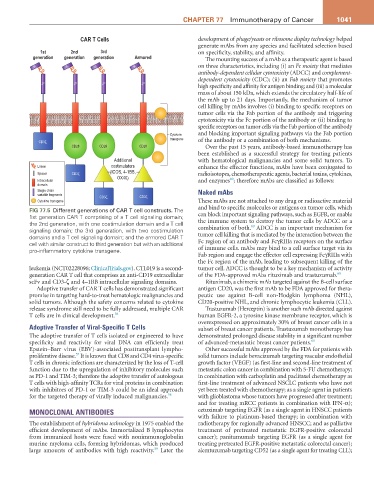
           Fig 77.5  Different generations of CAR T cell constructs. The   and bind to specific molecules or antigens on tumor cells, which
           1st generation CAR T comprising of a T cell signaling domain;   can block important signaling pathways, such as EGFR, or enable
           the 2nd generation, with one costimulation domain and a T cell   the immune system to destroy the tumor cells by ADCC or a
                                                                                   60
           signaling domain; the 3rd generation, with two costimulation   combination of both.  ADCC is an important mechanism for
           domains and a T cell signaling domain; and the armored CAR T   tumor cell killing that is mediated by the interaction between the
           cell with similar construct to third generation but with an additional   Fc region of an antibody and FcγRIIIa receptors on the surface
           pro-inflammatory cytokine transgene.                   of immune cells. mAbs may bind to a cell surface target via its
                                                                  Fab region and engage the effector cell expressing FcγRIIIa with
                                                                  the Fc region of the mAb, leading to subsequent killing of the
           leukemia (NCT02228096; ClinicalTrials.gov). CTL019 is a second-  tumor cell. ADCC is thought to be a key mechanism of activity
           generation CAR T cell that comprises an anti-CD19 extracellular   of the FDA-approved mAbs rituximab and trastuzumab. 60
           scFv and CD3-ζ and 4–1BB intracellular signaling domains.  Rituximab, a chimeric mAb targeted against the B-cell surface
             Adoptive transfer of CAR T cells has demonstrated significant   antigen CD20, was the first mAb to be FDA approved for thera-
           promise in targeting hard-to-treat hematologic malignancies and   peutic use against B-cell non-Hodgkin lymphoma (NHL),
           solid tumors. Although the safety concerns related to cytokine   CD20-positive NHL, and chronic lymphocytic leukemia (CLL).
           release syndrome still need to be fully addressed, multiple CAR   Trastuzumab (Herceptin) is another such mAb directed against
           T cells are in clinical development. 56                human EGFR-2, a tyrosine kinase membrane receptor, which is
                                                                  overexpressed on approximately 30% of breast cancer cells in a
           Adoptive Transfer of Viral-Specific T Cells            subset of breast cancer patients. Trastuzumab monotherapy has
           The adoptive transfer of T cells isolated or engineered to have   demonstrated prolonged disease stability in a significant number
           specificity and reactivity for viral DNA can efficiently treat   of advanced-metastatic breast cancer patients. 61
           Epstein–Barr virus (EBV)-associated posttransplant lympho-  Other successful mAbs approved by the FDA for patients with
                          57
           proliferative disease.  It is known that CD8 and CD4 virus-specific   solid tumors include bevacizumab targeting vascular endothelial
           T cells in chronic infections are characterized by the loss of T-cell   growth factor (VEGF) (as first-line and second-line treatment of
           function due to the upregulation of inhibitory molecules such   metastatic colon cancer in combination with 5-FU chemotherapy;
           as PD-1 and TIM-3; therefore the adoptive transfer of autologous   in combination with carboplatin and paclitaxel chemotherapy as
           T cells with high-affinity TCRs for viral proteins in combination   first-line treatment of advanced NSCLC patients who have not
           with inhibitors of PD-1 or TIM-3 could be an ideal approach   yet been treated with chemotherapy; as a single agent in patients
           for the targeted therapy of virally induced malignancies. 58  with glioblastoma whose tumors have progressed after treatment;
                                                                  and for treating mRCC patients in combination with IFN-α);
           MONOCLONAL ANTIBODIES                                  cetuximab targeting EGFR (as a single agent in HNSCC patients
                                                                  with failure to platinum-based therapy; in combination with
           The establishment of hybridoma technology in 1975 enabled the   radiotherapy for regionally advanced HNSCC; and as palliative
           efficient development of mAbs. Immortalized B lymphocytes   treatment of pretreated metastatic EGFR-positive colorectal
           from immunized hosts were fused with nonimmunoglobulin   cancer); panitumumab targeting EGFR (as a single agent for
           murine myeloma cells, forming hybridomas, which produced   treating pretreated EGFR-positive metastatic colorectal cancer);
                                                    59
           large amounts of antibodies with high reactivity.  Later the   alemtuzumab targeting CD52 (as a single agent for treating CLL);

