


Page 1096 - Clinical Immunology_ Principles and Practice ( PDFDrive )
P. 1096
1060         ParT EighT  Immunology of Neoplasia


         TABLE 78.5  Major Factors associated With Prognosis of Chronic Lymphocytic
         Leukemia (CLL)   30,4,5,6,7,9,31,33,34
                                                                                  Median            Used in Clinical
                                      Definition                                  Survival (Years)  Practice
          Rai stage 0                 Leukocytosis                                12.5              Yes
          1                           Leukocytosis and lymphadenopathy            8.4
          2                           Lymphocytosis plus hepatosplenomegaly       6.9
          3                           Lymphocytosis plus anemia (<11 gr/dL)       1.5
          4                           Lymphocytosis plus thrombocytopenia (<100 000 × 10 /L)  1.5
                                                                           9
          Binet                       Leukocytosis and lymphadenopathy            Age-matched       Yes
          Stage A                     Lymphadenopathy of more than two involved areas  7
          Stage B                     Anemia or thrombocytopenia                  2
          Stage C
          β 2  microglobulin          Normal                                      9.7               Yes
                                      Elevated                                    4.5
          CD 38                       >30%                                        2.9 to <10 years  Yes
          Early-stage CLL             <30%                                        9 to >26 years
          Chromosomal aberrations     17p-                                        2.7               Sometimes
           (FISH analysis)            11q-                                        6.5
                                      Trisomy 12                                  9.5
                                      Normal karyotype                            9.3
                                      13q-                                        11.1
          Zeta-associated protein 70 (ZAP-70)  >20%                               7.5               If available
          Early-stage CLL             <20%                                        Not reached
          Mutational status           Unmutated                                   5.7 to <9.9 years  If available
                                      Mutated                                     10.2 to >24 years


           The oldest staging systems of CLL risk stratification rely on   Unmutated                 Mutated
                                                         30
                                                29
        measurement of disease bulk as reported by Rai  and Binet     CD5          CD38         CD5
        (Table 78.5). These staging systems are very useful for identifying
        patients who will need treatment at the time of diagnosis, but   CD19               CD19
        not for predicting who will subsequently need treatment. About
        33% of patients never require treatment and have a long survival.    17p-                     Normal
        In another third, an initial indolent phase is followed by disease   11q-                     13q-
        progression. The remaining third of patients exhibit an aggressive   CD23           CD23
        disease at the onset and need immediate treatment.                          ZAP70
           The most powerful predictors for rapid and aggressive progres-  CD20                CD20
        sion are the mutational status of the V domains and chromosomal             β2m
        abnormalities, as described above (Fig. 78.6; see Table 78.5). In
        contrast to genomic aberrations and serum markers, such as      High risk phenotype       Low risk phenotype
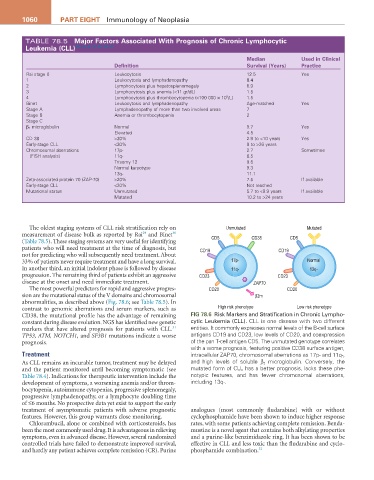
        CD38, the mutational profile has the advantage of remaining   Fig 78.6  Risk Markers and Stratification in Chronic Lympho-
        constant during disease evolution. NGS has identified new genetic   cytic Leukemia (CLL). CLL is one disease with two different
                                                         31
        markers that have altered prognosis for patients with CLL.    entities. It commonly expresses normal levels of the B-cell surface
        TP53, ATM, NOTCH1, and SF3B1 mutations indicate a worse   antigens CD19 and CD23, low levels of CD20, and coexpression
        prognosis.                                             of the pan T-cell antigen CD5. The unmutated genotype correlates
                                                               with a worse prognosis, featuring positive CD38 surface antigen,
        Treatment                                              intracellular ZAP70, chromosomal aberrations as 17p- and 11q-,
        As CLL remains an incurable tumor, treatment may be delayed   and high levels of soluble  β 2 microglobulin. Conversely, the
        and the patient monitored until becoming symptomatic (see   mutated form of CLL has a better prognosis, lacks these phe-
        Table 78.4). Indications for therapeutic intervention include the   notypic features, and has fewer chromosomal aberrations,
        development of symptoms, a worsening anemia and/or throm-  including 13q-.
        bocytopenia, autoimmune cytopenias, progressive splenomegaly,
        progressive lymphadenopathy, or a lymphocyte doubling time
        of ≤6 months. No prospective data yet exist to support the early
        treatment of asymptomatic patients with adverse prognostic   analogues (most commonly fludarabine) with or without
        features. However, this group warrants close monitoring.  cyclophosphamide have been shown to induce higher response
           Chlorambucil, alone or combined with corticosteroids, has   rates, with some patients achieving complete remission. Benda-
        been the most commonly used drug. It is advantageous in relieving   mustine is a novel agent that contains both alkylating properties
        symptoms, even in advanced disease. However, several randomized   and a purine-like benzimidazole ring. It has been shown to be
        controlled trials have failed to demonstrate improved survival,   effective in CLL and less toxic than the fludarabine and cyclo-
        and hardly any patient achieves complete remission (CR). Purine   phosphamide combination. 32

