


Page 1092 - Clinical Immunology_ Principles and Practice ( PDFDrive )
P. 1092
1056         ParT EighT  Immunology of Neoplasia


                                                                                        -4
        Since leukemia is clonal (i.e., it originates from one lymphoid   of leukemic blasts to below 10  cells within the first 2–4 weeks
        cell), all of the leukemic cells of a particular person carry the   of therapy is detected in  ≈40% of children with  ALL and is
        same Ig and/or TCR rearrangements. Because leukemic cells are   associated with an extremely good prognosis. Conversely, the
        genetically unstable, they often (>90% of the cases) carry multiple   presence of >0.1% blasts after 2 or 3 months of therapy defines
        rearrangements, a fact that facilitates the usefulness of using   a very-high-risk group. These initial findings have led the BFM-
        these rearrangements as a clonal marker for MRD detection.   AEIOP study group to initiate a prospective study on children
        The major advantages of this technique are the exquisite sensitivity   with ALL that utilize the MRD level determined by Ig/TCR-PCR
                 -5
        (at least 10 ), reliability, reproducibility, and its applicability to   for risk classification. This study, which involved 3184 patients,
        >90% of children with ALL. The application of NGS techniques   confirmed the strength of PCR MRD over genetic classification
                                                                                   17
        is likely to lower the costs and complexity of this approach.  as a prognostic marker.  At present, MRD studies have been
           Current strategies for flow cytometric detection of MRD rely   incorporated into most treatment protocols. Patients with high
        on combinations of leukocyte markers that do not normally   MRD are stratified into a high-risk arm and receive more intensive
        occur in cells of the peripheral blood and bone marrow. Such   chemotherapy.
        leukemia-associated phenotypes can be identified by multiple
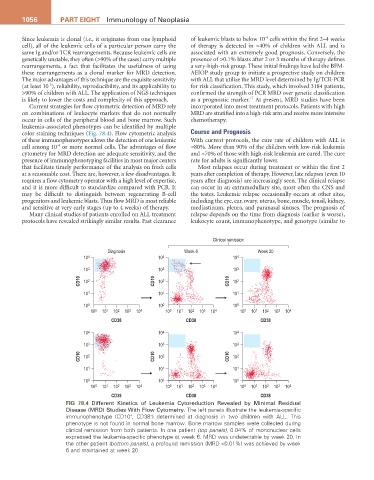
        color staining techniques (Fig. 78.4). Flow cytometric analysis   Course and Prognosis
        of these immunophenotypes allows the detection of one leukemic   With current protocols, the cure rate of children with ALL is
                    -4
        cell among 10  or more normal cells. The advantages of flow   ≈80%. More than 90% of the children with low-risk leukemia
        cytometry for MRD detection are adequate sensitivity, and the   and ≈70% of those with high-risk leukemia are cured. The cure
        presence of immunophenotyping facilities in most major centers   rate for adults is significantly lower.
        that facilitate timely performance of the analysis on fresh cells   Most relapses occur during treatment or within the first 2
        at a reasonable cost. There are, however, a few disadvantages. It   years after completion of therapy. However, late relapses (even 10
        requires a flow cytometry operator with a high level of expertise,   years after diagnosis) are increasingly seen. The clinical relapse
        and it is more difficult to standardize compared with PCR. It   can occur in an extramedullary site, most often the CNS and
        may be difficult to distinguish  between regenerating B-cell   the testes. Leukemic relapse occasionally occurs at other sites,
        progenitors and leukemic blasts. Thus flow MRD is most reliable   including the eye, ear, ovary, uterus, bone, muscle, tonsil, kidney,
        and sensitive at very early stages (up to 4 weeks) of therapy.  mediastinum, pleura, and paranasal sinuses. The prognosis of
           Many clinical studies of patients enrolled on ALL treatment   relapse depends on the time from diagnosis (earlier is worse),
        protocols have revealed strikingly similar results. Fast clearance   leukocyte count, immunophenotype, and genotype (similar to


                                                                       Clinical remission

                                    Diagnosis                Week 6                  Week 20
                            10 4                     10 4                    10 4
                            10 3                     10 3                    10 3
                           CD10  10 2              CD10  10 2               CD10  10 2

                            10 1                     10 1                    10 1

                            10 0                     10 0                    10 0
                               10 0  10 1  10 2  10 3  10 4  10 0  10 1  10 2  10 3  10 4  10 0  10 1  10 2  10 3  10 4
                                     CD38                     CD38                    CD38
                            10 4                     10 4                    10 4

                            10 3                     10 3                    10 3
                           CD10  10 2              CD10  10 2               CD10  10 2

                            10 1                     10 1                    10 1
                            10 0                     10 0                    10 0
                               10 0  10 1  10 2  10 3  10 4  10 0  10 1  10 2  10 3  10 4  10 0  10 1  10 2  10 3  10 4
                                     CD38                     CD38                    CD38
                       Fig 78.4  Different Kinetics of Leukemia Cytoreduction Revealed by Minimal Residual
                       Disease (MRD) Studies With Flow Cytometry. The left panels illustrate the leukemia-specific
                       immunophenotype (CD10 , CD38 ) determined at diagnosis in two children with ALL. This
                                            +
                                                  −
                       phenotype is not found in normal bone marrow. Bone marrow samples were collected during
                       clinical remission from both patients. In one patient (top panels), 0.04% of mononuclear cells
                       expressed the leukemia-specific phenotype at week 6. MRD was undetectable by week 20. In
                       the other patient (bottom panels), a profound remission (MRD <0.01%) was achieved by week
                       6 and maintained at week 20.

