


Page 1094 - Clinical Immunology_ Principles and Practice ( PDFDrive )
P. 1094
1058         ParT EighT  Immunology of Neoplasia


                           Central lymphoid tissue           Peripheral lymphoid tissue
                              Precursor B cell  Peripheral B cell
                              Bone marrow    Extrafollicular area  Follicular area  Marginal zone MALT and BM

                                                          Mantle              Marginal zone
                                                           cell                memory B cell
                            Progenitor B      Unmutated CLL
                              cell
                                                                                          Intestine


                             Pre-B
                              cell                                    Centrocyte
                                             Naïve peripheral
                                                 B cell
                                                              FDC
                                                                            GC
                          Immature
                           B cell

                                                                                   Longed lived
                                                                      Centroblast   plasma cell
                                              Mutated CLL

                                                               Somatic mutations
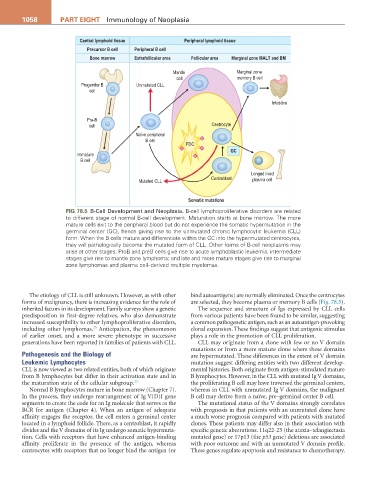
                       Fig 78.5  B-Cell Development and Neoplasia. B-cell lymphoproliferative disorders are related
                       to different stage of normal B-cell development. Maturation starts at bone marrow. The more
                       mature cells exit to the peripheral blood but do not experience the somatic hypermutation in the
                       germinal center (GC), hence giving rise to the unmutated chronic lymphocytic leukemia (CLL)
                       form. When the B cells mature and differentiate within the GC into the hypermutated centrocytes,
                       they will pathologically become the mutated form of CLL. Other forms of B-cell neoplasms may
                       arise at other stages. ProB and preB cells give rise to acute lymphoblastic leukemia; intermediate
                       stages give rise to mantle zone lymphoma; and late and more mature stages give rise to marginal
                       zone lymphomas and plasma cell–derived multiple myelomas.


           The etiology of CLL is still unknown. However, as with other   bind autoantigens) are normally eliminated. Once the centrocytes
        forms of malignancy, there is increasing evidence for the role of   are selected, they become plasma or memory B cells (Fig. 78.5).
        inherited factors in its development. Family surveys show a genetic   The sequence and structure of Igs expressed by CLL cells
        predisposition in first-degree relatives, who also demonstrate   from various patients have been found to be similar, suggesting
        increased susceptibility to other lymphoproliferative disorders,   a common pathogenetic antigen, such as an autoantigen-provoking
                               25
        including other lymphomas.  Anticipation, the phenomenon   clonal expansion. These findings suggest that antigenic stimulus
        of earlier onset, and a more severe phenotype in successive   plays a role in the promotion of CLL proliferation.
        generations have been reported in families of patients with CLL.  CLL may originate from a clone with few or no V domain
                                                               mutations or from a more mature clone where these domains
        Pathogenesis and the Biology of                        are hypermutated. These differences in the extent of V domain
        Leukemic Lymphocytes                                   mutation suggest differing entities with two different develop-
        CLL is now viewed as two related entities, both of which originate   mental histories. Both originate from antigen-stimulated mature
        from B lymphocytes but differ in their activation state and in   B lymphocytes. However, in the CLL with mutated Ig V domains,
        the maturation state of the cellular subgroup. 23.     the proliferating B cell may have traversed the germinal centers,
           Normal B lymphocytes mature in bone marrow (Chapter 7).   whereas in CLL with unmutated Ig V domains, the malignant
        In the process, they undergo rearrangement of Ig V(D)J gene   B cell may derive from a naïve, pre–germinal center B cell.
        segments to create the code for an Ig molecule that serves as the   The mutational status of the V domains strongly correlates
        BCR for antigen (Chapter 4).  When an antigen of adequate   with prognosis in that patients with an unmutated clone have
        affinity engages the receptor, the cell enters a germinal center   a much worse prognosis compared with patients with mutated
        located in a lymphoid follicle. There, as a centroblast, it rapidly   clones. These patients may differ also in their association with
        divides and the V domains of its Ig undergo somatic hypermuta-  specific genetic aberrations. 11q22-23 (the ataxia–telangiectasia
        tion. Cells with receptors that have enhanced antigen-binding   mutated gene) or 17p13 (the p53 gene) deletions are associated
        affinity proliferate in the presence of the antigen, whereas   with poor outcome and with an unmutated V domain profile.
        centrocytes with receptors that no longer bind the antigen (or   These genes regulate apoptosis and resistance to chemotherapy.

