


Page 1091 - Clinical Immunology_ Principles and Practice ( PDFDrive )
P. 1091
ChaPTEr 78  Lymphoid Leukemias               1055


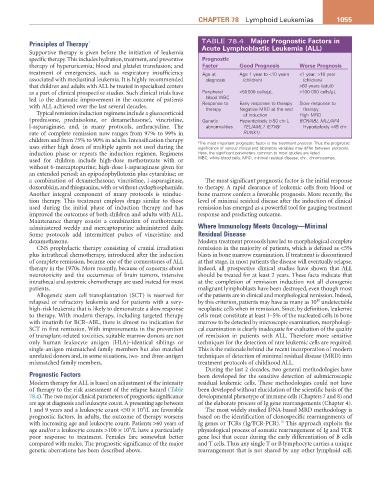
           Principles of Therapy 1                                 TABLE 78.4  Major Prognostic Factors in
                                                                   acute Lymphoblastic Leukemia (aLL)
                                                                                                          a
           Supportive therapy is given before the initiation of leukemia
           specific therapy. This includes hydration, treatment, and preventive   Prognostic
           therapy of hyperuricemia; blood and platelet transfusion; and   Factor  good Prognosis  Worse Prognosis
           treatment  of  emergencies,  such  as respiratory  insufficiency   Age at   Age 1 year to <10 years   <1 year; >10 year
           associated with mediastinal leukemia. It is highly recommended   diagnosis  (children)   (children)
           that children and adults with ALL be treated in specialized centers                     >60 years (adult)
           as a part of clinical prospective studies. Such clinical trials have   Peripheral   <50 000 cells/µL  >100 000 cells/µL
           led to the dramatic improvement in the outcome of patients   blood WBC
           with ALL achieved over the last several decades.        Response to   Early response to therapy  Slow response to
                                                                               Negative MRD at the end
                                                                                                    therapy.
                                                                    therapy
             Typical remission induction regimens include a glucocorticoid       of induction      High MRD
           (prednisone, prednisolone, or dexamethasone), vincristine,   Genetic   Hyperdiploidy (>50 chr.);   BCR/ABL MLL/AF4
           l-asparaginase, and, in many protocols, anthracycline. The   abnormalities  TEL/AML1 (ETV6/  Hypodiploidy <45 chr.
           rate of complete remission now ranges from 97% to 99% in              RUNX1)
           children and from 75% to 90% in adults. Intensification therapy   a The most important prognostic factor is the treatment protocol. Thus the prognostic
           uses either high doses of multiple agents not used during the   significance of various clinical and laboratory variables may differ between protocols.
           induction phase or repeats the induction regimen. Regimens   Here, the significant parameters common to most studies are listed.
           used for children include high-dose methotrexate with or   WBC, white blood cells; MRD, minimal residual disease; chr., chromosomes.
           without 6-mercaptopurine; high-dose l-asparaginase given for
           an extended period; an epipodophyllotoxin plus cytarabine; or
           a combination of dexamethasone, vincristine, l-asparaginase,   The most significant prognostic factor is the initial response
           doxorubicin, and thioguanine, with or without cyclophosphamide.   to therapy. A rapid clearance of leukemic cells from blood or
           Another integral component of many protocols is reinduc-  bone marrow confers a favorable prognosis. More recently, the
           tion therapy. This treatment employs drugs similar to those   level of minimal residual disease after the induction of clinical
           used during the initial phase of induction therapy and has   remission has emerged as a powerful tool for gauging treatment
           improved the outcomes of both children and adults with ALL.   response and predicting outcome.
           Maintenance therapy consist a combination of methotrexate
           administered weekly and mercaptopurine administered daily.   Where Immunology Meets Oncology—Minimal
           Some  protocols  add  intermittent  pulses  of  vincristine  and    Residual Disease
           dexamethasone.                                         Modern treatment protocols have led to morphological complete
             CNS prophylactic therapy consisting of cranial irradiation   remission in the majority of patients, which is defined as <5%
           plus intrathecal chemotherapy, introduced after the induction   blasts in bone marrow examination. If treatment is discontinued
           of complete remission, became one of the cornerstones of ALL   at that stage, in most patients the disease will eventually relapse.
           therapy in the 1970s. More recently, because of concerns about   Indeed, all prospective clinical studies have shown that  ALL
           neurotoxicity and the occurrence of brain tumors, intensive   should be treated for at least 2 years. These facts indicate that
           intrathecal and systemic chemotherapy are used instead for most   at  the  completion  of remission  induction  not all clonogenic
           patients.                                              malignant lymphoblasts have been destroyed, even though most
             Allogeneic stem cell transplantation (SCT) is reserved for   of the patients are in clinical and morphological remission. Indeed,
                                                                                                         10
           relapsed or refractory leukemia and for patients with a very-  by this criterion, patients may have as many as 10  undetectable
           high-risk leukemia that is likely to demonstrate a slow response   neoplastic cells when in remission. Since, by definition, leukemic
           to therapy. With modern therapy, including targeted therapy   cells must constitute at least 1–5% of the nucleated cells in bone
           with imatinib for BCR–ABL, there is almost no indication for   marrow to be detected by microscopic examination, morphologi-
           SCT in first remission. With improvements in the prevention   cal examination is clearly inadequate for evaluation of the quality
           of transplant-related toxicities, suitable marrow donors are not   of remission in patients with  ALL. Therefore more sensitive
           only human leukocyte antigen (HLA)–identical siblings or   techniques for the detection of rare leukemic cells are required.
           single-antigen mismatched family members but also matched   This is the rationale behind the recent incorporation of modern
           unrelated donors and, in some situations, two- and three-antigen   techniques of detection of minimal residual disease (MRD) into
           mismatched family members.                             treatment protocols of childhood ALL.
                                                                    During the last 2 decades, two general methodologies have
           Prognostic Factors                                     been developed for the sensitive detection of submicroscopic
           Modern therapy for ALL is based on adjustment of the intensity   residual leukemic cells. These methodologies could not have
           of therapy to the risk assessment of the relapse hazard (Table   been developed without elucidation of the scientific basis of the
           78.4). The two major clinical parameters of prognostic significance   developmental phenotype of immune cells (Chapters 7 and 8) and
           are age at diagnosis and leukocyte count. A presenting age between   of the elaborate process of Ig gene rearrangements (Chapter 4).
                                                9
           1 and 9 years and a leukocyte count <50 × 10 /L are favorable   The most widely studied DNA-based MRD methodology is
           prognostic factors. In adults, the outcome of therapy worsens   based on the identification of clonospecific rearrangements of
                                                                                             16
           with increasing age and leukocyte count. Patients >60 years of   Ig genes or TCRs (Ig/TCR-PCR).  This approach exploits the
                                           9
           age and/or a leukocyte counts >100 × 10 /L have a particularly   physiological process of somatic rearrangement of Ig and TCR
           poor response to treatment. Females fare somewhat better   gene loci that occur during the early differentiation of B cells
           compared with males. The prognostic significance of the major   and T cells. Thus any single T or B lymphocyte carries a unique
           genetic aberrations has been described above.          rearrangement that is not shared by any other lymphoid cell.

