


Page 1155 - Clinical Immunology_ Principles and Practice ( PDFDrive )
P. 1155
1120         Part NINE  Transplantation


            CLINICaL PEarLS                                          1.0          YEAR OF TRANSPLANTATION
         Considerations of Stem Cell Transplantation
         Unique to Severe Combined                                   0.8
         Immunodeficiency (SCID)

          Patients with SCID are strongly impaired in their ability to reject allogeneic   0.6  2000–2005  1995–1999
           cells, including stem cells. Therefore no chemotherapy is required in
           these patients in order to achieve T-cell reconstitution following stem   Proportion surviving  1968–1994
           cell transplantation.
          The quality and the kinetics of T-cell reconstitution following stem cell   0.4
           transplantation depend on the type of transplant.
          If unmanipulated bone marrow from genotypically human leukocyte
           antigen (HLA)-identical related donor is used, mature T cells contained   0.2  P =.0003
           in the graft expand as early as 2 weeks after transplantation and
           provide a rapid source of immune competence.
          A similar phenomenon is also observed following unmanipulated matched   0
           unrelated donor (MUD) transplantation. In this case, however, drugs
           used in conditioning regimen and for prevention of graft-versus-host   0  12  24  36  60          120
           disease (GvHD) decrease the degree of early expansion of donor-derived   Time after transplantation (months)
           T cells.                                               Months    0  6  12  24  36  60            120
          In contrast, appearance of naïve T cells occurs only at 3 months or more
           after transplantation, regardless of degree of HLA matching between   Number at risk
           donor and recipient. Consequently, following haploidentical transplanta-  1968–1994  361 245 187 172 166 151  88
           tion, there is a prolonged period during which the recipient remains   1995–1999  157  113  95  78  66  40  3
           lymphopenic and at high risk of infections.            2000–2005  181  111  74  49  26  4         0
          In the absence of pretransplant conditioning, following haploidentical
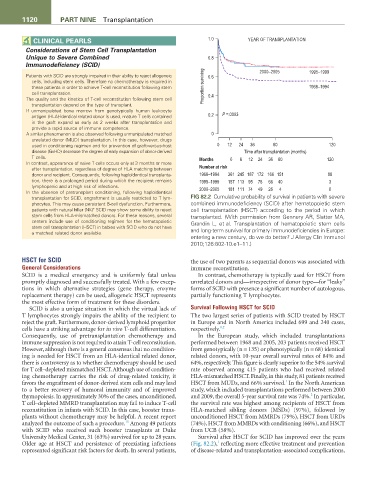
           transplantation for SCID, engraftment is usually restricted to T lym-  FIG 82.2  Cumulative probability of survival in patients with severe
           phocytes. This may cause persistent B-cell dysfunction. Furthermore,   combined immunodeficiency (SCID) after hematopoietic stem
                               +
           patients with natural killer (NK)  SCID may show some ability to reject   cell transplantation (HSCT) according to the period in which
           stem cells from HLA-mismatched donors. For these reasons, several   transplanted. (With permission from Gennery AR, Slatter MA,
           centers include use of conditioning regimen for the hematopoietic   Grandin L, et al. Transplantation of hematopoietic stem cells
           stem cell transplantation (HSCT) in babies with SCID who do not have   and long-term survival for primary immunodeficiencies in Europe:
           a matched related donor available.
                                                               entering a new century, do we do better? J Allergy Clin Immunol
                                                               2010;126:602-10.e1–11.)

        HSCT for SCID                                          the use of two parents as sequential donors was associated with
        General Considerations                                 immune reconstitution.
        SCID is a medical emergency and is uniformly fatal unless   In contrast, chemotherapy is typically used for HSCT from
        promptly diagnosed and successfully treated. With a few excep-  unrelated donors and—irrespective of donor type—for “leaky”
        tions in which alternative strategies (gene therapy, enzyme   forms of SCID with presence a significant number of autologous,
        replacement therapy) can be used, allogeneic HSCT represents   partially functioning T lymphocytes.
        the most effective form of treatment for these disorders.
           SCID is also a unique situation in which the virtual lack of   Survival Following HSCT for SCID
        T lymphocytes strongly impairs the ability of the recipient to   The two largest series of patients with SCID treated by HSCT
        reject the graft. Furthermore, donor-derived lymphoid progenitor   in Europe and in North America included 699 and 240 cases,
        cells have a striking advantage for in vivo T-cell differentiation.   respectively. 1,2
        Consequently, use of pretransplantation chemotherapy and   In the European study, which included transplantations
        immune suppression is not required to attain T-cell reconstitution.   performed between 1968 and 2005, 203 patients received HSCT
        However, although there is a general consensus that no condition-  from genotypically (n = 135) or phenotypically (n = 68) identical
        ing is needed for HSCT from an HLA-identical related donor,   related donors, with 10-year overall survival rates of 84% and
        there is controversy as to whether chemotherapy should be used   64%, respectively. This figure is clearly superior to the 54% survival
        for T cell–depleted mismatched HSCT. Although use of condition-  rate observed among 415 patients who had received related
        ing  chemotherapy  carries  the  risk of  drug-related toxicity, it   HLA-mismatched HSCT. Finally, in this study, 81 patients received
                                                                                              1
        favors the engraftment of donor-derived stem cells and may lead   HSCT from MUDs, and 66% survived.  In the North American
        to a better recovery of humoral immunity and of improved   study, which included transplantations performed between 2000
                                                                                                       2
        thymopoiesis. In approximately 30% of the cases, unconditioned,   and 2009, the overall 5-year survival rate was 74%.  In particular,
        T cell–depleted MMRD transplantation may fail to induce T-cell   the survival rate was highest among recipients of HSCT from
        reconstitution in infants with SCID. In this case, booster trans-  HLA-matched sibling donors (MSDs) (97%), followed by
        plants without chemotherapy may be helpful. A recent report   unconditioned HSCT from MMRDs (79%), HSCT from URDs
                                          15
        analyzed the outcome of such a procedure.  Among 49 patients   (74%), HSCT from MMRDs with conditioning (66%), and HSCT
        with SCID who received such booster transplants at Duke   from UCB (58%).
        University Medical Center, 31 (63%) survived for up to 28 years.   Survival after HSCT for SCID has improved over the years
                                                                        1
        Older age at HSCT and persistence of preexisting infections   (Fig. 82.2),  reflecting more effective treatment and prevention
        represented significant risk factors for death. In several patients,   of disease-related and transplantation-associated complications,

