


Page 1156 - Clinical Immunology_ Principles and Practice ( PDFDrive )
P. 1156
CHaPtEr 82  Immune Reconstitution Therapy for Immunodeficiency                  1121


           such as infections and GvHD. In particular, according to the   Factors that may contribute to such poor outcome may include
                        1
           European study,  the current survival rate after HSCT from   the presence of autologous NK cells that may mediate graft
           HLA-identical related donors is 90%, whereas 3-year survival   rejection. Consistent with this, in a UK series of 77 infants with
           after HSCT from related HLA-mismatched donors has improved   SCID who received HSCT, survival rate was higher among patients
                                                                                                        +
                                                                         −
           from 49% in transplantations performed up to 1994 to 69% in   with NK  SCID than among recipients with NK  SCID (see Fig.
                                                                      17
           those performed between 1995 and 1999. However, no further   82.1).  Furthermore, RAG and Artemis deficiencies cause a later
           improvement in survival has been observed since that time.  block in T-cell development compared with the majority of
                                                                                             +
             Several factors influence survival after HSCT for SCID. In   genetic defects associated with B  SCID. This may lead to a
           particular, younger age at transplantation leads to superior   stronger competition between donor-derived and autologous
                                                                                               −
           survival. In the North American study, among 68 infants who   T-cell progenitors in patients with B  SCID who receive uncon-
                                                            2
           were treated before 3.5 months of life, 64 (94%) survived.    ditioned HSCT.
           Similarly high survival rates were observed also among infants   Finally, in a series of 106 patients with SCID caused by adenos-
                                                                                           −
           older than 3.5 months with no history of infections or whose   ine deaminase deficiency (ADA  SCID), unconditioned trans-
           infections had resolved before HSCT (90% and 84% 5-year   plantation from MMRDs was associated with a high risk of graft
                                 2
           survival rates, respectively).  Collectively, these data emphasize   failure. 18
           the importance of early diagnosis to prevent infections and
           provide strong support to newborn screening for SCID. For    CLINICaL PEarLS
           patients of any age who do not have MSDs and have an active   Outcome of Hematopoietic Stem Cell
           infection at the time of HSCT, a higher survival rate (65%) is
           observed with unconditioned transplantation from MMRDs. 2  Transplantation (HSCT) for Primary
             The SCID genotype and phenotype may also affect the outcome   Immunodeficiencies
                                                   +
           of HSCT. In the European  series, infants  with  B  SCID  had   For severe combined immunodeficiency (SCID), the 5-year survival rate
           superior 10-year survival after HSCT compared with infants   of patients transplanted between 2000 and 2009 is over 74% and is
                −
                                                     1
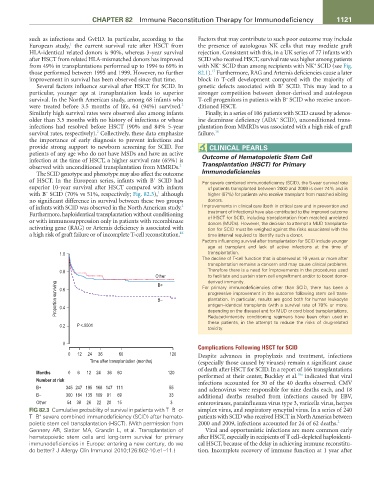
           with B  SCID (70% vs 51%, respectively; Fig. 82.3),  although   higher (97%) for patients who receive transplant from matched sibling
           no significant difference in survival between these two groups   donors.
                                                            2
           of infants with SCID was observed in the North American study.    Improvements in clinical care (both in critical care and in prevention and
           Furthermore, haploidentical transplantation without conditioning   treatment of infections) have also contributed to the improved outcome
                                                                     of HSCT for SCID, including transplantation from matched unrelated
           or with immunosuppression only in patients with recombinase   donors (MUDs). However, the decision to attempt a MUD transplanta-
           activating gene (RAG) or Artemis deficiency is associated with   tion for SCID must be weighed against the risks associated with the
                                                            16
           a high risk of graft failure or of incomplete T-cell reconstitution.    time interval required to identify such a donor.
                                                                   Factors influencing survival after transplantation for SCID include younger
                                                                     age  at  transplant  and  lack  of  active  infections  at  the  time  of
                     1.0                                             transplantation.
                                                                   The decline of T-cell function that is observed at 10 years or more after
                                                                     transplantation remains a concern and may cause clinical problems.
                     0.8                                             Therefore there is a need for improvements in the procedures used
                                                                     to facilitate and sustain stem cell engraftment and/or to boost donor-
                                                    Other          For  primary  immunodeficiencies  other  than  SCID,  there  has  been  a
                                                                     derived immunity.
                   Proportion surviving  0.6         B–              progressive improvement in the outcome following stem cell trans-
                                                     B+
                                                                     plantation. In particular, results are good both for human leukocyte
                                                                     antigen–identical  transplants  (with  a  survival  rate  of  70%  or  more,
                     0.4
                                                                     depending on the disease) and for MUD or cord blood transplantations.
                                                                     Reduced-intensity conditioning regimens have been often used in
                                                                     these  patients, in  the  attempt to reduce  the risks  of  drug-related
                     0.2  P <.0001
                                                                     toxicity.
                      0
                                                                  Complications Following HSCT for SCID
                       0  12  24  36    60               120      Despite advances in prophylaxis and treatment, infections
                              Time after transplantation (months)  (especially those caused by viruses) remain a significant cause
                                                                  of death after HSCT for SCID. In a report of 166 transplantations
             Months    0  6  12  24  36  60             120       performed at their center, Buckley et al.  indicated that viral
                                                                                                  18a
             Number at risk                                       infections accounted for 30 of the 40 deaths observed. CMV
             B+        345 247 195 168 147 111          55        and adenovirus were responsible for nine deaths each, and 18
             B–        300  184  135  109  91  69       33        additional deaths resulted from infections caused by EBV,
             Other     54  38  26  22  20  15            3        enteroviruses, parainfluenza virus type 3, varicella virus, herpes
           FIG 82.3  Cumulative probability of survival in patients with T  B  or   simplex virus, and respiratory syncytial virus. In a series of 240
                                                          −
                                                        −
           T  B  severe combined immunodeficiency (SCID) after hemato-  patients with SCID who received HSCT in North America between
            −
              +
           poietic stem cell transplantation (HSCT). (With permission from   2000 and 2009, infections accounted for 24 of 62 deaths. 2
           Gennery AR, Slatter MA, Grandin L, et al. Transplantation of   Viral and opportunistic infections are more common early
           hematopoietic  stem  cells  and  long-term  survival  for  primary   after HSCT, especially in recipients of T cell–depleted haploidenti-
           immunodeficiencies in Europe: entering a new century, do we   cal HSCT, because of the delay in achieving immune reconstitu-
           do better? J Allergy Clin Immunol 2010;126:602-10.e1–11.)  tion. Incomplete recovery of immune function at 1 year after

