


Page 1160 - Clinical Immunology_ Principles and Practice ( PDFDrive )
P. 1160
CHaPtEr 82  Immune Reconstitution Therapy for Immunodeficiency                  1125


           HSCT in patients with hypermorphic mutations of the IKBA     1
           gene, another cause of combined immune deficiency with      0.9
           ectodermal dystrophy. 28                                    0.8
           Wiskott-Aldrich Syndrome                                    0.7
           Bone marrow transplantation for correction of  WAS was      0.6
           attempted as early as 1968, with partial success. Full correction   Survival  0.5
           following HSCT was first reported in 1978 when a more robust   0.4
           conditioning regimen was used. Since then, results of related   0.3
           HLA-identical HSCT in WAS have been consistently good, with
           continuous improvement in recent years, and excellent results   0.2
           have been also achieved with HSCT from MUDs. A multiinsti-  0.1
           tutional  study  of  194  patients  with WAS  treated  with  HSCT   0
           showed an overall survival of 84%, and a 5-year survival as high   0  500  1000  1500  2000  2500  3000
                                                         29
           as 89.1% for transplantations performed since year 2000.  For               Days following HCT
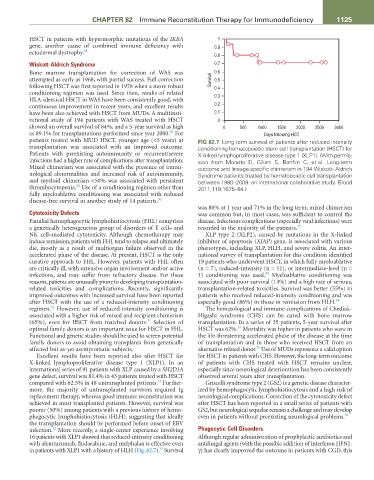
           patients treated with MUD HSCT, younger age (<5 years) at   FIG 82.7  Long-term survival of patients after reduced intensity
           transplantation was associated with an improved outcome.   conditioning hematopoietic stem cell transplantation (HSCT) for
           Patients with preexisting autoimmunity or recurrent/severe   X-linked lymphoproliferative disease type 1 (XLP1). (With permis-
           infections had a higher rate of complications after transplantation.   sion from Moratto D, Giliani S, Bonfim C, et al. Long-term
           Mixed chimerism was associated with the presence of immu-  outcome and lineage-specific chimerism in 194 Wiskott–Aldrich
           nological  abnormalities and  increased risk  of  autoimmunity,   Syndrome patients treated by hematopoietic cell transplantation
           and myeloid chimerism  <50% was associated with persistent   between 1980–2009: an international collaborative study. Blood
                          29
           thrombocytopenia.  Use of a conditioning regimen other than   2011;118:1675–84.)
           fully myeloablative conditioning was associated with reduced
           disease-free survival in another study of 14 patients. 30
                                                                  was 80% at 1 year and 71% in the long term; mixed chimerism
           Cytotoxicity Defects                                   was common but, in most cases, was sufficient to control the
           Familial hemophagocytic lymphohistiocytosis (FHL) comprises   disease. Infectious complications (especially viral infections) were
           a genetically heterogeneous group of disorders of T cell– and   recorded in the majority of the patients. 33
           NK cell–mediated cytotoxicity.  Although chemotherapy may   XLP type 2 (XLP2), caused by mutations in the X-linked
           induce remission, patients with FHL tend to relapse and ultimately   inhibitor of apoptosis (XIAP) gene, is associated with various
           die, mostly as a result of multiorgan failure observed in the   phenotypes, including XLP, HLH, and severe colitis. An inter-
           accelerated phase of the disease. At present, HSCT is the only   national survey of transplantation for this condition identified
           curative approach to FHL. However, patients with FHL often   19 patients who underwent HSCT, in which fully myeloablative
           are critically ill, with extensive organ involvement and/or active   (n = 7), reduced-intensity (n = 11), or intermediate-level (n =
                                                                                        34
           infections, and may suffer from refractory disease. For these   1) conditioning was used.  Myeloablative conditioning was
           reasons, patients are unusually prone to developing transplantation-  associated with poor survival (14%) and a high rate of serious,
           related  toxicities  and  complications.  Recently,  significantly   transplantation-related toxicities. Survival was better (55%) in
           improved outcomes with increased survival have been reported   patients who received reduced-intensity conditioning and was
           after HSCT with the use of a reduced-intensity conditioning   especially good (86%) in those in remission from HLH. 34
                  31
           regimen.  However, use of reduced-intensity conditioning is   The hematological and immune complications of Chediak-
           associated with a higher risk of mixed and recipient chimerism   Higashi syndrome (CHS) can be cured with bone marrow
                                                 31
           (65%), even for HSCT from matched donors.  Selection of   transplantation. In a series of 35 patients, 5-year survival after
                                                                               35
           optimal family donors is an important issue for HSCT in FHL.   HSCT was 62%.  Mortality was higher in patients who were in
           Functional and genetic studies should be used to screen potential   the life-threatening accelerated phase of the disease at the time
           family donors to avoid obtaining transplants from genetically   of transplantation and in those who received HSCT from an
                                                                                     35
           affected but as-yet asymptomatic subjects.             alternative related donor.  Use of MUDs represents a valid option
             Excellent  results  have  been  reported  also  after  HSCT for   for HSCT in patients with CHS. However, the long-term outcome
           X-linked  lymphoproliferative  disease  type  1  (XLP1).  In  an   of  patients  with  CHS  treated with  HSCT remains  unclear,
           international series of 91 patients with XLP caused by a SH2D1A   especially since neurological deterioration has been consistently
           gene defect, survival was 81.4% in 43 patients treated with HSCT   observed several years after transplantation.
                                                     32
           compared with 62.5% in 48 untransplanted patients.  Further-  Griscelli syndrome type 2 (GS2) is a genetic disease character-
           more,  the  majority  of  untransplanted  survivors  required  Ig   ized by hemophagocytic lymphohistiocytosis and a high risk of
           replacement therapy, whereas good immune reconstitution was   neurological complications. Correction of the cytotoxicity defect
           achieved in most transplanted patients. However, survival was   after HSCT has been reported in a small series of patients with
           poorer (50%) among patients with a previous history of hemo-  GS2, but neurological sequelae remain a challenge and may develop
           phagocytic lymphohistiocytosis (HLH), suggesting that ideally   even in patients without preexisting neurological problems. 36
           the transplantation should be performed before onset of EBV
                  32
           infection.  More recently, a single-center experience involving   Phagocytic Cell Disorders
           16 patients with XLP1 showed that reduced-intensity conditioning   Although regular administration of prophylactic antibiotics and
           with alemtuzumab, fludarabine, and melphalan is effective even   antifungal agents (with the possible addition of interferon [IFN]-
                                                     33
           in patients with XLP1 with a history of HLH (Fig. 82.7).  Survival   γ) has clearly improved the outcome in patients with CGD, this

