


Page 1181 - Clinical Immunology_ Principles and Practice ( PDFDrive )
P. 1181
1146         ParT TEN  Prevention and Therapy of Immunological Diseases


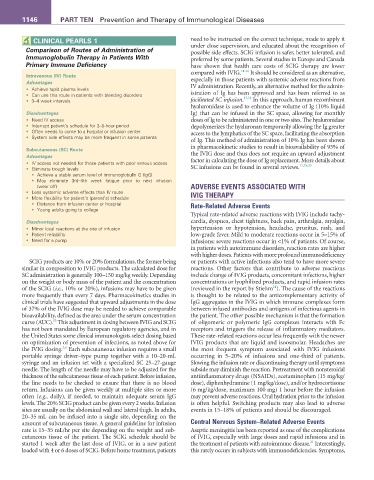
            CLINICaL PEarLS 1                                  need to be instructed on the correct technique, made to apply it
         Comparison of Routes of Administration of             under close supervision, and educated about the recognition of
                                                               possible side effects. SCIG infusion is safer, better tolerated, and
         Immunoglobulin Therapy in Patients With               preferred by some patients. Several studies in Europe and Canada
         Primary Immune Deficiency                             have shown that health care costs of SCIG therapy are lower
                                                               compared with IVIG. 14-16  It should be considered as an alternative,
          Intravenous (IV) route
          Advantages                                           especially in those patients with systemic adverse reactions from
          •  Achieve rapid plasma levels                       IV administration. Recently, an alternative method for the admin-
          •  Can use this route in patients with bleeding disorders  istration of Ig has been approved and has been referred to as
                                                                                 17,18
          •  3–4 week intervals                                facilitated SC infusion.   In this approach, human recombinant
                                                               hyaluronidase is used to enhance the volume of Ig (10% liquid
          Disadvantages                                        Ig) that can be infused in the SC space, allowing for monthly
          •  Need IV access                                    doses of Ig to be administered in one or two sites. The hyaluronidase
          •  Interrupt patient’s schedule for 3–5-hour period  depolymerizes the hyaluronan temporarily allowing the Ig greater
          •  Often needs to come to a hospital or infusion center  access to the lymphatics of the SC space, facilitating the absorption
          •  System side effects may be more frequent in some patients
                                                               of Ig. This method of administration of 10% Ig has been shown
          Subcutaneous (SC) route                              in pharmacokinetic studies to result in bioavailability of 93% of
          Advantages                                           the IVIG dose and thus does not require an upward adjustment
          •  IV access not needed for those patients with poor venous access  factor in calculating the dose of Ig replacement. More details about
                                                                                                   11,19,20
          •  Eliminate trough levels                           SC infusions can be found in several reviews.
           •  Achieve a stable serum level of immunoglobulin G (IgG)
           •  May  eliminate  3rd–4th  week  fatigue  prior  to  next  infusion
             (wear off)                                        ADVERSE EVENTS ASSOCIATED WITH
          •  Less systemic adverse effects than IV route       IVIG THERAPY
          •  More flexibility for patient’s (parent’s) schedule
           •  Distance from infusion center or hospital        Rate-Related Adverse Events
           •  Young adults going to college
                                                               Typical rate-related adverse reactions with IVIG include tachy-
          Disadvantages                                        cardia, dyspnea, chest tightness, back pain, arthralgia, myalgia,
          •  Minor local reactions at the site of infusion     hypertension or hypotension, headache, pruritus, rash, and
          •  Patient reliability                               low-grade fever. Mild to moderate reactions occur in 5–15% of
          •  Need for a pump                                   infusions; severe reactions occur in <1% of patients. Of course,
                                                               in patients with autoimmune disorders, reaction rates are higher
                                                               with higher doses. Patients with more profound immunodeficiency
           SCIG products are 10% or 20% formulations, the former being   or patients with active infections also tend to have more severe
        similar in composition to IVIG products. The calculated dose for   reactions. Other factors that contribute to adverse reactions
        SC administration is generally 100–150 mg/kg weekly. Depending   include change of IVIG products, concomitant infections, higher
        on the weight or body mass of the patient and the concentration   concentrations or lyophilized products, and rapid infusion rates
                                                                                          21
        of the SCIG (i.e., 10% or 20%), infusions may have to be given   (reviewed in the report by Stiehm ). The cause of the reactions
        more frequently than every 7 days. Pharmacokinetics studies in   is thought to be related to the anticomplementary activity of
        clinical trials have suggested that upward adjustments in the dose   IgG aggregates in the IVIG in which immune complexes form
        of 37% of the IVIG dose may be needed to achieve comparable   between infused antibodies and antigens of infectious agents in
        bioavailability, defined as the area under the serum concentration   the patient. The other possible mechanism is that the formation
                  13
        curve (AUC).  This adjustment in dosing between IVIG and SCIG   of oligomeric or polymeric IgG complexes interacts with Fc
        has not been mandated by European regulatory agencies, and in   receptors and triggers the release of inflammatory mediators.
        the United States some clinical immunologists select dosing based   These rate-related reactions occur less frequently with the newer
        on optimization of prevention of infections, as noted above for   IVIG products that are liquid and isoosmolar. Headaches are
                     5,6
        the IVIG dosing.  Each subcutaneous infusion requires a small   the most frequent symptom associated with IVIG infusions
        portable syringe driver–type pump together with a 10–20-mL   occurring in 5–20% of infusions and one-third of patients.
        syringe and an infusion set with a specialized SC 25–27-gauge   Slowing the infusion rate or discontinuing therapy until symptoms
        needle. The length of the needle may have to be adjusted for the   subside may diminish the reaction. Pretreatment with nonsteroidal
        thickness of the subcutaneous tissue of each patient. Before infusion,   antiinflammatory drugs (NSAIDs), acetaminophen (15 mg/kg/
        the line needs to be checked to ensure that there is no blood   dose), diphenhydramine (1 mg/kg/dose), and/or hydrocortisone
        return. Infusions can be given weekly at multiple sites or more   (6 mg/kg/dose, maximum 100 mg) 1 hour before the infusion
        often (e.g., daily), if needed, to  maintain adequate serum  IgG   may prevent adverse reactions. Oral hydration prior to the infusion
        levels. The 20% SCIG product can be given every 2 weeks. Infusion   is often helpful. Switching products may also lead to adverse
        sites are usually on the abdominal wall and lateral thigh. In adults,   events in 15–18% of patients and should be discouraged.
        20–35 mL can be infused into a single site, depending on the
        amount of subcutaneous tissue. A general guideline for infusion   Central Nervous System–Related Adverse Events
        rate is 15–35 mL/hr per site depending on the weight and sub-  Aseptic meningitis has been reported as one of the complications
        cutaneous tissue of the patient. The SCIG schedule should be   of IVIG, especially with large doses and rapid infusions and in
                                                                                                       21
        started 1 week after the last dose of IVIG, or in a new patient   the treatment of patients with autoimmune disease.  Interestingly,
        loaded with 4 or 6 doses of SCIG. Before home treatment, patients   this rarely occurs in subjects with immunodeficiencies. Symptoms,

