


Page 1182 - Clinical Immunology_ Principles and Practice ( PDFDrive )
P. 1182
CHaPTEr 84  Immunoglobulin Therapy: Replacement and Immunomodulation                      1147


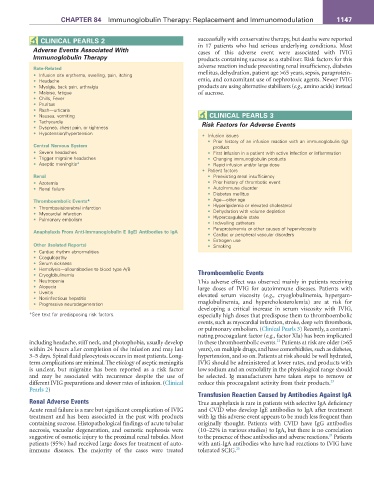
               CLINICaL PEarLS 2                                  successfully with conservative therapy, but deaths were reported
            Adverse Events Associated With                        in 17 patients who had serious underlying conditions. Most
                                                                  cases of this adverse event were associated with IVIG
            Immunoglobulin Therapy                                products containing sucrose as a stabilizer. Risk factors for this
            rate-related                                          adverse reaction include preexisting renal insufficiency, diabetes
            •  Infusion site erythema, swelling, pain, itching    mellitus, dehydration, patient age >65 years, sepsis, paraprotein-
            •  Headache                                           emia, and concomitant use of nephrotoxic agents. Newer IVIG
            •  Myalgia, back pain, arthralgia                     products are using alternative stabilizers (e.g., amino acids) instead
            •  Malaise, fatigue                                   of sucrose.
            •  Chills, Fever
            •  Pruritus
            •  Rash—urticaria
            •  Nausea, vomiting                                       CLINICaL PEarLS 3
            •  Tachycardia                                         Risk Factors for Adverse Events
            •  Dyspnea, chest pain, or tightness
            •  Hypotension/hypertension
                                                                   •  Infusion issues
                                                                     •  Prior history of an infusion reaction with an immunoglobulin (Ig)
            Central Nervous System                                     product
            •  Severe headaches                                      •  First infusion in a patient with active infection or inflammation
            •  Trigger migraine headaches                            •  Changing immunoglobulin products
            •  Aseptic meningitis*                                   •  Rapid infusion and/or large dose
                                                                   •  Patient factors
            renal                                                    •  Preexisting renal insufficiency
            •  Azotemia                                              •  Prior history of thrombotic event
            •  Renal failure                                         •  Autoimmune disorder
                                                                     •  Diabetes mellitus
            Thromboembolic Events*                                   •  Age—older age
            •  Thrombosis/cerebral infarction                        •  Hyperlipidemia or elevated cholesterol
            •  Myocardial infarction                                 •  Dehydration with volume depletion
            •  Pulmonary embolism                                    •  Hypercoagulable state
                                                                     •  Indwelling catheters
                                                                     •  Paraproteinemia or other causes of hyperviscosity
            anaphylaxis From anti-Immunoglobulin E (IgE) antibodies to Iga
                                                                     •  Cardiac or peripheral vascular disorders
                                                                     •  Estrogen use
            Other (Isolated reports)                                 •  Smoking
            •  Cardiac rhythm abnormalities
            •  Coagulopathy
            •  Serum sickness
            •  Hemolysis—alloantibodies to blood type A/B
            •  Cryoglobulinemia                                   Thromboembolic Events
            •  Neutropenia                                        This adverse effect was observed mainly in patients receiving
            •  Alopecia                                           large doses of IVIG for autoimmune diseases. Patients with
            •  Uveitis                                            elevated serum viscosity (e.g., cryoglobulinemia, hypergam-
            •  Noninfectious hepatitis
            •  Progressive neurodegeneration                      maglobulinemia, and hypercholesterolemia) are at risk for
                                                                  developing a critical increase in serum viscosity with IVIG,
           *See text for predisposing risk factors.               especially high doses that predispose them to thromboembolic
                                                                  events, such as myocardial infarction, stroke, deep vein thrombosis,
                                                                  or pulmonary embolism. (Clinical Pearls 3) Recently, a contami-
                                                                  nating procoagulant factor (e.g., factor XIa) has been implicated
                                                                                            22
           including headache, stiff neck, and photophobia, usually develop   in these thromboembolic events.  Patients at risk are older (>65
           within 24 hours after completion of the infusion and may last   years), on multiple drugs, and have comorbidities, such as diabetes,
           3–5 days. Spinal fluid pleocytosis occurs in most patients. Long-  hypertension, and so on. Patients at risk should be well hydrated,
           term complications are minimal. The etiology of aseptic meningitis   IVIG should be administered at lower rates, and products with
           is unclear, but migraine has been reported as a risk factor    low sodium and an osmolality in the physiological range should
           and may be associated with recurrence despite the  use of     be  selected.  Ig  manufacturers  have  taken  steps  to  remove  or
           different IVIG preparations and slower rates of infusion. (Clinical   reduce this procoagulant activity from their products. 23
           Pearls 2)
                                                                  Transfusion Reaction Caused by Antibodies Against IgA
           Renal Adverse Events                                   True anaphylaxis is rare in patients with selective IgA deficiency
           Acute renal failure is a rare but significant complication of IVIG   and CVID who develop IgE antibodies to IgA after treatment
           treatment and has been associated in the past with products   with Ig; this adverse event appears to be much less frequent than
           containing sucrose. Histopathological findings of acute tubular   originally thought. Patients with CVID have IgG antibodies
           necrosis, vacuolar degeneration, and osmotic nephrosis were   (10–22% in various studies) to IgA, but there is no correlation
                                                                                                             24
           suggestive of osmotic injury to the proximal renal tubules. Most   to the presence of these antibodies and adverse reactions.  Patients
           patients (95%) had received large doses for treatment of auto-  with anti-IgA antibodies who have had reactions to IVIG have
           immune diseases. The majority of the cases were treated   tolerated SCIG. 25

