


Page 1184 - Clinical Immunology_ Principles and Practice ( PDFDrive )
P. 1184
CHaPTEr 84  Immunoglobulin Therapy: Replacement and Immunomodulation                      1149


             These antiidiotypic antibodies may also act in concert with   to the sialylation of the glycan component of the Fc fragment.
           their effects on the FcγRIIB receptor on B cells to produce a   The important glycan moiety in the IgG molecule is located at
                                                                                 297
           negative “off signal” to the B cells synthesizing these autoimmune   the asparagine (Asn ) site in the second domain of the constant
           antibodies. Thus the antiidiotypic antibodies in IVIG may be   region. Using a K/BxN serum-induced arthritis model in mice,
                                                                            32
           beneficial by restoring the idiotypic control network in these   Kaneko et al.  showed that IVIG at 1 g/kg inhibited the inflam-
           autoimmune diseases.                                   matory arthritic process. Deglycosylated or neuraminidase-treated
                                                                  IVIGs were unable to inhibit this inflammation. IVIG enriched
           The Role of the FcRn Receptor on Immune Modulation     for the sialylated glycan moiety had comparable inhibitory effects
           The FcRn receptor (neonatal Fc receptor) was identified as the   on the inflammatory process at only one-10th of the dosage
           receptor responsible for protecting IgG from catabolism in the   used with intact IVIG. This inhibitory activity was dependent
                                                                                                                   33
           endocytic vesicles of the endosome, and this explains the relatively   on FcγRIIB expression on effector macrophages. Anthony et al.
           long half-life of this plasma protein. IVIG may accelerate the   engineered a recombinant/sialylated human IgG1 Fc protein that
           catabolism of IgG autoantibodies by saturating these protective   had 35-fold enhanced immune-modulating activity compared
                                                                                           34
           receptors in direct proportion to the relative concentration of   with native IVIG. Anthony et al.  performed studies to examine
           exogenous plasma levels of IgG from IVIG. In mouse models   the mechanism by which the sialylated Fc fragment could mediate
           of bullous pemphigoid and arthritis, IVIG treatment resulted   its antiinflammatory activity and to identify the target cell that
           in a reduction in pathogenic antibodies to levels below the   initiates this antiinflammatory pathway. A splenic marginal zone
           disease-causing threshold, and this effect was attenuated in   macrophage expressing the C-type lectin receptor (i.e., SIGN-R1)
                           28
                                               29
           FcRn-deficient mice.  Hansen and Balthasar  showed in a rat   was required for the antiinflammatory activity of IVIG in concert
           model of immune thrombocytopenia that IVIG enhanced the   with its ability to bind to sialylated Fc domains. These authors
           clearance of antiplatelet antibodies in a dose-dependent manner   proposed that the interaction between sialylated IgG Fc and
                                                            30
           by saturation of the FcRn receptor. These same investigators    SIGN-R1 leads to the upregulation of the inhibitory FcγRIIB
           estimated that approximately 50% of the overall effect of IVIG   receptor on effector cells. They suggested that DC-SIGN (dendritic
           in ITP may be attributed to IVIG-mediated acceleration of the   cell–specific intercellular adhesion molecule-grabbing noninte-
           elimination of antiplatelet antibodies by the FcRn saturation   grin), the human orthologue of SIGN-R1, has a comparable role
           mechanism and showed that in FcRn knock-out mice, IVIG   in the antiinflammatory effects of IgG Fc fragment on human
                                                                                                           35
           failed to increase the clearance of antiplatelet antibodies. However,   macrophages and dendritic cells (DCs). Anthony et al.  presented
           very little data, if any, are available in human autoimmune disease   data in their murine model that this immune-modulating pathway
           to support this mechanism.                             may be mediated by the production of interleukin-33 (IL-33)
                                                                  by DCs, which, in turn, produce IL-4 from basophils, leading
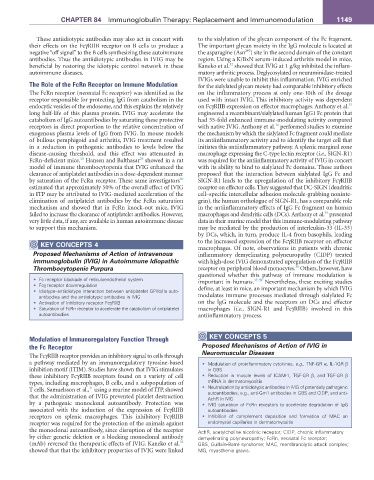
               KEY CONCEPTS 4                                     to the increased expression of the FcγRIIB receptor on effector
                                                                  macrophages. Of note, observations in patients with chronic
            Proposed Mechanisms of Action of intravenous          inflammatory demyelinating polyneuropathy (CIDP) treated
            immunoglobulin (IVIG) in Autoimmune Idiopathic        with high-dose IVIG demonstrated upregulation of the FcγRIIB
            Thrombocytopenic Purpura                              receptor on peripheral blood monocytes.  Others, however, have
                                                                                                  36
                                                                  questioned whether this pathway of immune modulation is
            •  Fc receptor blockade of reticuloendothelial system  important in humans. 37-39  Nevertheless, these exciting studies
            •  Fcγ receptor downregulation
            •  Idiotype–antiidiotype interaction between antiplatelet GPIIb/IIa auto-  define, at least in mice, an important mechanism by which IVIG
              antibodies and the antiidiotypic antibodies in IVIG  modulates immune processes mediated through sialylated Fc
            •  Activation of inhibitory receptor FcγRIIB          on the IgG molecule and the receptors on DCs and effector
            •  Saturation of FcRn receptor to accelerate the catabolism of antiplatelet   macrophages (i.e., SIGN-R1 and FcγRIIB) involved in this
              autoantibodies                                      antiinflammatory process.


           Modulation of Immunoregulatory Function Through            KEY CONCEPTS 5
           the Fc Receptor                                         Proposed Mechanisms of Action of IVIG in
           The FcγRIIB receptor provides an inhibitory signal to cells through   Neuromuscular Diseases
           a pathway mediated by an immunoregulatory tyrosine-based   •  Modulation of proinflammatory cytokines, e.g., TNF-GR α, IL-1GR β
           inhibition motif (ITIM). Studies have shown that IVIG stimulates   in GBS
           these inhibitory FcγRIIB receptors found on a variety of cell   •  Reduction in muscle levels of ICAM-1, TGF-GR  β, and TGF-GR  β
           types, including macrophages, B cells, and a subpopulation of   mRNA in dermatomyositis
                              31
           T cells. Samuelsson et al.,  using a murine model of ITP, showed   •  Neutralization by antiidiotypic antibodies in IVIG of potentially pathogenic
                                                                     autoantibodies, e.g., anti-Gm1 antibodies in GBS and CIDP, and anti-
           that the administration of IVIG prevented platelet destruction   AchR in MG
           by a pathogenic monoclonal autoantibody. Protection was   •  IVIG saturation of FcRn receptors to accelerate degradation of IgG
           associated with the induction of the expression of FcγRIIB   autoantibodies
           receptors  on splenic  macrophages.  This  inhibitory  FcγRIIB   •  Inhibition of complement deposition and formation of MAC on
           receptor was required for the protection of the animals against   endomysial capillaries in dermatomyositis
           the monoclonal autoantibody, since disruption of the receptor   AchR, acetylcholine nicotinic receptor; CIDP, chronic inflammatory
           by either genetic deletion or a blocking monoclonal antibody   demyelinating polyneuropathy; FcRn, neonatal Fc receptor;
                                                            32
           (mAb) reversed the therapeutic effects of IVIG. Kaneko et al.    GBS, Guillain-Barré syndrome; MAC, membranolytic attack complex;
           showed that that the inhibitory properties of IVIG were linked   MG, myasthenia gravis.

