


Page 1215 - Clinical Immunology_ Principles and Practice ( PDFDrive )
P. 1215
CHaPtEr 87  Immunomodulating Pharmaceuticals                 1179


           metabolism by intestinal flora. In inflammatory arthritides,   the imidazole moiety occurs rapidly within erythrocytes, both
           sulfapyridine is likely to play a more important role, as it is rela-  enzymatically by glutathione transferase and nonenzymatically.
           tively well absorbed and has a bioavailability in the region of   Several enzymes (Table 87.3) participate in the metabolism of
           60%. Since acetylation is the principal route of metabolism of   6-mercaptopurine into active and inactive compounds. One of
           sulfapyridine following absorption, acetylator status is a major   these, thiopurine methyltransferase, is associated with genetic
           determinant of the plasma half-life. For the same reason, slow   polymorphisms; inherited changes in its activity may impact
           acetylators are more liable to develop side effects.   patient response to azathioprine. Xanthine oxidase inactivates
                                                                  6-mercaptopurine by converting it to 6-thiouric acid. Since this
           Mechanisms of Action for Sulfasalazine                 occurs mainly in the liver, toxicity from azathioprine therapy is
                                                                  a danger in enzyme deficiency states, as a result of disease or
               KEY CONCEPt                                        use of drugs, such as allopurinol.
            Sulfasalazine: Mechanism of Action                    Proposed Mechanisms of Action for Azathioprine
            Suppresses the proliferation of lymphocytes           The immunomodulatory mechanism of azathioprine remains
            Suppresses proinflammatory cytokine production        unclear. As purine analogues, the active metabolites interfere
            Inhibits activation of nuclear factor (NF)-κB         with the salvage pathway and de novo synthesis of purines, and
            Promotes adenosine accumulation
                                                                  they are incorporated into RNA and DNA. Proliferation of T
                                                                  and B lymphocytes is inhibited, and function of natural killer
           Sulfasalazine has a number of immunomodulatory effects.   (NK) cells is suppressed without any change in cell numbers.
           Lymphocyte proliferation is suppressed  in vitro and involves   The production of antibodies is also suppressed, although it is
           both B-cell and T-cell populations. In vivo, a decrease in acti-  not known which of these effects predominate in vivo. Cellular
           vated lymphocytes in the peripheral blood is also seen. Tumor   responses to chemoattractants are altered, and the production
           necrosis factor-α (TNF-α) production is suppressed, and receptor   of cytokines, such as interleukin-6 (IL-6), is also affected.
           binding is inhibited. Sulfasalazine also inhibits activation of
           the transcription factor, nuclear factor (NF)-κB. Like methotrexate,   Adverse Effects
           sulfasalazine inhibits AICAR transformylase and thus promotes   Azathioprine is generally well tolerated. The most common side
           accumulation of adenosine and its antiinflammatory actions via   effects are mild and affect the GI system. Pancreatitis can occur
           the adenosine A 2A  receptor. Indeed, treatment of animals with   as an idiosyncratic reaction. Hepatotoxicity and cholestasis are
           an  adenosine A 2A  receptor antagonist reversed sulfasalazine’s   not uncommon, and hepatic peliosis and nodular regenerative
           reduction of leukocyte accumulation in an air-pouch model   hyperplasia occur rarely. There have been reports of a possible
           of inflammation.                                       heightened risk for non-Hodgkin lymphoma, but because of
                                                                  the rarity of these events, no definite link has been established
           Adverse Effects                                        between azathioprine and malignancies. Bone marrow suppression
           In a large series, a quarter of those treated over 11 years stopped   and opportunistic infections pose far greater threats.
                                   6
           treatment  because of toxicity.  Most toxicities occurred early
           and were both trivial and resolved following therapy withdrawal.   CYCLOPHOSPHAMIDE
           Most common are nausea, vomiting, anorexia, and rash. Serious
           cutaneous reactions, such as exfoliative dermatitis or Stevens-  Alkylating agents were used in the treatment of inflammatory
           Johnson syndrome, are rare. Transaminasemia and drug-induced   diseases after promising reports on using nitrogen mustard in
           hepatitis can occur. Blood dyscrasias with megaloblastic anemia,   RA. Cyclophosphamide (Fig. 87.4) is metabolized to produce
           neutropenia, aplastic anemia, and myelodysplastic syndrome   the alkylating agent phosphoramide mustard as well as acrolein,
           may arise. Neurological adverse effects include headache and   which, although inactive, results in the hemorrhagic cystitis
           dizziness or, more seriously, peripheral neuropathy, Guillain-Barré   associated with cyclophosphamide. Cyclophosphamide can be
           syndrome, or transverse myelitis. Sulfasalazine should be avoided   given intravenously, but bioavailability following oral administra-
           in patients with sulfa allergy, and glucose-6-phosphate dehydro-  tion is high (>75%). Toxicity has severely limited its use in
           genase (G6PD) deficiency screening should be performed before   inflammatory diseases, although its contribution to the manage-
           prescribing.                                           ment of lupus nephritis cannot be denied. The alkylating actions
                                                                  occur at guanine residues (principally on DNA but also on RNA)
           AZATHIOPRINE                                           resulting in cross-linkable strands and disruption of transcription
                                                                  and translation.
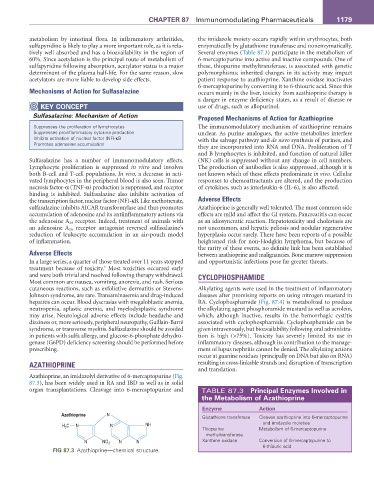
           Azathioprine, an imidazolyl derivative of 6-mercaptopurine (Fig.
           87.3), has been widely used in RA and IBD as well as in solid
           organ  transplantations.  Cleavage  into  6-mercaptopurine  and    TABLE 87.3  Principal Enzymes Involved in
                                                                   the Metabolism of azathioprine

                                                                   Enzyme             action
                     Azathioprine   N
                                                                   Glutathione transferase  Cleaves azathioprine into 6-mercaptopurine
                                                                                       and imidazole moieties
                     H C  N          N           NH                Thiopurine         Metabolism of 6-mercaptopurine
                      3
                                                                    methyltransferase
                             N     NO 2  N    N                    Xanthine oxidase   Conversion of 6-mercaptopurine to
                                                                                       6-thiouric acid
                  FIG 87.3  Azathioprine—chemical structure.

